Most commercial cleaning contracts are not written to describe the work. They are written to survive a dispute about the work. There is a difference, and it is the whole game.
I have signed, rewritten, and walked away from these agreements for years running Swiff & Span here in Columbus, across the Short North, Dublin and New Albany. The pattern is consistent: the language that sounds reassuring on the page is usually the language doing the least, and the sentence that quietly decides everything is the one nobody reads twice. What follows are the seven I would flag first if a property manager in Dublin or an office administrator in New Albany slid a contract across the desk and asked, "Does this look fair?"
None of these clauses are illegal. That is exactly why they work.
1. "Areas will be cleaned as needed."
"As needed" means "as we decide." It moves the judgment of what gets cleaned, and how often, from you to the vendor, and the vendor is the party with a financial reason to decide that less was needed. There is no scope, no frequency, no standard you can hold up and say this wasn't met. A contract that cannot be breached cannot protect you.
2. "Subject to crew availability."
This is the sentence that lets a cleaner send whoever they have, whenever they have them, or send no one and call it a staffing issue. In commercial cleaning, inconsistency is not a scheduling inconvenience. It is the defect. The person who cleaned your medical suite last Tuesday learned where the biohazard bins are, which door sticks, which exam room the physician is particular about. Replace that person weekly and you are paying to retrain a stranger every visit while your standard silently erodes.
We call it the Franchise Fade: the slow decline that happens when a rotating, anonymous crew replaces a consistent one. "Subject to crew availability" is the clause that makes the Fade contractual.
3. "Cleaning performed to industry standard."
Ask three cleaning companies to define "industry standard" and you will get three answers, none of them written down. It is a phrase that sounds like a benchmark and functions as an escape hatch. When a surface looks clean but isn't, "industry standard" is what the vendor points to.
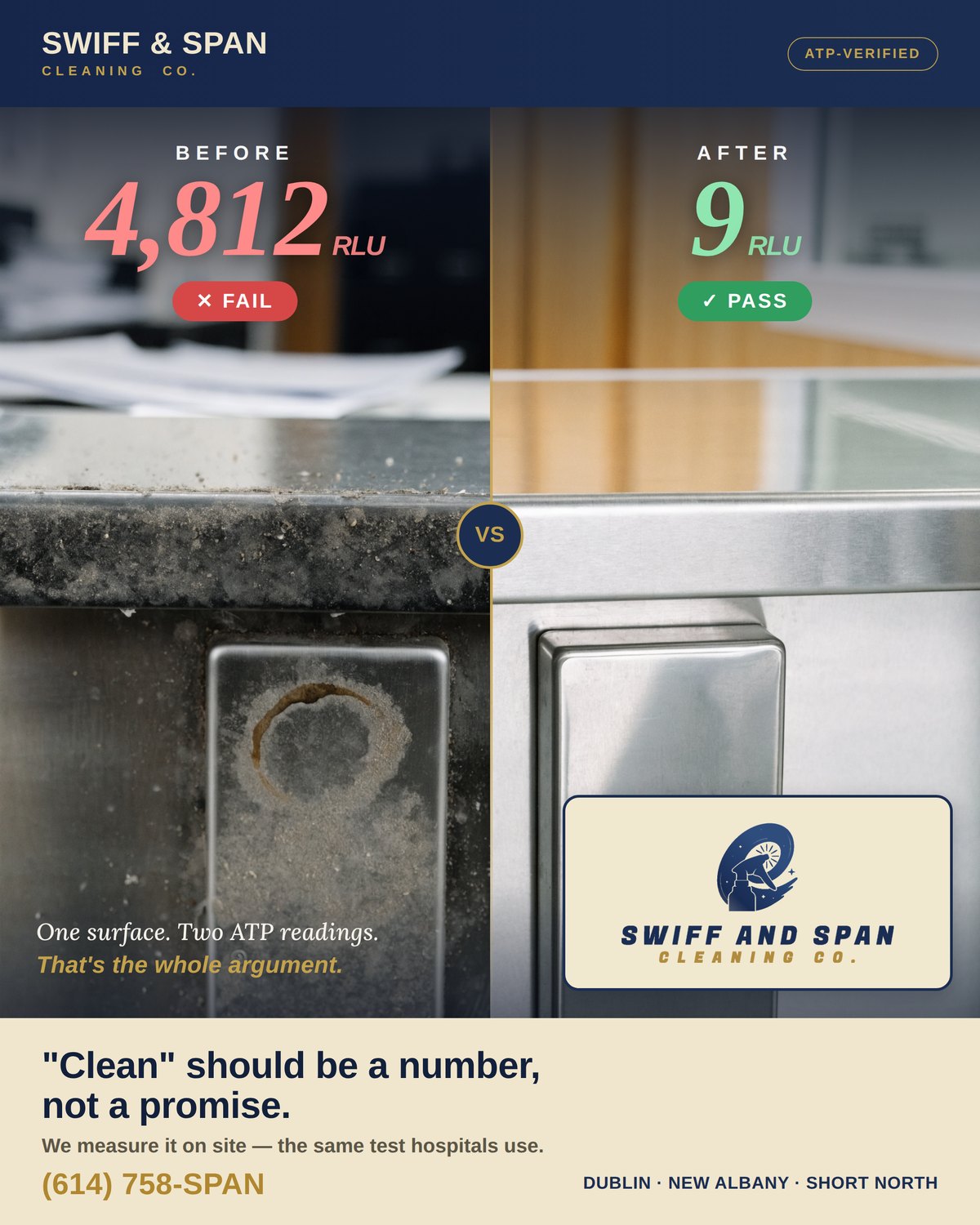
The honest alternative is a measurable one. At Swiff & Span, "clean" is a number, not an adjective. We use ATP bioluminescence testing, the same method hospitals and food-safety auditors use, to measure the organic residue left on a surface after cleaning. A high-touch surface that reads under 25 RLU meets our standard. One in the hundreds does not, no matter how it looks or smells. A contract should name the standard it can be measured against. Most name the one that can't.
4. "Additional services billed at prevailing rates."
Prevailing rates set by whom? Published where? This clause leaves a blank check inside your agreement. The initial bid comes in low to win the contract, then the margin gets rebuilt through "additional services" priced at a number you have no way to predict or contest. The same sleight of hand shows up one step earlier, in how the per square foot price itself is built.
5. "Company not liable for items left unsecured."
Read plainly, this can extend far past a stray laptop. In a medical office, in a med spa, in any space handling regulated materials or sensitive records, "unsecured" is a word a vendor's attorney can stretch a long way after something goes wrong. You want a cleaning partner whose liability language matches the actual risk of your space, and whose insurance certificate you have seen. Not a screenshot. The certificate.
If a company resists showing proof of coverage before you sign, you have learned everything the contract was designed to hide.
6. "Either party may terminate with 60 days' written notice, auto-renewing annually."
The termination clause is where the leverage lives. A long notice window paired with automatic annual renewal means the day you realize the service has slipped, you are already months and possibly a full year from being free of it. The Fade and the auto-renew are a matched set: the service declines slowly enough that you tolerate it right up until the renewal quietly locks you in again.
7. "This agreement constitutes the entire understanding between the parties."
Standard boilerplate, and that is the point. It means every reassurance the salesperson gave you in the walkthrough, every "oh, of course we'll handle that," evaporates the moment you sign. If it is not in the document, it does not exist. The friendly promises were never part of the deal.
The fix is simple and it is a test of character: if it was promised, put it in writing. Watch closely how a vendor reacts when you ask.
What should a fair cleaning contract include?
Notice the through-line. Every clause above transfers a decision, a cost, or a risk from the vendor to you while sounding like ordinary language. A contract built to earn your trust does the opposite. It names the scope with frequencies. It names the standard with a number. It attaches the rate card. It shows the insurance. It lets you leave when the standard slips.
That is the contract we hand people, because our entire model is built on proof rather than promises: the same team every visit, photo verification of completed work, and ATP testing you can watch us run on site. We would rather be measured than trusted on faith. It is the only honest way to sell something invisible.
There is one more thing in every Swiff & Span agreement that the franchises do not put in theirs: a portion of every contract goes to supporting Columbus youth facing homelessness and poverty. A clean building in Dublin quietly helps feed a kid across town. That is not a marketing line at the bottom of the page. It is a line item, and you can see it.