Here's a scene that plays out in more Columbus offices than anyone would like to admit. A cleaner arrives with one bucket, one bottle of blue stuff, and a stack of cotton rags. They start in the restroom, wipe the toilet and sink, wring the rag into the bucket, then carry that same rag and that same bucket to the breakroom counter, the front desk, the conference table. Every surface now looks fine. Every surface has also just met whatever was on the last one.
That's not laziness. It's the default. Cleaning looks simple, which is exactly why the gap between "looks clean" and "is cleaner" hides in equipment and method most people never think about. I'm Erik Kuusisto, I own Swiff & Span, and I'm usually the one holding the swab. So let me open the cart and walk you through what's actually on it.
What do the microfiber cloth colors mean?
The fix for that restroom-to-reception tour is simple: give cloths a color and never let them wander. Our color-coded microfiber system runs a fixed map. Red for high-risk restroom surfaces, yellow for general bathroom, blue for offices and common areas, green for the breakroom, and white or gray for clinical-admin, glass, and detail work. One cloth per zone, used once, then dropped straight into a dirty-textile bag. It never gets rinsed and reused down the hall.
The point isn't the colors. It's that the colors make cross-contamination visible. Anyone glancing at the cart can see whether a red cloth wandered somewhere it shouldn't. The same logic runs through our flat microfiber mop system, which uses color-coded pads, and disposable pads for the highest-risk floors, so a mop head that handled a restroom floor never crosses into a waiting room. In a med spa or dental office, that one habit is the difference between a facility that reads clean and one that quietly moves yesterday's problems around after dark. It's also the kind of discipline the big franchises drop first: rotating temp crews learn the map differently every week, if at all, the slow 90-day quality fade that follows most national franchise contracts. We run the same background-checked team every visit, so the map stays the map.
Is microfiber better than cotton for cleaning?
Yes. Split-fiber microfiber has far more surface area and a slight electrostatic grab that lifts and traps fine soil into the cloth, where cotton smears film around and sheds lint. People assume a rag is a rag. It isn't.
There's a second advantage that matters for disinfection. A soaked cotton rag dumps standing liquid everywhere and dilutes whatever product you just applied. Microfiber holds far less liquid, so when we apply an EPA-registered disinfectant, it stays on the surface at the concentration it's meant to be. Free to sit for its full label dwell time and do its job. That's the step untrained crews skip most, because a surface looks finished long before the chemistry has finished working. (It's also why cleaning and disinfecting are two separate jobs, done in that order.)
What is the two-bucket cleaning method?
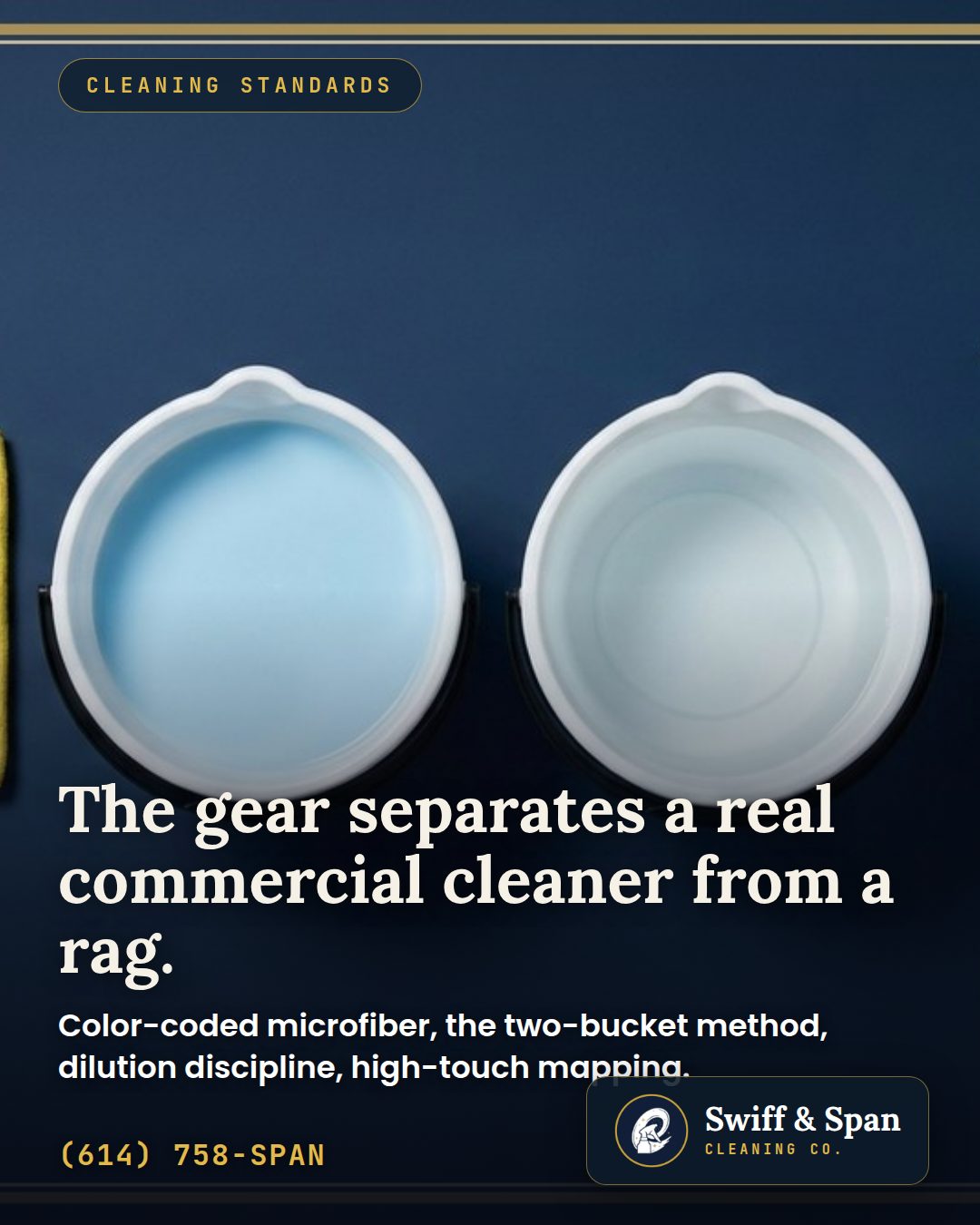
One bucket holds clean solution, a second holds rinse water. Instead of dunking a dirty mop or cloth back into your only bucket of solution, you wring the soil into the rinse bucket and the solution stays clean.
Now back to that single bucket. Every time a mop or cloth gets dunked into your only bucket of solution, the soil you just picked up goes right back in, and within a few rooms you're spreading progressively dirtier water and calling it cleaning. The two-bucket method breaks that loop with an obvious tweak: one bucket holds clean cleaning solution, a second holds rinse water. You wring the dirty water into the rinse bucket first, then reload from the clean solution. The working solution stays a working solution across the whole route.
It costs almost nothing and it separates a professional from someone who owns a mop. Pair it with our dilution-control system, measured dosing off a wall chart instead of a free-pour glug, and you get chemistry mixed to its label strength. Too weak and the disinfectant underperforms. Too strong wastes product, leaves residue, and can damage finishes. Dosing discipline is unglamorous, and it's the whole ballgame.
Why can't you disinfect a dirty surface?
A theme runs through all of this: you can't disinfect a dirty surface. Soil load physically shields microbes and neutralizes disinfectant chemistry, which is why every route runs clean-first, then disinfect, working top-to-bottom and clean-to-dirty so gravity and sequence work for you instead of against you. Disinfecting a greasy breakroom counter without cleaning it first is theater. Our crew is trained on that sequence and certified to run it, every cleaner holds OSHA Bloodborne Pathogens training (BPC I and II) and IJCSA Medical Cleaning certification, so the discipline behind a clinical route isn't improvised.
The other half is knowing where to aim. High-touch mapping is what it sounds like. Identifying the surfaces hands actually hit dozens of times a day: door handles, light switches, elevator buttons, the shared coffee-pot handle, the pen at the front desk, faucet levers, the tablet at check-in. It's the backbone of a properly scoped commercial office clean, and it looks different in a dental operatory than it does in an open-plan office. Those are where germs concentrate and where a rushed crew skims. Our room-by-room checklists put those points on paper so they get hit every visit, and photo-timestamped documentation lands in your inbox afterward as proof they were.
What equipment does a commercial cleaning crew use?
Beyond cloths and buckets, a real commercial kit carries equipment a home closet doesn't. We run commercial HEPA vacuums, a ProTeam GoFit backpack for open floor and an upright for carpet, that capture fine dust rather than blowing it back into the air, which matters in any waiting room where people are already breathing shared air. For even, wrap-around application of EPA-registered disinfectant on 3D and high-touch surfaces, we use commercial-grade electrostatic sprayers, and disinfection foggers where a full-room pass is scoped. A precise note: an electrostatic sprayer is an application method. It lays disinfectant down evenly, but clean-first and full dwell time still apply. It doesn't sterilize anything on its own, and any cleaner who tells you their sprayer "kills everything" is overselling the tool.
Our disinfectant lineup is matched to each surface's risk level rather than one bottle for everything: PDI Super Sani-Cloth germicidal wipes for everyday clinical surfaces, Diversey Oxivir Tb, an accelerated hydrogen peroxide, low-odor for daily use, Spartan TB-Cide Quat for broad quaternary work, and Clorox Healthcare Bleach Germicidal wipes held in reserve for higher-risk cleanup. All EPA-registered, all used at full label contact time. Never "sterilizing". A word we avoid, because it's a claim these products and this work don't support. We carry steam mops for hard-floor detail too, and we're fully insured through Hiscox. Every cleaner we send carries a minimum of 15 years of professional cleaning experience, background-checked, in branded team shirts so you always know who's in your building.
What extra cleaning services can you request?
Most contracts run on a recurring route, but facilities have days that don't fit the schedule. We keep a set of specially requested additional services on offer, priced on request rather than bundled into a rate you don't need every visit: window and high dusting, industrial carpet care by commercial hot-water extraction, grout and tile detail, floor waxing, fogging, and whole-room electrostatic disinfection. You scope what you actually want.
The other day that doesn't fit the schedule is the one you didn't see coming. We take last-minute, emergency, and same-day cleaning, the kind of call an STR host makes when a guest checks out three hours before the next one arrives, or a dental office makes after a spill that can't wait for the regular visit. Our standard response is one business day, and when the schedule allows, we're there same-day. And the work behind every one of those calls is backed the same way the routine work is: the same team every visit, a reply within one business day, an ATP-triggered re-clean and re-test on the spot if a reading comes back high, and a 24-hour satisfaction return. If you're ever dissatisfied with the team's performance, we come back within 24 hours of the last job.
How do you check a cleaning company's equipment claims?
There's a difference between the gear on the cart and the gear in the marketing, and the fastest way to judge a cleaning company is to close that gap. Everything named in this article rides on our cart: the color-coded microfiber, the two-bucket setup, the EPA-registered disinfectant lineup, HEPA filtration, electrostatic sprayers, steam mops for hard-floor detail, and the ATP meter that grades the work. Each piece was chosen for clinical and patient-facing spaces, and each one earns its spot every visit. If a cleaning company rattles off a spec sheet of exotic equipment, it's fair to ask which of it actually shows up at your building, and to expect a straight answer. (One detail we're fond of: the UV flashlight on the cart is for inspecting restroom detail work under light. Inspection is its own tool category, and it's the one most spec sheets skip.)
What does an ATP luminometer do?
All of the above is process. Process is invisible, which is why the last tool on our cart is a Hygiena SystemSURE Plus luminometer and a box of UltraSnap swabs. An ATP swab reads organic residue on a surface in about ten seconds and scores it in RLU (Relative Light Units). It's the difference between telling you a room was cleaned and showing you a number that says how well, the full RLU scoring explainer breaks down where the lines fall. That number is the thing the big franchises don't leave behind. They leave a signature on a clipboard. We leave a reading.
That number measures whether the residue got removed, which is exactly what all that color-coding and two-bucket discipline is for. Every clean is held to our 25 RLU standard with photo documentation and a checklist every visit, and ATP verification runs on the cadence you scope. Want to see what your highest-touch surfaces read right now? The complimentary ATP Environmental Verification Walkthrough answers it with numbers, and you keep the readings whether you hire us or not, book yours here.
One more thing worth saying plainly, because it's why I built the company this way. A share of every contract we sign goes to Columbus and Franklin County youth facing homelessness and poverty. It's not a marketing line bolted on at the end. It's the reason the standard is this high. The same gear that makes your commercial office or specialty facility measurably cleaner also does a little good across the city we live and clean in. Call me at (614) 758-7726, and I'll bring the swab.
Related reading
- What Is ATP Testing? RLU Scores Explained. The number behind "is it actually clean."
- Clean vs. Disinfect: Chemistry & Dwell Time. Why the two steps aren't interchangeable.
- Franchise vs. Local: The 90-Day Quality Fade, why rotating crews lose the method.
- OSHA Bloodborne Pathogen Standards in Dental Cleaning, the certification behind a clinical route.
Or jump straight to the service that fits your facility: commercial office, medical & dental, dental office, health & wellness, institutional & specialty, or short-term rental turnovers, or book a complimentary ATP Environmental Verification Walkthrough.
Frequently Asked Questions
Does Swiff & Span test every clean with ATP?
No. Every clean is performed to our 25 RLU ATP standard with photo-timestamped documentation and a room-by-room checklist after every visit. ATP swab verification is run on the cadence you scope at your complimentary walkthrough, not on every single visit. ATP measures organic residue as a cleaning-verification proxy; it does not prove disinfection, kill pathogens, or establish regulatory compliance.