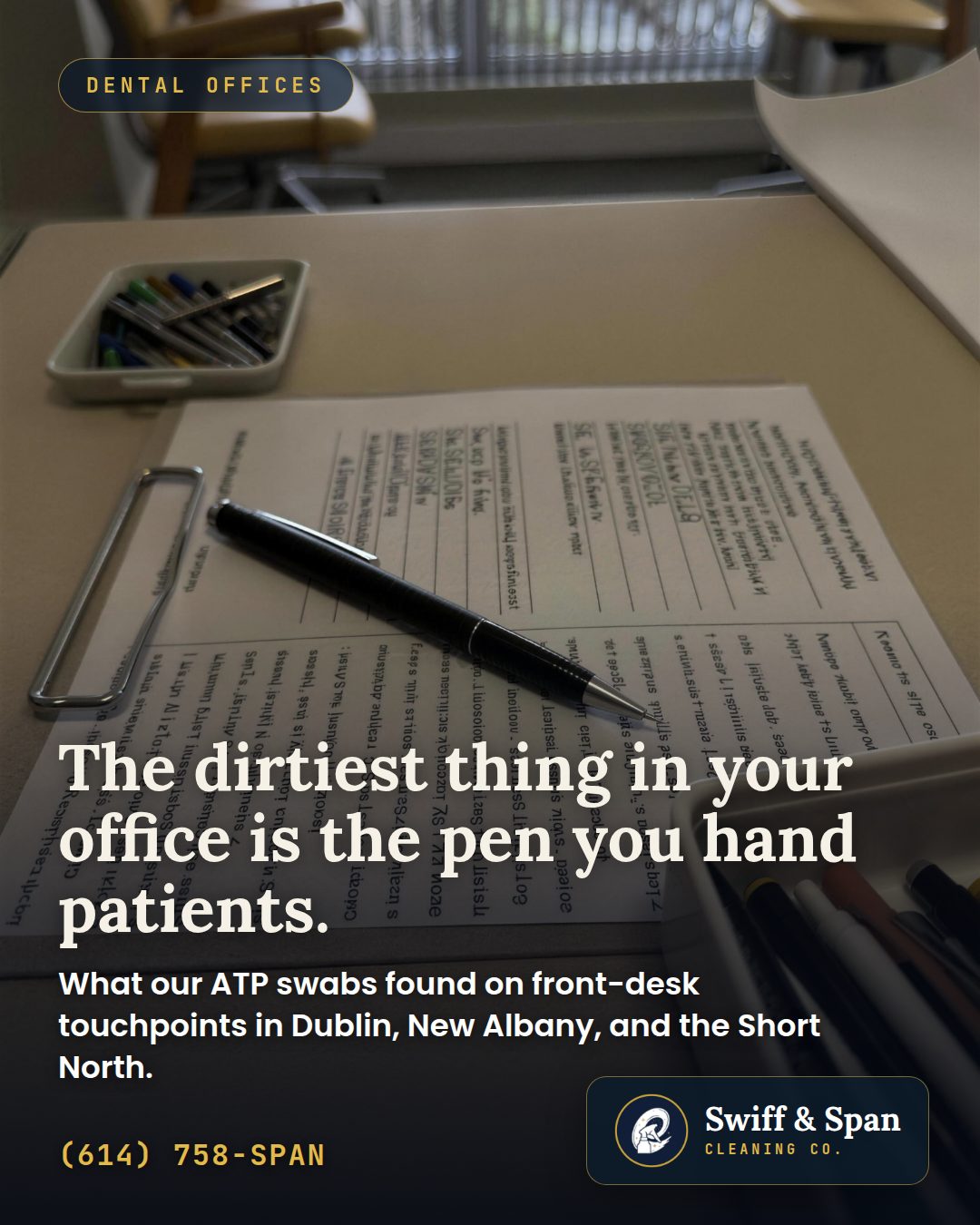
The dirtiest surface in a typical dental office isn't the chair, the tray, or the suction line. Every one of those gets sterilized or hospital-grade disinfected between patients, by protocol, without exception, because everyone in the building knows they're clinical. The dirtiest surface is the pen. The one clipped to the clipboard at the front desk, handed to every patient who walks in, pressed into the hands of the last patient before them, and returned to the cup without a second thought.
Nobody sterilizes the pen. In years of walking into dental offices across Dublin, New Albany, and the Short North with a clipboard of our own, we have never once seen one get wiped down.
That's the premise of this piece, and it isn't a gotcha. It's a gap. Practices spend real money and real training hours on operatory sterilization (autoclaves, barrier protection, single-use everything) because the clinical side of the business lives and dies by infection control. Then a patient sits down in the waiting room, coughs into a fist, picks up a shared pen, signs a form, hands the pen to the next patient, and nobody in the building has thought about that transaction since dental school.
Why does the front desk get missed?
Because it doesn't look clinical. A pen isn't an instrument. A clipboard isn't a tray. The waiting room reads as "soft" space (carpet, chairs, a coffee station) and soft space gets a wipe-down at closing, not a disinfection protocol between uses. That's a reasonable assumption for furniture. It's a bad assumption for anything a stranger's hand touches every few minutes.
Here's the tour. Five surfaces, all in the first twelve feet of a patient's visit, none of them on a sterilization log.
- The clipboard pen. The highest-frequency touch point in the building. A single pen can be handled by twenty to forty patients in a day, plus the front-desk staff resetting it after each one. It travels from hand to mouth more than any other object a patient touches during the visit. People click it, chew it, tap it against their teeth while thinking.
- The clipboard itself. Rests on laps, gets set on the floor between forms, gets passed hand to hand along with the pen. It picks up whatever the last three patients were carrying, plus whatever the waiting room chair fabric transferred to it.
- The tablet stylus, where practices have gone digital. Practices assume "paperless" means "cleaner." It doesn't. A stylus gets the same hand-to-hand rotation as a pen, except it's easier to forget belongs on a cleaning checklist at all, because it reads as a piece of technology, not a shared surface.
- The front door handle and the operatory door push-plate. Every patient touches the front door on the way in, sick or not. Every patient touches the operatory door or the chairside door on the way to treatment. Both get wiped when someone remembers. Neither is on a between-patient protocol in most practices, because neither one is "medical equipment."
- The chairside light handle. This one is inside the operatory, which is the interesting part. It's surrounded by strict protocol on every side, and it's still one of the most commonly missed touch points in a room where everything else gets sterilized. Hygienists adjust it with bare hands mid-procedure, then go back to gloved work, and the handle itself doesn't always make the reset list between patients the way the tray does.
What does an ATP number actually tell you here?
An ATP bioluminescence swab doesn't detect a specific germ. It detects adenosine triphosphate, the energy molecule present in any living cell, human or microbial. Swab a surface, run it through the reader, and in about fifteen seconds you get a number: relative light units, a stand-in for how much biological material is sitting there. Low number, clean surface. High number, something to explain. It's a cleaning measurement, not a diagnosis of any particular pathogen. here's exactly what an ATP reading covers, and what it doesn't.
We run this test as a standard part of every walkthrough we do for Columbus dental and medical practices, and we photograph the reading every visit, because a client shouldn't have to take our word for "clean." In our own spot-checks across front-of-house areas, the pen and the stylus have posted numbers on par with, and sometimes above, the reception counter and restroom door handle, surfaces practices already suspect are dirty. The chair, by contrast, almost always reads low, because it's the one thing in the building everybody already agreed to sterilize.
That gap is the whole story. It's not that dental offices are dirty. Most of the ones we walk into are meticulous where they think to look. It's that "where to look" got drawn around the clinical footprint decades ago and never got redrawn around how patients actually move through the front of the building.
What's the fix, and does it take extra staff time?
Not really. This isn't a bigger cleaning contract. It's a five-point rotation added to an existing one. Pens get wiped with an EPA-registered disinfectant between patients, or swapped for a clean-cup, used-cup system that takes the decision out of anyone's hands. Clipboards get wiped on the same cadence. Styluses get a screen-safe wipe. Door handles and push-plates get worked into the hourly high-touch pass most practices already run for the restroom. Chairside light handles get added explicitly to the between-patient reset checklist, not assumed to be covered by "wipe down the room."
We build this rotation into the standard service for every dental and medical client, with the same team on-site every visit rather than a rotating cast of subcontractors, because a crew that knows your layout catches the stylus on the counter that a stranger walks past. Erik, who owns and runs the company, sets that standard directly with new clients rather than handing them off to a call center. A share of every contract we sign also goes to Columbus organizations supporting Franklin County youth facing homelessness and poverty, so the work funds something past the invoice.
If your practice has never had a third party actually test these surfaces, that's exactly what the complimentary walkthrough is for. It's 30 minutes, on-site, and it includes a live ATP test on the surfaces above, done in front of your staff, with the number on the reader for everyone to see, and it's yours whether or not you ever hire us. Curious what your own front desk reads today? Book the complimentary ATP Environmental Verification Walkthrough, or call (614) 758-SPAN.
Frequently Asked Questions
What is the dirtiest surface in a dental office?
In our own spot-checks, front-desk items handled by every patient (the sign-in pen, the clipboard, and the tablet stylus) consistently read higher on ATP tests than the treatment chair, which is already on a strict sterilization protocol. The waiting room, not the operatory, is usually where the real gap lives.
Does a dental office need to sterilize the check-in pen between patients?
Full sterilization isn't necessary, but a wipe with an EPA-registered disinfectant between uses, or a two-cup clean/used pen system, closes most of the risk. The goal is removing the assumption that a pen is furniture rather than a shared touchpoint.
What does an ATP test actually measure?
ATP (adenosine triphosphate) testing measures biological residue, from skin cells, saliva, or microbes, on a surface, returning a numeric reading in about fifteen seconds. It doesn't identify a specific pathogen; it tells you how much organic material a surface is carrying, which is a fast proxy for how well it's actually being cleaned.
How often should high-touch surfaces in a waiting room be disinfected?
Front-desk high-touch points (pens, clipboards, door handles, chair arms) should be wiped between patients or at minimum hourly during business hours, not just at closing. Practices in Dublin, New Albany, and the Short North that add this to an existing cleaning contract typically see it cost no extra staff time, since it rides along with an existing crew's visit.
Can a cleaning company actually prove a dental office is clean, or is that just a sales claim?
A reputable commercial cleaner can prove it with a measured ATP number, read on-site and photographed, rather than a verbal assurance. Ask any provider whether they test on a defined cadence and document the results. If the answer is no, you're paying for an opinion, not a measurement.