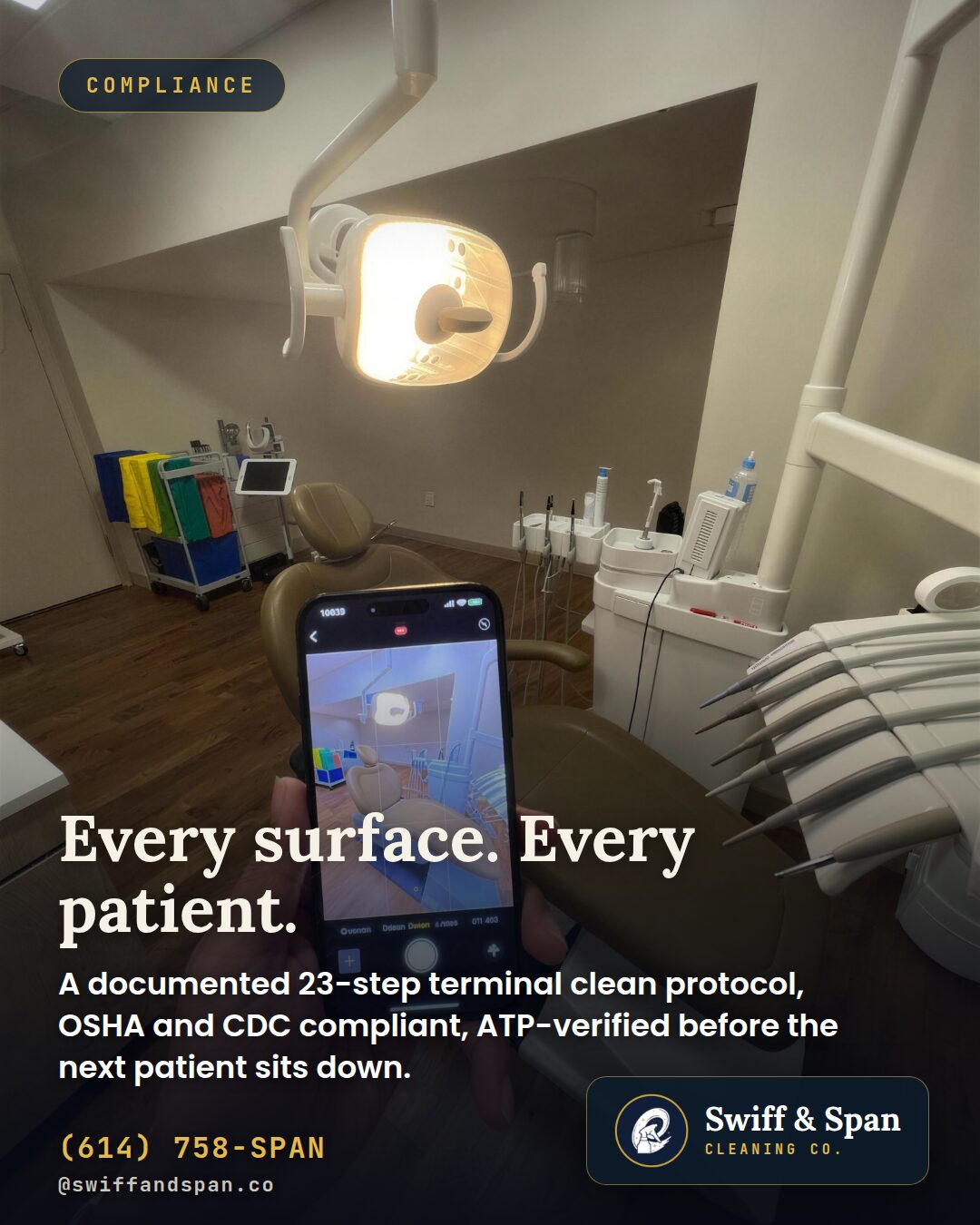
"Terminal clean" is a term borrowed from hospitals: the thorough, end-of-day reset of a room after the last patient encounter, distinct from the quick surface disinfection your clinical staff perform between appointments. In a dental practice the phrase gets used loosely, so it's worth drawing the line clearly before anyone signs a cleaning contract around it.
There are two different jobs happening in your operatories, and confusing them is how practices end up either overpaying for the wrong scope or assuming a general cleaner is doing something they were never trained to do.
Who cleans what in a dental operatory?
Between-patient disinfection belongs to your clinical team. Wiping down the chair, light handles, delivery unit, and countertops with an EPA-registered disinfectant at full contact time, barrier changes, instrument processing in the sterilization area, that is clinical work, performed by clinical staff, on a clinical cadence. No outside cleaning company should be touching it, and any that offers to is telling you they don't understand the boundary.
The end-of-day environmental clean is a different layer. It's the deep, whole-room reset the practice does not have time for between patients: floors, baseboards, the surfaces around (never through) the clinical workflow, restrooms, the sterilization area's environmental surfaces, waiting room, and front desk. This is the layer a cleaning company is actually hired for, and in a dental operatory it is not the same job as cleaning an office.
What does an end-of-day operatory clean include?
Scoped for a clinical room rather than a lobby: top-down clean-to-dirty order, color-coded microfiber on a two-bucket system, environmental surfaces before floors, and the restroom on its own cloths. Most general janitorial routines skip half of it.
Top-down, clean-to-dirty order
Cleaning runs from high surfaces to low and from the cleanest zone to the dirtiest, so nothing already cleaned gets re-contaminated on the way out. In an operatory that means the environmental surfaces and fixtures first, floors last, and the restroom on its own dedicated set of cloths entirely.
Color-coded microfiber and a two-bucket system
A cloth that touched a restroom must never reappear on an operatory surface. Color-coded microfiber assigns cloths to zones, and a two-bucket method keeps rinse water from re-depositing soil back onto surfaces. This is the single clearest tell between a crew trained for clinical spaces and one applying an office template.
Disinfectant used the way the label requires
EPA-registered disinfectants only perform at their full label dwell time. The step undertrained crews skip most often, because a surface looks finished long before the chemistry has actually finished working. Disinfection is a specific activity, with a specific product, for a specific contact time. Wiping a surface and calling it disinfected is not the same thing as doing it.
Working around the sterilization area, never through it
The instrument-processing workflow belongs to your team. A cleaning crew's job is the environmental surfaces of that space, counters, floors, touch points, while never handling instruments, never crossing into the clean/dirty processing boundary, and being able to explain why that line exists.
High-touch points, not just visible surfaces
Light switches, door handles, cabinet pulls, the chair's adjustment controls, faucet levers. The points hands actually touch are where soil concentrates and where an "it looks clean" assessment misses most. A real operatory clean treats those as the priority, not an afterthought.
Photo-timestamped completion
Every visit leaves a record: timestamped photos of key areas completed, so a new hygienist, a returning associate, or an owner reviewing the account can see the work happened rather than take it on faith.
How do you measure whether an operatory is clean?
With an ATP swab, scored in RLU. Photos prove presence, someone showed up and did something, but they don't prove the surface is clean. A number does.
At Swiff & Span, dental office cleaning is verified with ATP surface testing on the cadence each practice scopes, a swab and luminometer reading of organic residue, scored in RLU (Relative Light Units), delivered to your inbox alongside the photo documentation. Our cleaning target threshold is 25 RLU on high-touch operatory surfaces. On the scale we work to, 0 to 100 RLU is acceptable, 101 to 299 means re-clean and retest, and 300 or above is a fail. Most practices have never had a number for those surfaces at all.
What that number proves is that the cleaning actually happened, to a measurable standard, in the rooms where it matters most, the difference between a surface that looks finished and one you can hand a number for. If you want the full picture of what an RLU reading does and doesn't tell you, here's how we prove clean.
The teams doing the work are trained on the same OSHA bloodborne pathogen awareness and the noncritical/semicritical surface distinction that govern a clinical space, not as a marketing line, but as the protocol that decides who we send into your practice and how they're taught to work there. If you haven't yet, it's worth reading what that standard asks of a cleaning contractor.
Run a combined practice with a medical or clinical suite alongside dental? See medical and clinical facility cleaning for how the exam-room protocol compares.
Frequently Asked Questions
What does terminal clean mean in a dental office?
It is borrowed from hospital language: the end-of-day reset of a room after the last patient encounter. In a practice it covers the whole-room environmental layer, floors, baseboards, high-touch points, restrooms, waiting room, and the environmental surfaces of the sterilization area. It is a separate job from the disinfection your clinical staff perform between appointments.
Can a general office cleaner clean an operatory?
General janitorial onboarding is built for desks and lobbies, and an operatory is neither. The tell is the cloth. A crew trained for clinical rooms assigns color-coded microfiber by zone so a restroom cloth never reaches an operatory surface, and runs a two-bucket method so rinse water stops re-depositing soil. A crew working from an office template usually cannot explain either one.
Why does the order of cleaning matter?
Order is what keeps finished work finished. Top-down and clean-to-dirty means environmental surfaces and fixtures first, floors last, and the restroom on its own dedicated cloths. Reverse it and you carry soil back across a surface you already cleaned.
Should a cleaning crew work inside the sterilization area?
On its environmental surfaces, yes: counters, floors, and touch points. The instrument-processing workflow stays with your team, and the clean-to-dirty processing boundary stays uncrossed. A crew that can explain why that line exists is a crew that was trained for clinical rooms.