The question is simple, and it rarely gets said out loud: did the cleaning actually happen? Not "did someone show up", a photo answers that. Did the surfaces that matter actually get clean? For most facilities the honest answer is a shrug, because nobody has ever put a number on it. ATP testing is how the number gets there.
This is a plain English guide to ATP testing, RLU readings, and where surface verification fits inside a professional cleaning program. By the end, you will know what the swab measures, how to read an RLU score, how facilities use the number as a cleaning checkpoint, and how ATP fits alongside cleaning, disinfection, and documentation.
What does ATP testing measure?
ATP is the molecule that gives residue away
ATP, adenosine triphosphate, is the energy-carrying molecule found in every living and formerly-living thing: skin cells, saliva, food residue, the biofilm that builds on a surface nobody scrubs. The rule is short. If a surface has organic residue on it, it has ATP on it. Remove the residue and the ATP goes with it. That's why ATP works as a stand-in for how much is still on a surface after the crew is done.
The test works by chemistry that glows
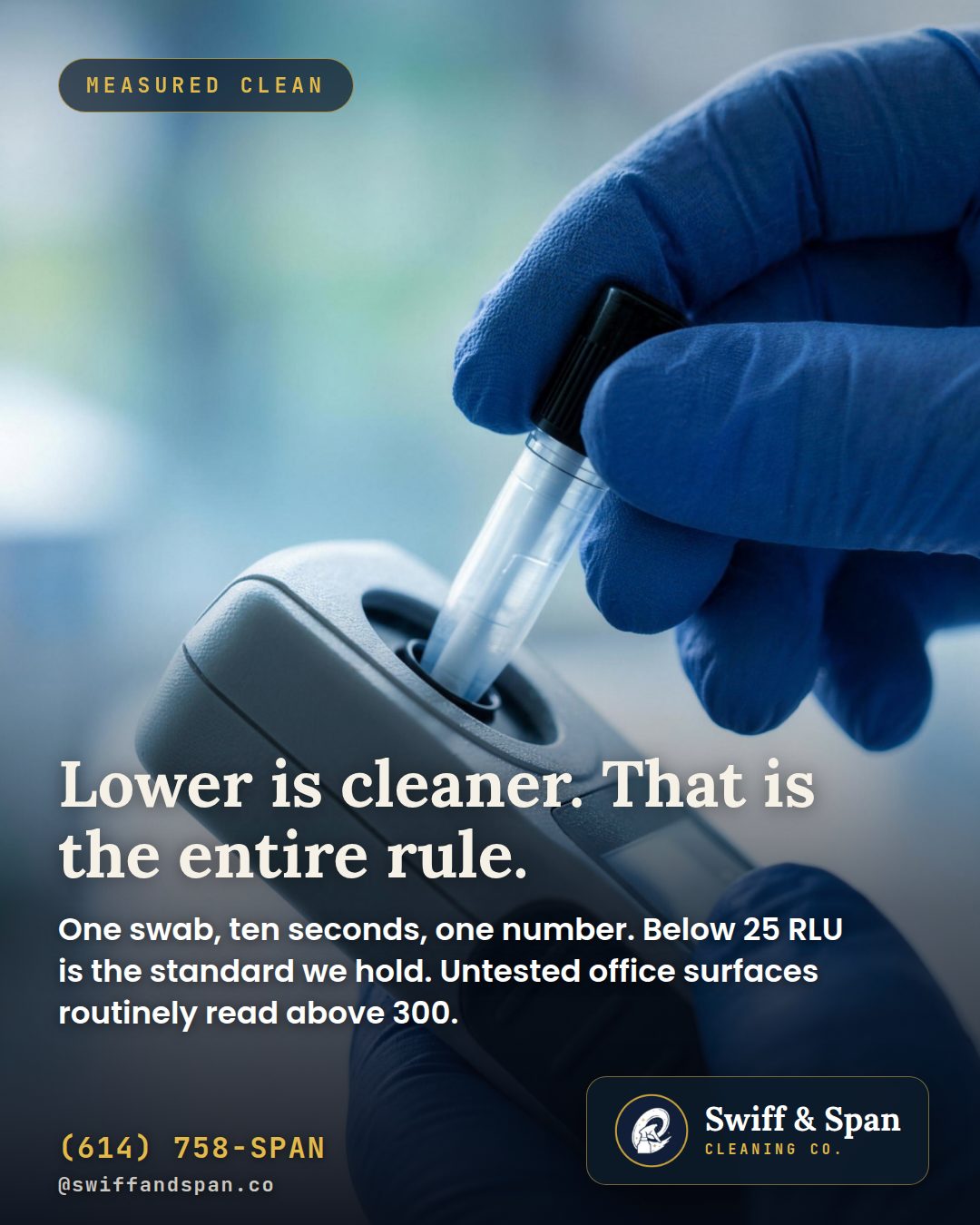
An ATP bioluminescence swab, we use Hygiena UltraSnap swabs, carries a reagent from the same family of chemistry that lights up a firefly. When the swab collects ATP off a surface and the reagent reacts with it, the mixture emits light. More ATP, more light. A handheld luminometer, the Hygiena SystemSURE Plus, measures exactly how much, and it does it in roughly ten seconds. That speed is the point: a technician can read a dozen surfaces before the disinfectant on the first one has dried.
The result is an RLU score
The meter reports the light as a number: RLU, Relative Light Units. The chain runs one direction. More residue means more ATP, more ATP means more light, more light means a higher number. The whole thing collapses to a rule you can hand a front-desk staffer without a chemistry lecture: lower is cleaner. A surface at 12 RLU is cleaner than a surface at 120. Nothing to interpret, nothing to argue. It's a reading.
What is a passing RLU score?
A passing score meets the documented target for the meter, surface, and verification plan being used. Swiff & Span's cleaning target is below 25 RLU within its scoped ATP verification program. The useful comparison is a consistent one: the same instrument and swab system, the same sampling method, and the same surface target over time.
The measurement becomes practical when it tells your team what to do next. Keep the target, result, surface, and follow-up action together in the cleaning record.
| Reading or comparison | How it is used |
|---|---|
| Below the documented target | Record the result against the selected surface and verification plan. |
| At or above the documented target | Review the cleaning step, re-clean, and re-test the selected surface. |
| Before and after cleaning | Compare readings from the same sampling approach to assess residue removal. |
| Repeated readings over time | Watch for changes that call for an adjustment to the cleaning routine. |
A reception counter, door handle, waiting-room chair arm, or breakroom faucet can look well presented while still needing closer attention. A documented ATP reading adds a second checkpoint and gives the team a clear basis for follow-up.
Where does ATP testing fit in the cleaning process?
The work starts with a documented cleaning sequence. Soil is removed with the right methods and tools: color-coded microfiber and the two-bucket method, plus HEPA vacuums such as the ProTeam GoFit. EPA registered disinfectants are selected for the surface and application, with the full label dwell time built into the process.
Cleaning prepares the surface for the disinfection step. ATP verification adds a residue measurement at the checkpoints defined in the service plan. Recording the surface, result, sampling method, and any re-clean gives the facility a useful record of cleaning performance.
How ATP fits into a science based cleaning system
ATP is most useful when it is treated as one measurement layer inside a complete cleaning process.
At Swiff & Span, the sequence is simple:
- Clean. Remove soil, residue, dust, and debris using the facility's documented SOPs and surface controls.
- Disinfect. Apply EPA registered disinfectants according to label directions and hold them for full dwell time. Whole-Room Electrostatic Disinfection can be included where the facility and scope call for it.
- Verify. Use ATP surface readings on the scoped cadence to add a measurable cleanliness checkpoint to selected high touch surfaces.
- Document. Record completed work through checklists, photo timestamped documentation, and quality control records.
That is why ATP matters. It gives a facility manager a number that can be compared over time instead of relying only on appearance or memory. The reading becomes part of a larger documented system rather than a stand alone marketing claim.
Why don't most cleaning companies use ATP testing?
Because the meter doesn't flatter anyone. A commercial-grade luminometer plus a steady supply of consumable swabs is a real, ongoing cost, and more to the point a real risk. It reports the number whether the number is 15 or 315.
A cleaning company that measures is grading its own homework and handing you the grade. Most won't take that bet. There's a pattern behind that: the big franchises chase volume with rotating temp crews, and the standard fades once the sales rep who signed you has moved on to the next account. Owner-led is a different arrangement. I run the meter myself, and I'd rather show you a number than ask you to take my word for it. Competitors claim clean. We measure it.
Which surfaces get swabbed on an ATP test?
Selected high touch surfaces are agreed at your walkthrough. Surface verification follows a documentation cadence matched to your facility. The service plan brings the cleaning target, room by room records, and scheduled ATP measurements together.
First, every clean is performed to the below-25-RLU cleaning standard, the target, every visit, in every room. Second, you get photo-timestamped documentation and a room-by-room checklist after every visit, no exceptions. That one is absolute. Third, ATP swab verification runs on the cadence you scope at your walkthrough. A documentation rhythm tuned to your facility and your risk, delivered to your inbox so a drifting number shows up the week it starts, not four months later. If a swab comes back high, we re-clean and re-test on the spot. You can read the full method on How We Prove Clean.
A few things I'd want to know if I were the one hiring. It's the same team every visit. Background-checked, a minimum of 15 years of professional cleaning experience, branded shirts, not a rotating roster you have to re-explain your floor to each week. We're fully insured through Hiscox and hold OSHA Bloodborne Pathogens certification (BPC I & II) plus IJCSA credentials in Medical Cleaning, Carpet Cleaning, Chemical Hazards, and Customer Service. We respond within one business day. And if you're ever dissatisfied with the team's performance, we come back within 24 hours of the last job and make it right.
The recurring clean is the core, but not the whole menu. On request, never bundled in to pad the invoice, we handle window and high dusting, industrial carpet hot-water extraction, grout and tile, floor waxing, fogging, and whole-room electrostatic disinfection. We also take last-minute, emergency, and same-day work: an STR turnover that got booked tight, a medical or dental spill that can't wait for the next scheduled visit. Ask, and we'll tell you plainly whether we can be there.
The same standard travels across everything we clean, a Columbus dental operatory, a medical exam room, a med spa treatment table, or the high-touch surfaces of an STR turnover. Different rooms, same rule: clean has a number, and you get to see it.
One more thing that matters to us, quietly. A share of every contract goes to Columbus and Franklin County youth facing homelessness and poverty. It doesn't change what shows up on your RLU report. It's just the kind of company we want to be while we do the work.
Curious what your own high-touch surfaces read right now? That's the complimentary ATP Environmental Verification Walkthrough. 30 minutes, your facility, real readings you keep either way. No number to defend, no homework to hide.
Frequently Asked Questions
What is ATP testing?
ATP testing is a bioluminescence method that measures organic residue on a surface and reports the result as an RLU reading. Facilities use it as a measurable surface cleanliness checkpoint before or after cleaning, depending on the verification plan.
What does an RLU score mean?
RLU stands for Relative Light Units. The meter reports the light produced by the ATP reaction as a number. Compare each reading with the documented target for the instrument, surface, and verification plan, and use a consistent sampling method when tracking results over time.
How do ATP testing and disinfection work together?
ATP verification and disinfection are two parts of the same science based cleaning program. Cleaning removes soil and residue, EPA registered disinfectants are applied at full label dwell time, and ATP readings add a measurable surface cleanliness checkpoint on the selected surfaces included in the verification plan. Checklists and photo records document the completed work.
How often does Swiff & Span run ATP testing?
ATP verification is scoped to the facility and account. Depending on the environment and service plan, selected surfaces may be verified weekly, biweekly, monthly, or on another agreed cadence. The complimentary ATP walkthrough gives the facility an initial set of readings and helps determine what verification rhythm makes sense for the space.