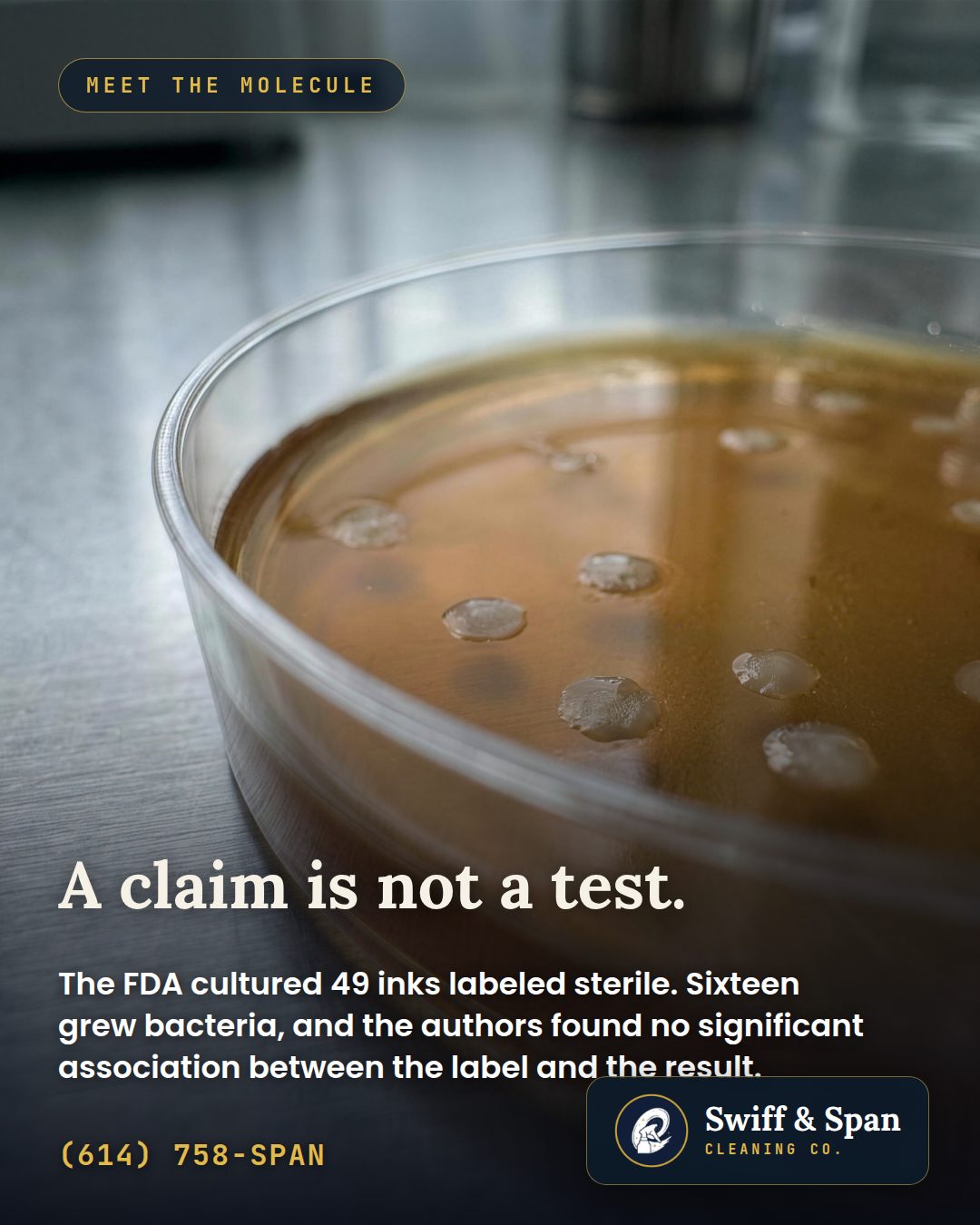
The FDA bought 75 bottles of ink off the commercial market, from 14 manufacturers, and did the one thing nobody selling pigment expects a federal lab to do. It opened them and tried to grow something.
Twenty-six of the 75 grew something. That is 35% of a sampled commercial ink supply carrying live bacteria in the bottle. The split points at your industry. Tattoo inks came back contaminated 9 times out of 40, roughly 22.5%. Permanent makeup inks, the pigments behind microblading, lip blush and eyeliner, came back contaminated 17 times out of 35. That is 49%. Coin-flip odds on a product deposited into the dermis of somebody's face.
Then the authors sorted the same bottles a second way, not by what the ink was for, but by what the label promised. Forty-nine of the samples carried a sterility claim printed on them. 16 of 49 grew bacteria anyway.
The paper, published in Applied and Environmental Microbiology in July 2024, states the conclusion without softening it:
"no significant association was found between sterility claims on the ink label and the absence of bacterial contamination."
That sentence is the article. A sterility claim printed on a bottle is a marketing statement. A culture plate is a measurement. About a third of the time, the two disagreed, and the culture plate is the one that gets a vote.
Does a sterile label on permanent makeup ink mean the ink is sterile?
Not reliably. In the FDA's 2024 culture study, 49 inks carried a sterility claim and 16 of 49 grew bacteria anyway, a failure rate of 32.7%. The authors found no significant association between the claim and the absence of contamination.
Here is the part worth being able to repeat at dinner. The word sterile has a hard technical definition: the absence of all viable microorganisms, demonstrated by a validated process with a documented sterility assurance level. That is what it means in an autoclave log. On a bottle of pigment it carries none of that freight, and nothing on the label tells you which version of the word you are holding.
So claim and reality drift apart and nothing downstream notices, because nobody downstream is culturing anything. The artist does not own an incubator. The distributor does not own an incubator. Until the FDA ran plates, the claim and the truth had never been introduced.
What was actually growing in the bottles?
Thirty-four bacterial isolates, spanning 14 genera and 22 species. Nineteen of the 34 were classed as possibly pathogenic. Both aerobic and anaerobic organisms turned up, and that pairing is the technically interesting part.
Anaerobes are bacteria that do not need oxygen and are often actively harmed by it. They are also invisible to a lazy quality check, because an anaerobe will not grow on a standard aerobic plate in room air. If your screening method assumes oxygen, the organisms that thrive without it are not detected. They are absent from your results, which looks identical on paper.
Now consider where permanent makeup ink ends up. Under skin. Sealed off from air. A sterile-labeled bottle carrying anaerobes is carrying organisms that will find the destination more hospitable than the container. The study title says the quiet part out loud: anaerobic and aerobic.
What does contaminated ink have to do with cleaning a treatment room?
Nothing directly. We do not supply ink and we do not perform procedures. What carries over is the logic: every product in your treatment room arrives with a label, and labels differ enormously in how much testing sits behind them.
We have written before that green cleaning is often just a sticker, because "natural" and "eco" have no legal definition on a cleaning label and no test standing behind them. This FDA paper is that same thesis proven on a federal lab bench, on a product that goes under a client's skin. An unverified claim is not a weaker version of a tested one. It is a different category of object.
Which brings the argument to the cart standing three feet from your treatment chair. That disinfectant bottle also carries a label. But that one has an EPA registration number, an efficacy claim tied to named organisms, and a contact time arrived at by somebody killing things in a lab and timing it. That is more than the ink had. Not a guarantee, and we will not sell it as one. A claim with a test behind it and a number you can look up.
Our scope is narrow on purpose. Swiff & Span does not perform medical procedures, does not supply ink, and does not inspect medical devices. We clean the room the procedure happens in. That is the whole job, and it is enough of a job to do with a number attached.
Can you reuse a microneedling cartridge if you clean it first?
No. The FDA's position is that re-use of the needle cartridge is unsafe and is not consistent with the agency's review and authorization, even if the cartridge is cleaned. Cleaned and safe are not the same finding.
The agency's own wording is worth reading, because of the clause at the end:
"Re-use of the needle cartridge is unsafe and is not consistent with the FDA's review and authorization, even if the cartridge is cleaned."
Six words doing enormous work: even if the cartridge is cleaned. The FDA anticipated the objection and closed it in advance. Cleaning removes soil. It does not restore a single-use device to its authorized condition.
This is the same wall we hit in cleaning versus disinfecting. Cleaning removes organic soil. Disinfection applies an EPA-registered chemistry that has to stay visibly wet for its full labeled dwell time. Sterilization destroys all microbial life, spores included, in an autoclave run by clinical staff, not by us and not by a wipe. Three separate acts. A room where all three get called cleaning is a room where the wrong one is being skipped.
Has a med spa ever actually transmitted an infection?
In 2024 the CDC published an investigation of an unlicensed New Mexico spa offering platelet-rich plasma facials. Investigators tested 198 former clients and partners and identified five presumptive HIV cases. MMWR describes the transmission as presumptive.
Two qualifiers, stated plainly. The facility was unlicensed, which is not your Dublin or New Albany practice. And MMWR calls the transmission presumptive rather than proven, which is the correct scientific posture and we will not overstate it on their behalf.
What survives the qualifiers is the shape of the investigation. Public health did not begin by testing needles. It began with the physical condition of the facility and the state of the records, then it called 198 people. New York's inspection sweep told the same story from another angle, where the majority of med spa citations were sanitation and records rather than the needle. The environment is where the paper trail lives.
What should a Columbus med spa check on the disinfectant cart this week?
Four things: the EPA registration number, the contact time printed on the label, whether the surface actually stays wet that long in practice, and whether the chemistry is rated for the upholstery it is landing on.
That fourth one gets skipped and gets expensive. A disinfectant strong enough for a treatment room can crack, tack and discolor a vinyl table, which is how practices end up in the disinfect, degrade, replace loop and blame the table. The substrate decides the chemical.
The third one fails silently. A four-minute contact time is a wetness requirement, not a waiting period. If the product flashes off a headrest in ninety seconds and the room turns over in four, the label was followed on paper and not in the room.
Then measure something. ATP bioluminescence testing reads organic residue on a surface in about fifteen seconds and returns a number in RLU. Roughly 100 RLU is the general industry line. We hold tested high-touch surfaces to 25. Untested surfaces routinely read north of 300, which people find rude the first time they watch it happen on their own armrest. ATP does not detect a pathogen, does not prove sterility, and does not make anybody compliant. It answers one question: was this surface actually cleaned.
Your next move
Pick up the disinfectant bottle in your busiest treatment room, a Short North microblading studio, an Upper Arlington injectables suite, a Worthington or Clintonville wellness practice, and find the EPA registration number and the contact time. If either is missing, you are holding an ink bottle.
Then ask your cleaning provider two questions: which product they use on treatment surfaces, and how they verify the surface afterward. Not whether they clean. What the number is, and where it is written down.
Swiff & Span runs a complimentary ATP walkthrough for med spas across Columbus, Bexley, Hilliard, Westerville, Grandview and Licking County. Thirty minutes, your room, your readings, and you keep them either way. Call (614) 758-SPAN or book the walkthrough.
Frequently Asked Questions
How often were permanent makeup inks contaminated in the FDA study?
Just under half the time. Of 35 permanent makeup inks cultured, 17 came back contaminated, which is 49%. Tattoo inks failed less often, 9 of 40, or 22.5%. Across all 75 samples from 14 manufacturers, 26 were contaminated, which is 35%.
Does a sterility claim on an ink label mean anything?
Not on the evidence. Forty-nine of the tested inks carried a sterility claim, and 16 of 49 of them grew bacteria anyway, a rate of 32.7%. The FDA authors wrote that no significant association was found between sterility claims on the ink label and the absence of bacterial contamination.
Is it safe to clean and reuse a microneedling cartridge?
No. The FDA states that re-use of the needle cartridge is unsafe and is not consistent with the FDA's review and authorization, even if the cartridge is cleaned. The agency put the cleaning exception in writing so nobody would have to guess about it.
Does ATP testing prove a treatment room is sterile?
No, and we will not let anyone believe it does. ATP bioluminescence measures organic residue left on a surface and reports it as an RLU score. It does not detect a specific pathogen, does not prove sterility, and does not make a practice compliant.
What does Swiff & Span actually do in a med spa treatment room?
We clean the room the procedure happens in. Environmental surfaces, high-touch points, floors and the cart itself, using EPA-registered products held to their labeled contact time, then swabbed with an ATP luminometer against a 25 RLU internal standard. We do not supply ink, perform procedures, or inspect medical devices.
Sources
- Detection of anaerobic and aerobic bacteria from commercial tattoo and permanent makeup inks. Applied and Environmental Microbiology, 90(7), 24 July 2024. journals.asm.org
- U.S. Food and Drug Administration. Microneedling Devices. Aesthetic (Cosmetic) Devices. fda.gov
- Centers for Disease Control and Prevention. Presumptive HIV transmission associated with platelet-rich plasma microneedling facials at an unlicensed spa, New Mexico. MMWR, 73(16), 25 April 2024. cdc.gov