A bank branch at 9 PM is the only building in Columbus where the cleaning crew holds a key to a room full of cash and nobody finds that strange. The lobby is empty, the drive-through drawer is closed, the alarm panel is counting down, and for the next hour the most important document in the branch is the one the crew fills out on the way out.
Most branch managers never read it. Not because they are careless, but because the report they get is a single line: “Cleaned. No issues.” That line tells you the crew was there. It does not tell you what they did, what they could not reach, or whether the building was secured the way it was found.
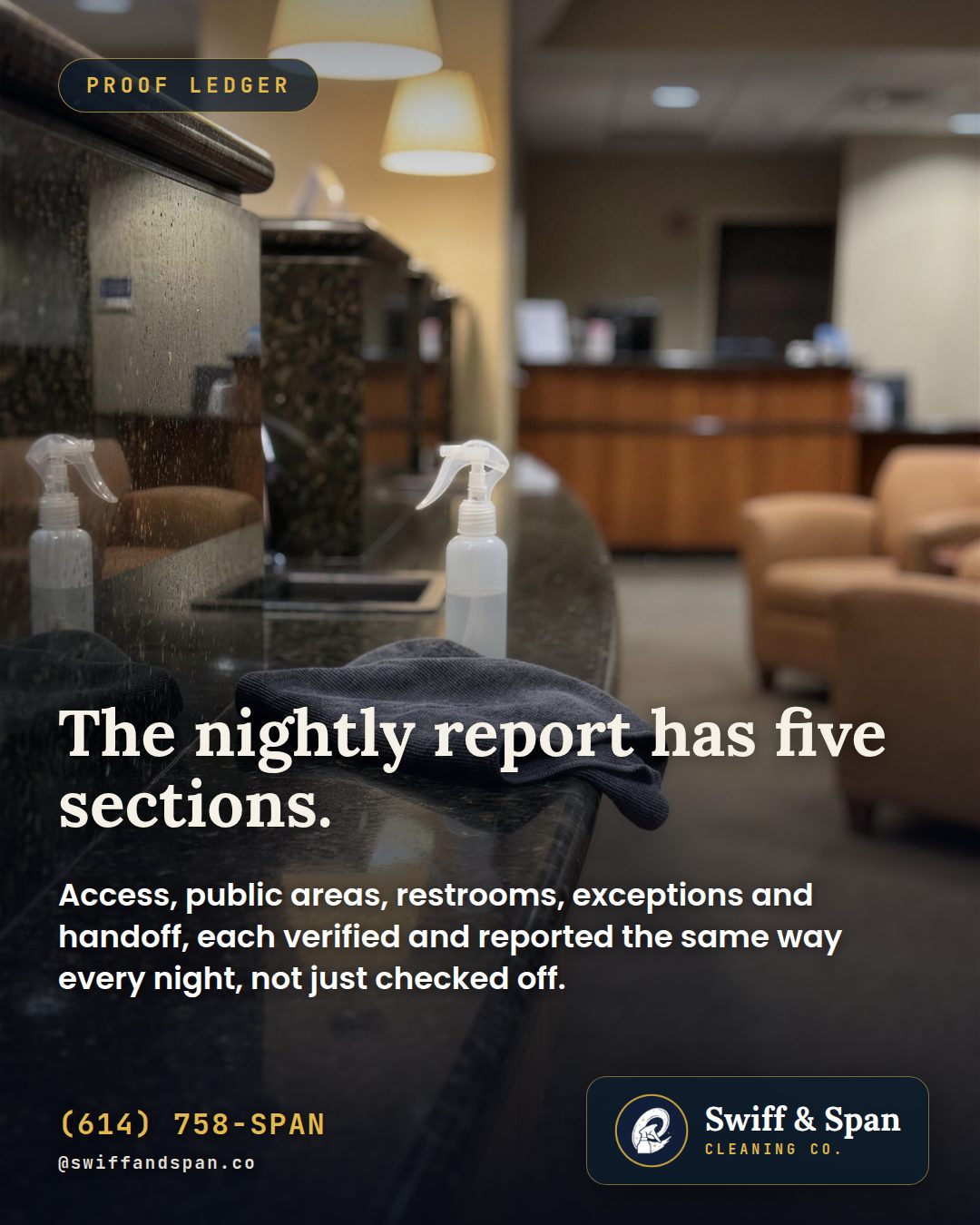
A useful nightly cleaning report has five sections: access, public areas, restrooms, exceptions, and handoff. Here is what belongs in each one, and what a branch manager should expect to see written down.
Why does a bank branch need a nightly cleaning report at all?
Because the cleaning crew is the only outside party alone in the branch after close, and the report is the only record of what happened while they were there. It turns an unwitnessed hour into a documented one.
That matters for three reasons. Security: the report records who entered, when, and whether the alarm was re-armed. Accountability: it shows which surfaces were actually cleaned, not just which rooms were visited. Continuity: when a teller finds a sticky counter at 8 AM, the report is how you trace it back to a specific night instead of a general complaint.
Section 1: What should the access section record?
Who came in, when, with which key or code, and what state the alarm and cameras were in on entry and exit. This is the section a branch manager should read first, every morning.
- Entry log. Names and times for every crew member, in and out.
- Key control. Which keys or cards were issued, and confirmation they came back.
- Alarm status. Disarm time on entry, re-arm time on exit, both written down.
- Cameras. A note that nothing was moved or blocked during the clean.
A sample access entry, for illustration only:
| Item | Completed | Notes |
|---|---|---|
| Entry log | Yes | 8:35 PM, 2 staff |
| Key control | Yes | Keys returned |
| Alarm status | Yes | Re-armed 10:05 PM |
| Camera check | Yes | Nothing obstructed |
Section 2: What counts as a public area in a branch?
Everything a customer can reach: the lobby floor, the teller line, the check-writing stand, the seating, the ATM vestibule, and the entry doors. These are the surfaces that carry nearly all of the hand contact in the building.
- Floors. Vacuumed or mopped, including the walk-off mat at the entry.
- Teller counters and check-writing stands. Wiped with attention to the front edge, where hands actually land.
- Seating. Arms and seat fronts, not just the cushions.
- ATM vestibule. Keypad, screen surround, and door handles.
- Glass and entry doors. Push plates and pulls first, then the glass.
This is also where verification belongs. An ATP meter measures organic residue left on a surface and returns a reading in RLU in about fifteen seconds. Under 100 RLU is generally considered clean industry-wide. Our own standard is 25 RLU, and the report should say which surfaces were swabbed and what they read.
Section 3: What should the restroom section cover?
Fixtures, touch points, floors, and restock. Restrooms are where a customer forms an opinion about the whole branch, and they are also the room most likely to be cleaned by memory instead of by list.
- Toilets and urinals. Cleaned and disinfected, with any leak noted.
- Sinks and counters. Faucet handles and the counter edge included.
- Door handles and locks. The last thing everyone touches on the way out.
- Floors. Mopped with the restroom’s own color-coded equipment, never the lobby’s.
- Dispensers. Soap, paper, and towels restocked and noted.
Disinfection is only disinfection when the product stays wet for the full contact time on its label. A restroom wiped dry in ten seconds was cleaned, not disinfected, and the report should reflect which one happened.
Section 4: What is an exception, and why does it need its own section?
An exception is anything the crew could not do or found wrong. Locked rooms, a leaking sink, a door that would not latch, a supply that ran out. It gets its own section because a checklist can only record what was done, and the most useful information is usually what was not.
| Exception | Location | Action taken | Follow-up needed |
|---|---|---|---|
| Maintenance | Restroom | Reported to manager | Yes |
| Access issue | Vault room | Not cleaned | Yes |
| Supply shortage | Janitor closet | Noted for reorder | No |
A report with no exceptions for three months straight is not a sign of a perfect branch. It is usually a sign that nobody is writing them down.
Section 5: What does a proper handoff look like?
Keys returned, alarm re-armed with the time written down, a final walkthrough confirming lights off and doors locked, and the report delivered to the branch manager before the branch opens. Handoff is the section that closes the loop.
- Key return. Confirmed, with who received them.
- Alarm re-armed. Time recorded.
- Final walkthrough. Doors locked, lights off, nobody left inside.
- Report delivered. By email or in a folder the manager actually opens.
A nightly cleaning report template you can use
Copy this, adapt it to your branch, and hand it to whoever cleans tonight.
Branch: ____________ Date: ____________ Crew: ____________
Access: entry log, key control, alarm status, camera check
Public areas: floors, teller counters and check stands, seating, ATM vestibule, glass and entry doors
Restrooms: toilets and urinals, sinks and counters, door handles, floors, dispensers
Exceptions: access issues, maintenance, security concerns, supply shortages
Handoff: key return, alarm re-armed, final walkthrough, report delivered
Notes: ____________________________________________
How do you know the report is telling the truth?
You check it against something the crew did not write. The simplest version is to swab two or three surfaces the report says were cleaned and read the number. A counter that reads under 25 RLU was cleaned. A counter that reads in the hundreds was visited.
That is what our complimentary ATP walkthrough is. Erik walks your branch with you, swabs the surfaces you pick, the teller line and the ATM keypad included, and you keep the readings whether you hire us or not. It takes about 30 minutes.
We clean bank branches, credit unions and commercial offices across Columbus, Dublin, New Albany, the Short North, Upper Arlington, Bexley, Hilliard and Worthington. Our crews are background checked, carry at least fifteen years of professional cleaning experience, work from documented SOPs with color-coded microfiber and the two-bucket method, and photograph every room they finish. A portion of every contract supports Columbus youth programs. Call (614) 758-SPAN.
Frequently Asked Questions
What should a nightly bank cleaning report include?
Five sections: access, public areas, restrooms, exceptions, and handoff. Access records who entered and the alarm status. Public areas and restrooms list the surfaces cleaned. Exceptions record what could not be done. Handoff confirms keys, alarm, and delivery of the report.
How often should a bank branch be ATP tested?
Periodically rather than every night. A walkthrough at the start of a contract sets a baseline, and spot checks on high-touch surfaces like the teller line and ATM keypad confirm the nightly work is holding. Under 100 RLU is generally considered clean; our standard is 25 RLU.
Who should receive the nightly cleaning report?
The branch manager, before the branch opens the next morning. If the report goes to a regional facilities inbox that nobody reads, it is paperwork, not accountability.
What is an exception in a cleaning report?
Anything the crew could not complete or found wrong, such as a locked room, a leak, a door that would not latch, or a supply that ran out. Exceptions are the most useful part of the report because they are the part a checklist cannot capture.
Does ATP testing prove a surface was disinfected?
No. ATP measures organic residue on a surface, which tells you how well it was cleaned. Disinfection depends on using an EPA-registered product and keeping the surface wet for the full contact time on its label.
Every Columbus dental, medical, wellness, and commercial facility gets the same offer: a complimentary 30-minute ATP walkthrough. We swab your highest-touch surfaces, on the spot, and hand you the readings. No obligation, no pitch required to see the number. Book your complimentary ATP walkthrough or text (614) 758-SPAN.
Erik Kuusisto, Owner
Swiff & Span Cleaning Company