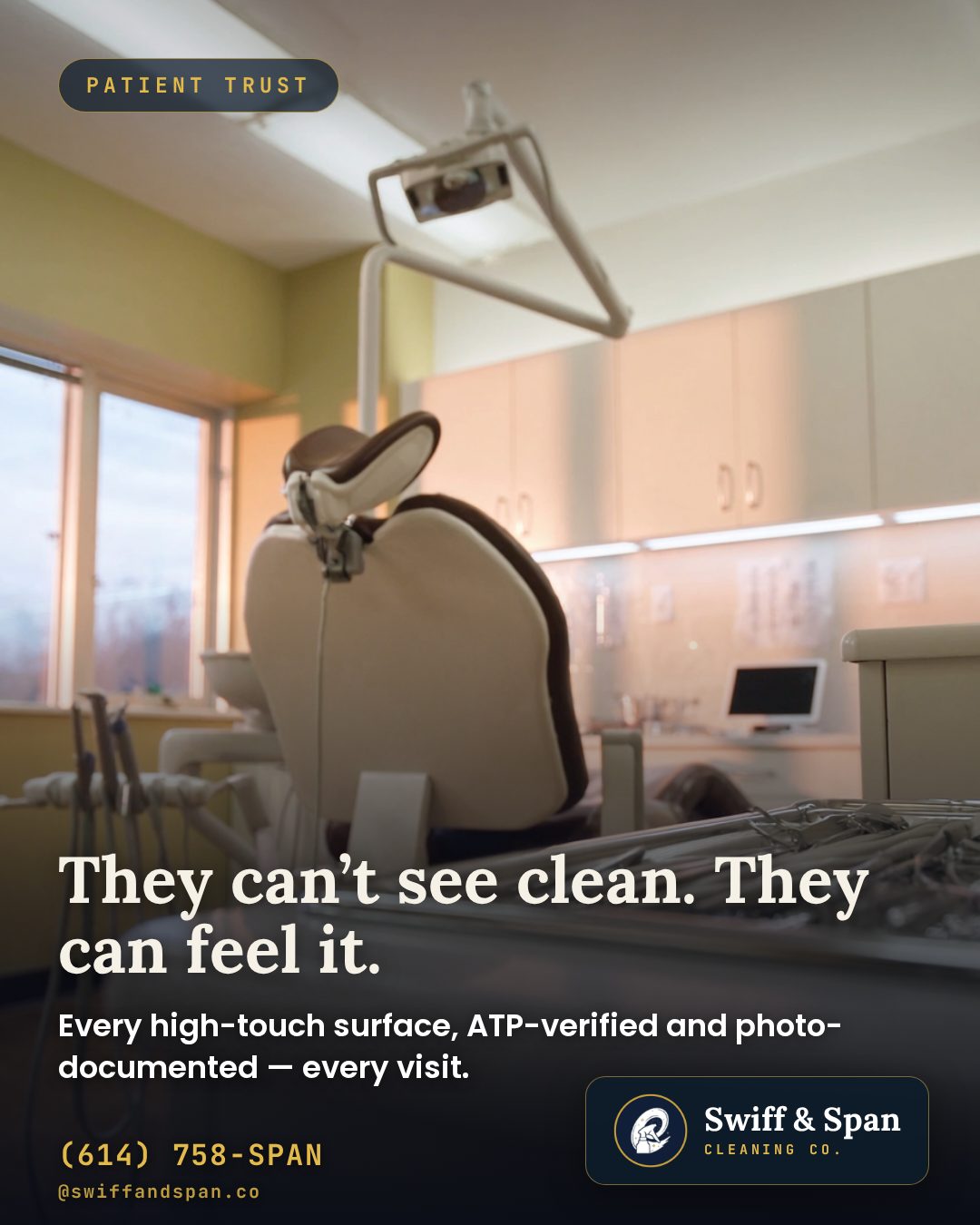
Your patients can’t see bacteria. But they can feel the difference between a room that’s been wiped down and a room that’s actually been verified, and most of them couldn’t tell you why.
That instinct isn’t imagination. It’s measurable. And the measurement most cleaning companies never show you is the one that actually matters.
Does your cleaning company measure anything?
Ask your current cleaning vendor one question: what does your practice’s cleanest surface read on an ATP meter?
Most won’t know what you’re asking. ATP testing (Adenosine Triphosphate testing) is the closest thing the cleaning industry has to a lie detector. Swab a surface, wait about fifteen seconds, and a handheld reader returns an RLU score: Relative Light Units, a direct measure of the organic residue still living on that surface. Bacteria, biofilm, leftover soil. Things a visual inspection will never catch, because "looks clean" and "is clean" are two different claims. What ATP testing measures and how RLU scores work covers the full mechanics.
We use a Hygiena SystemSURE Plus ATP meter with UltraSnap swabs on every job. The number it returns isn’t a guess. It’s a receipt.
What is a good ATP reading for a medical office?
Here’s the distinction that gets glossed over industry-wide: under 100 RLU is generally considered "clean." That’s the number most facilities, and most cleaning companies, treat as the finish line.
Swiff & Span’s own standard sits at 25 RLU.
That’s not a rounding difference. It’s a different bar entirely. Most Columbus dental and medical offices we test for the first time read in the hundreds on their highest-touch surfaces, well above even the loose industry line, because nobody has ever measured them before. Getting a surface under 100 is "clean enough." Getting it to 25 is what we actually hold ourselves to, every visit, on the surfaces your patients touch first: door handles, tray tables, chair arms, the light switch by the restroom.
The gap between those two numbers is the gap between a cleaning company that hopes it’s doing enough and one that’s built its entire operation around proving it.
How do you get a surface to verified clean?
A tight RLU number doesn’t happen by accident. It’s the output of a specific, repeatable process, not a harder scrub.
Electrostatic coverage. Chairs, equipment housings, light fixtures: anything curved or three-dimensional physically can’t get even coverage from a wiped cloth. Electrostatic application gives the disinfectant an electric charge as it’s sprayed, so it wraps around the surface instead of just falling straight down. It’s the difference between disinfecting the parts of a chair you can reach and disinfecting the whole chair. What electrostatic spraying actually does walks through the physics.
Named, EPA-registered chemistry. Not every disinfectant is interchangeable, and using the wrong one for the surface is as common a miss as skipping disinfection altogether. We match the product to the surface’s risk level and hold it at its full label dwell time: the minutes it needs to sit wet to actually work, not the seconds before someone wipes it dry. Our rotation includes PDI Super Sani-Cloth, Diversey Oxivir Tb, Clorox Healthcare Bleach Germicidal, and Spartan TB-Cide Quat, each selected for the job in front of it. Clean versus disinfect, and why dwell time decides it is the deeper argument.
Documented SOPs. Color-coded microfiber so a restroom cloth never touches a reception counter. The two-bucket method, so a tool never gets re-dipped into clean solution. Top-to-bottom, clean-to-dirty sequencing, so nothing already finished gets re-soiled on the way out. HEPA vacuums on anything carpeted. None of this is visible once the job is done, which is exactly why we document it and hand it to you. The color-coded microfiber map and two-bucket method shows the system in full.
Every one of these is a proof point on its own. Together, they’re why the number holds.
Why do patients sense a room's cleanliness?
Patients don’t evaluate disinfection protocols. They form an instant, subconscious read on a room the second they sit down, and that read shapes how much they trust everything that happens in the appointment after it.
The surfaces that create that impression aren’t the ones staff wipe down in front of a patient. They’re the ones touched between visits (door handles, tray tables, chair arms), and they’re exactly the surfaces a rushed clean skips. A room that’s been ATP-verified to 25 RLU and a room that’s simply been wiped can look identical. They don’t feel identical. One makes a patient settle in. The other makes them start reading the corners, even if they never consciously notice they’re doing it.
We’d rather hand you the reading than ask you to trust the feeling.
What does this standard look like in Columbus?
This is the same standard we bring to every clinical account across New Albany, Dublin, the Short North, Columbus, Upper Arlington, Bexley, Hilliard, and Worthington. It’s built into how we handle medical, dental, and wellness spaces, and it’s documented the same way for every office we service, from Powell to German Village and everywhere between.
If compliance documentation is the piece you actually need for an audit or insurer, that’s covered in full on our compliance and safety page. And if you want to see exactly what a verification visit looks like before booking one, here’s what happens in a complimentary ATP walkthrough, minute by minute.
Frequently Asked Questions
What is Swiff & Span’s ATP cleaning standard?
25 RLU, held to that standard on high-touch surfaces, with ATP verification on the cadence scoped at contract. That’s tighter than the general industry benchmark of 100 RLU.
Is electrostatic disinfection worth it for a dental or medical office?
Yes, specifically for complex or curved high-touch surfaces (chairs, equipment, fixtures) where a cloth can’t get even coverage. Electrostatic application wraps the disinfectant around the whole surface, not just the flat parts.
How do I know if my cleaning company’s disinfectant is EPA-registered?
Ask for the product name and EPA registration number, and confirm it’s matched to the surface’s risk level and held at full label dwell time. We use PDI Super Sani-Cloth, Diversey Oxivir Tb, Clorox Healthcare Bleach Germicidal, and Spartan TB-Cide Quat, selected by surface.
Every Columbus dental, medical, and wellness practice gets the same offer: a complimentary 30-minute ATP walkthrough. We swab your highest-touch surfaces, on the spot, and hand you the readings. No obligation, no pitch required to see the number. Book your complimentary ATP walkthrough or text (614) 758-SPAN.
Erik Kuusisto, Owner
Swiff & Span Cleaning Company
Keep reading
- What ATP testing measures, and what an RLU score does not prove
- What electrostatic spraying actually does
- Clean versus disinfect, and why dwell time decides it
- Color-coded microfiber and the two-bucket method
- What happens in a complimentary ATP walkthrough
- Hospital cleaning runs on four documents, not better chemistry
- Med spa and wellness cleaning services
- How we prove clean · FAQ · Contact