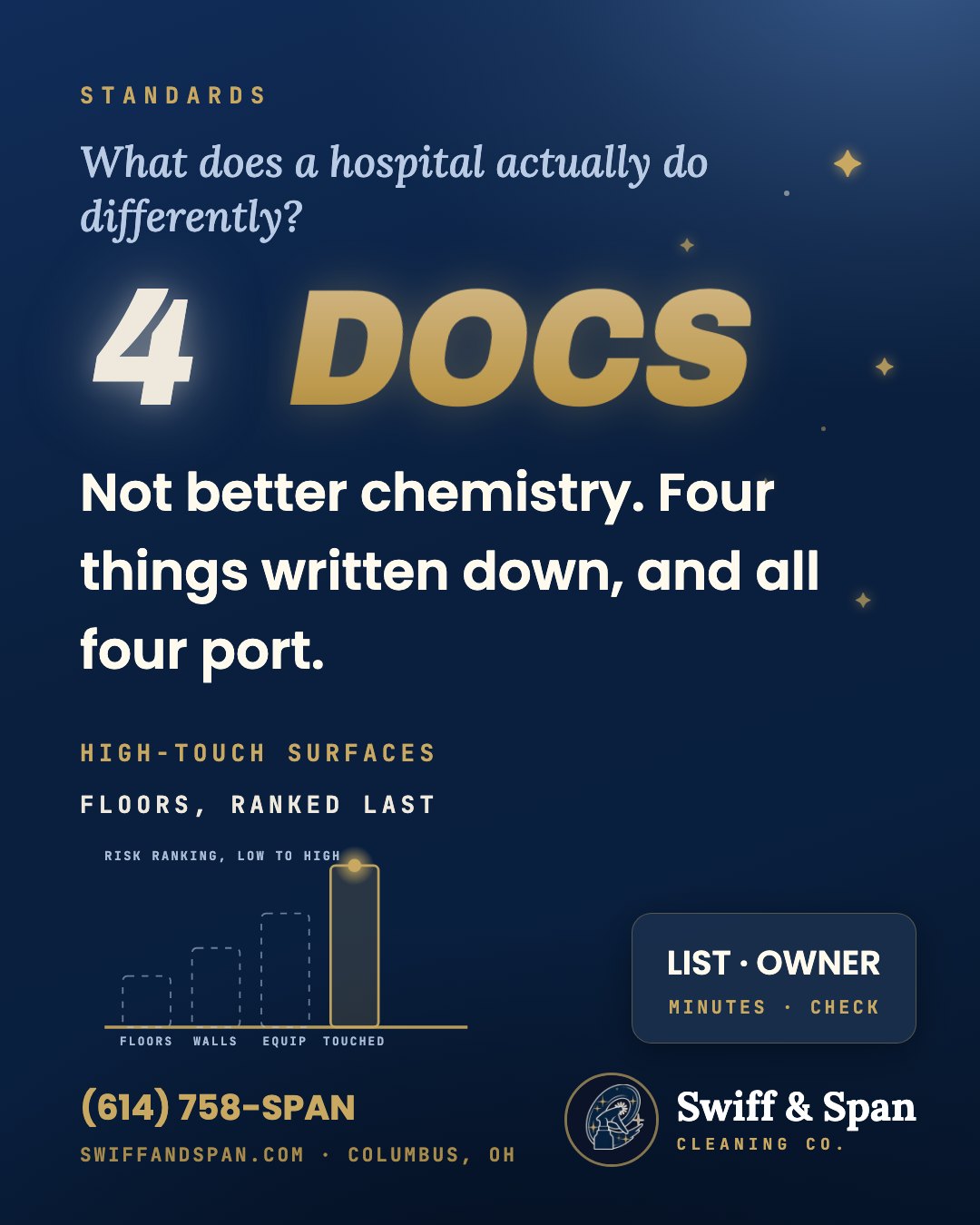
Hospital environmental services spent decades building a discipline that private practices never inherited. It is not better chemistry and it is not better equipment. Both are sold to anyone with a business account. It is four things written down, and all four port to a six-room practice. The reference point throughout is CDC’s guidance on environmental infection control in healthcare facilities, described here in general terms.
The short version. A hospital wrote four things down that most practices never did.
- Which surfaces matter, built by watching your own rooms rather than borrowed from a template.
- Who owns each one, recorded surface by surface so nothing sits in the gap between two parties.
- How many minutes the work gets, budgeted to cover cleaning AND full label contact time.
- How anybody checks, on a rhythm rather than after a complaint.
Are floors the lowest priority surface?
Environmental cleaning guidance is unsentimental about floors. They sit with the housekeeping surfaces: low-touch, low transmission risk. They get cleaned daily and they get cleaned last. In the hierarchy the discipline actually uses, the floor is near the bottom.
Now think about how a practice evaluates its cleaning company. Someone unlocks the door at seven in the morning, looks down the hallway, and has formed an opinion before reaching the front desk. The contract was scoped on square footage, which is a floor measurement. The complaint email, when it comes, is about a floor. The entire commercial relationship is priced, walked, and judged on the surface the discipline ranks lowest.
Meanwhile the surfaces that carry the risk, the ones hands land on all day, rarely get written down anywhere in the building.
That is the actual gap. A hospital wrote four things down that most practices never did: which surfaces matter, who owns each one, how many minutes the work gets, and how anybody checks. The rest of this article is those four documents, plus the two habits they exist to enforce.
Can you borrow a high-touch surface list?
The most useful move in the guidance is a refusal. It does not hand you a universal high-touch list, because what gets touched depends on how a room is used, and that differs by room and by facility. The instruction is to identify those surfaces by watching the room in normal operation, with input from the clinical staff in it, then write the result onto the checklist.
So do that. Stand in your own suite at four in the afternoon and watch where hands land. It will not be the list you expected. The pen cup and the card reader at the front desk. The break room refrigerator handle, touched by every person in the building. Cabinet pulls, opened with a knuckle, a glove, or a bare hand depending on the hour. The fabric edge of any privacy curtain, grabbed at the same spot every time and almost never named in a scope of work.
What a dental operatory terminal clean actually involves walks through one room’s finished version. The method matters more than the example, because a list built from your own workflow beats one inherited from someone else’s.
Who is responsible for each surface?
Here is the beat that makes the list work. Guidance on terminal cleaning asks that responsibility for every surface and item be assigned across cleaning staff, infection prevention, and clinical staff, and recorded in writing, so nothing is left to assumption. The failure mode being named there is not laziness. It is ambiguity.
In a practice the boundary is real and well understood in the abstract. The clinical team owns between-patient disinfection, barrier changes, and the instrument reprocessing area. The contractor owns the end-of-day environmental layer. Where that boundary touches exposure control, OSHA’s bloodborne pathogen standard and what it asks of a cleaning contractor sets the floor. What almost never happens is anyone writing the boundary down surface by surface.
So the keyboard at the check-in station, the sanitizer dispenser body, and the chair arm in the consult room sit in a gap where both parties assume the other has it. A surface that belongs to everyone belongs to nobody, and it goes untouched for months in a building where every other protocol is airtight.
What order should a room be cleaned in?
Sequence in hospital cleaning is not a rule of thumb. It is specified, and it runs on three axes at once.
Cleaner to dirtier. Patient areas before toilets. Surfaces outside the immediate patient zone before the ones inside it.
High to low, because anything dislodged from above lands on surfaces not yet cleaned. Environmental surfaces before floors, floors last, which is the same top-down, clean-to-dirty order a proper operatory clean runs on. It is also where the opening argument lands: the surface the buyer grades first is the surface the discipline finishes with.
And systematic. A fixed path through the room, clockwise or left to right, the same path in every room every night, because a repeatable route is what keeps a skipped corner from becoming a habit. It opens with a quick visual pass before any product comes out.
Spills of blood or body fluid break the route on purpose. Those get handled immediately, and as two distinct steps: confine and remove first, then clean and disinfect.
How many cloths does one room take?
Which colored cloth goes where is a solved problem, and the color-coded microfiber map and two-bucket method covers it. What hospital practice adds is how many and how used, and that part rarely survives the trip to a small facility.
More than one cloth per room, staged and counted before the session starts, because a cleaner who plans on one starts economizing halfway through. The cloth is folded in half and in half again so a fresh face turns up with each rotation, and it is retired once the faces are used. It never goes back into the container of cleaning solution, which is the same reason the two-bucket method exists: that one motion turns working solution into a bucket of soil. And it never gets shaken out, which puts back into the air exactly what you just spent the room capturing.
What is the third cleaning schedule?
Hospitals run three cleaning cadences. A practice usually runs one.
There is daily cleaning. There is terminal cleaning, defined more precisely than "end of day": the pass that reaches what could not be reached while the room was in use. And there is a third, separate schedule for low-touch surfaces on a longer rhythm. Above shoulder height. Tops of cabinets. Vents, walls, baseboards, the corners a daily route never enters. Blinds and curtains on a longer cycle still.
Nothing on that third list is urgent on any given Tuesday. All of it is visible when it has been skipped for a year, and it is the reason a suite can be cleaned nightly and still feel tired.
The schedule carries one more thing. Assignment sheets allot time per area, and those minutes have to cover two jobs: cleaning the surface thoroughly, and letting the disinfectant sit for its full label contact time. The chemistry gets budgeted rather than hoped for. The chemistry and dwell time article covers why the second job is the one that gets skipped.
Is verification an audit or a routine?
The last artifact turns the other three from paperwork into practice, and it runs as routine rather than as an event.
The literature describes several monitoring methods and is careful about what each measures. Direct observation measures a person’s adherence to the process, not the state of the room. Fluorescent markers show whether an area was wiped at all. ATP bioluminescence reads organic residue and returns a number immediately, which is what makes it usable during the shift rather than after it. And looking at a surface tells you whether it looks clean, which is a different question from whether residue is still on it. That gap is the entire reason a meter exists.
In a functioning program the monitoring is formative: the number is read as information about the method, and it feeds retraining rather than discipline.
Thresholds are device-specific, so a reading only means something against a stated benchmark and a consistent method, and what an RLU score covers and where it stops is the whole of that argument.
What can a small practice copy from hospitals?
None of this needs a budget. It needs four documents that fit on two pages. The list, built by watching your own suite. A name beside every surface on it, agreed in writing between your clinical team and whoever holds the cleaning contract. Minutes per area that cover the cleaning and the contact time both. And a check that runs on a rhythm rather than after a complaint.
Our version looks like this. Room-by-room checklists on paper, photo-timestamped documentation every visit, and below 25 RLU is where we hold every clean, whether the route is a dental practice or a medical and clinical suite. Every cleaner on every account carries a minimum of fifteen years of professional cleaning experience, which is how we screen before anyone reaches a facility. ATP swab verification runs as a scoped part of the agreement, on the cadence each facility sets, and those readings are yours to keep.
A share of every contract we sign goes to Columbus organizations supporting Franklin County youth facing homelessness and poverty. Same city, same standard.
Frequently Asked Questions
What does a hospital do differently from a regular office cleaning company?
Mostly it writes things down: a surface inventory built by watching the room, a documented owner for every surface, a schedule that allots minutes per area, and routine monitoring that feeds retraining. Products and equipment are available to anyone. The documentation is the difference, and it ports to a small facility without new spending.
What is one question that tells me whether a crew was trained on process?
Ask how many cloths one specific room takes. A crew working from a written process answers with a number and can say why the cloth gets retired at that point. A crew working from an office template has never counted. The fuller vendor list lives in the questions worth asking a commercial cleaning company, and how we prove clean walks through the version we run.
Thirty minutes, your facility, you keep the readings. If you want to see how your own high-touch surfaces read against a stated benchmark, book a complimentary ATP walkthrough and we will swab them together.
Erik Kuusisto, Owner
Swiff & Span Cleaning Company
Keep reading
- What a dental operatory terminal clean actually involves
- Clean versus disinfect, and why dwell time decides it
- Color-coded microfiber and the two-bucket method
- What ATP testing measures, and what an RLU score does not prove
- OSHA bloodborne pathogen standards and the cleaning contractor
- Medical office building cleaning for property managers
- Medical and dental cleaning services
- How we prove clean · FAQ · Contact