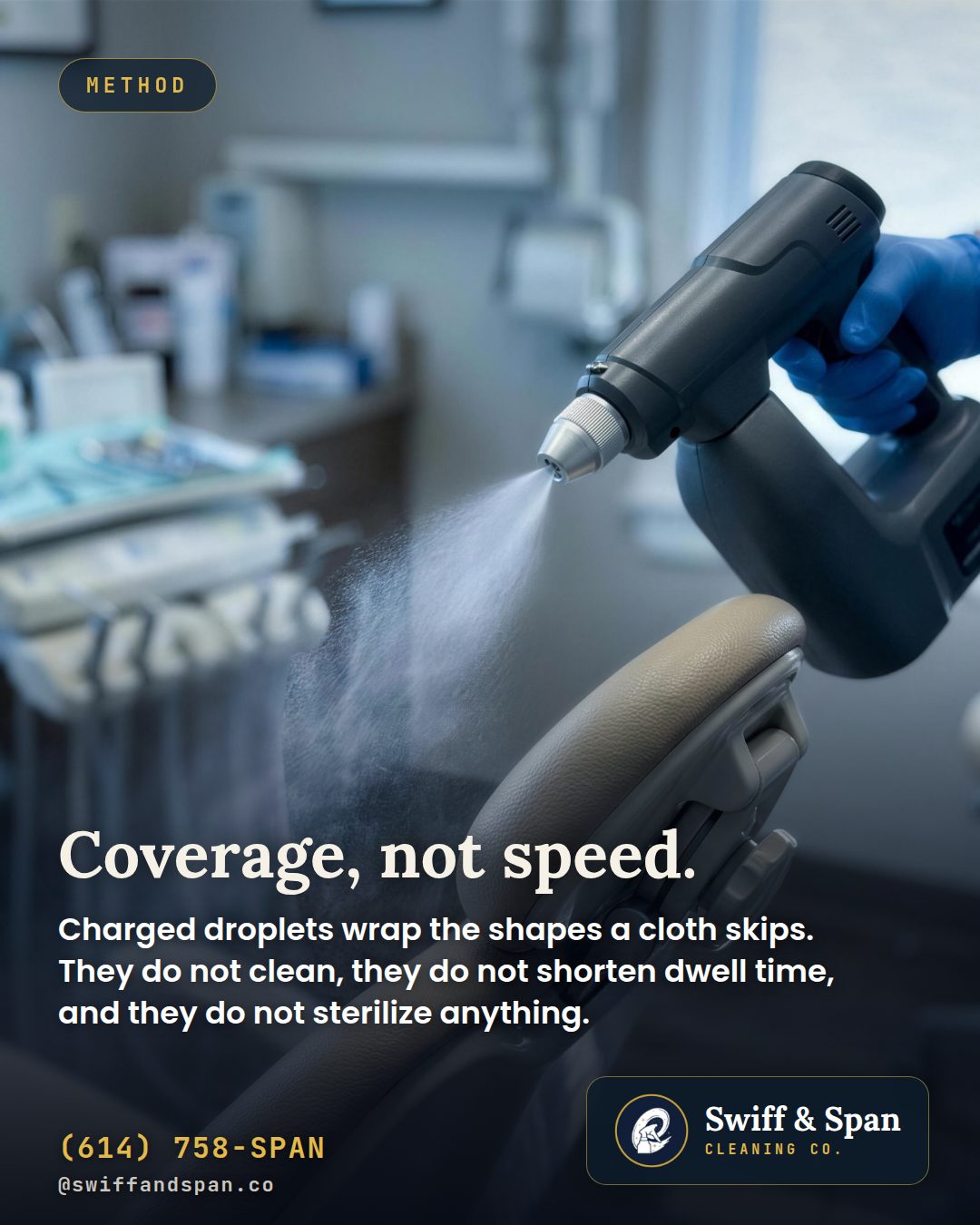
Electrostatic sprayers arrived in commercial cleaning with an unfortunate amount of marketing attached. For a stretch there, every company had one in a stock photo and nobody explained what it did. So let us be specific about the physics, the real benefit, and, just as importantly, the four things it does not do.
What problem does electrostatic spraying solve?
Take a dental chair. A microfiber cloth cleans the flat armrest beautifully. Now consider the underside of that armrest, the seam where the upholstery meets the base, the curve behind the headrest, the control lever, the tubing housing. A cloth reaches those surfaces only if a person deliberately works it into every one, in the right order, without missing a pass, at 9pm on the fourth room of the night.
Multiply that by equipment housings, door hardware, chair bases, keyboard trays, and the awkward geometry in every clinical room. Flat wiping is excellent on flat surfaces and structurally unreliable on complex ones. That is the gap electrostatic application is for.
How does electrostatic spraying work?
An electrostatic sprayer gives the disinfectant droplets an electrical charge as they leave the nozzle. Charged droplets do two useful things. They repel each other, so the spray spreads into an even cloud instead of clumping. And because the surfaces they are heading toward are relatively neutral or oppositely charged, the droplets are actively attracted to them, including surfaces the nozzle is not aimed straight at.
The practical result is wraparound. Spray the front of a chair arm and charged droplets curl toward the underside and back as well. Coverage follows the shape of the object rather than the line of the nozzle. On a curved, textured, or hard-to-reach fixture, that is a meaningfully more even application than any hand can manage in the time available.
What does electrostatic spraying not do?
1. It does not replace cleaning. This is the big one. Electrostatic spraying applies disinfectant; it does not remove soil. Disinfectant applied over an organic film gets partly consumed neutralizing that soil instead of doing its job, the same problem we cover in the clean-versus-disinfect chemistry. A crew that sprays a dirty room and calls it disinfected has skipped the step that makes the spray worth anything. You clean first. Always.
2. It does not shorten dwell time. The product on the surface still has to stay visibly wet for its full EPA-registered label time, commonly one to ten minutes. An even coat applied in fifteen seconds still needs those minutes to work. Electrostatic application improves coverage, not speed.
3. It does not sterilize anything. Sterilization is a defined process for instruments, done in an autoclave, by your clinical team. No sprayer sterilizes a room, and anyone using that word about environmental cleaning is misusing it.
4. It is not a substitute for touching high-touch points. The surfaces people grab constantly, handles, switches, rails, keyboards, still earn direct mechanical cleaning. Spray is a complement to the hand-cleaned pass, not a replacement for it.
Which surfaces benefit from electrostatic spraying?
On the shapes that defeat a cloth. Dental chairs and delivery units. Exam tables and stools. Equipment housings and cart surfaces. Waiting-room seating, especially fabric-backed chairs and the frames underneath them. Restroom fixtures and partitions. Physical therapy tables and the equipment around them, where patient skin contact is constant and the geometry is unfriendly.
The sequence never changes: clean the surface first with color-coded microfiber and the two-bucket method, apply an EPA-registered disinfectant matched to that surface's risk level. PDI Super Sani-Cloth, Diversey Oxivir Tb, Clorox Healthcare Bleach Germicidal, or Spartan TB-Cide Quat. Hold it at full label dwell time, and use electrostatic application where even coverage on a complex shape is the hard part. Then we verify the cleaning step with ATP surface testing on the cadence each client scopes, and hand over photo-timestamped documentation.
What should you ask about electrostatic spraying?
If you are vetting cleaners and one of them leads with electrostatic spraying, three questions will tell you everything:
"Do you clean the surface before you spray it?" If there is any hesitation, the sprayer is theater. Soil load defeats disinfectant regardless of how evenly it is applied.
"What is the dwell time on the product you spray, and how do you honor it?" A real answer names the product and its label time. A vague one means someone is spraying and leaving.
"What does the sprayer not do?" This is the tell. A company that can name its own tool's limits is describing a method. A company that cannot is describing a purchase.
Is electrostatic spraying worth it?
Electrostatic spraying is a useful tool for a specific problem: getting even disinfectant coverage on three-dimensional surfaces where a flat wipe cannot. It is not a shortcut, not a substitute for cleaning, and not a magic word. Used in the right sequence, it closes a real gap in clinical rooms. Used as a headline, it hides one.
Curious what your own high-touch surfaces read today, sprayer or no sprayer? The complimentary 30-minute ATP Environmental Verification Walkthrough answers that with a number, and the readings are yours whether you hire us or not.
Frequently Asked Questions
Does electrostatic spraying replace cleaning?
No. Electrostatic spraying applies disinfectant but does not remove soil. Disinfectant applied over organic residue is partly consumed neutralizing that soil instead of working as labeled, so surfaces must be cleaned first and sprayed second.
Does electrostatic spraying reduce disinfectant dwell time?
No. The disinfectant still has to remain visibly wet on the surface for its full EPA-registered label contact time, commonly one to ten minutes. Electrostatic application improves the evenness of coverage, not the speed of disinfection.
Does an electrostatic sprayer sterilize a room?
No. Sterilization is a defined process performed on instruments, typically in an autoclave by clinical staff. Environmental cleaning and disinfection of rooms and surfaces is a different process, and no sprayer sterilizes a room.