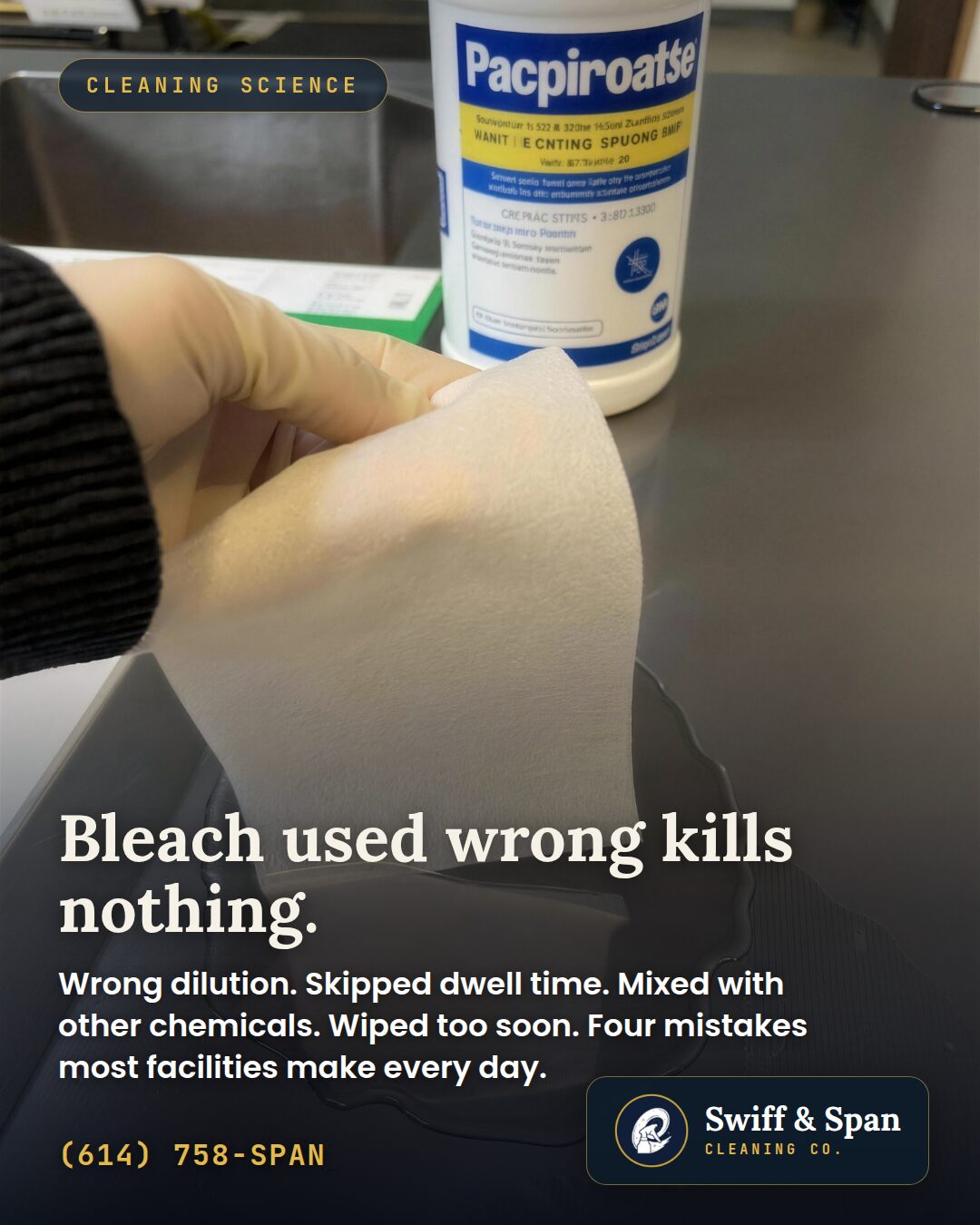
Bleach works. That part is not up for debate. Sodium hypochlorite, the active compound in household and commercial bleach, kills bacteria, viruses, fungi, and most of the pathogens a dental or medical office worries about. The CDC lists it as one of the most reliable surface disinfectants available.
The problem is that “bleach works” has become a permission slip to use it however, wherever, and for however long feels about right. And “about right” is where things fall apart.
Here are four ways almost everyone gets bleach wrong, and what each mistake actually costs the clean you thought you were getting.
How long does bleach need to stay wet?
Every EPA-registered disinfectant has a number printed on its label called the dwell time, sometimes listed as “contact time.” That is the number of minutes the surface must remain visibly wet with the product for disinfection to actually occur. For most bleach-based products, it is somewhere between one and ten minutes.
Most cleaning crews spray bleach on a surface and wipe it dry in under thirty seconds. At that point, they have cleaned the surface. They have not disinfected it. The chemical reaction that kills pathogens is an oxidation process, and it needs time. Cutting the dwell time short is the single most common disinfection failure in commercial cleaning, and it is invisible: the surface looks and smells exactly the same either way.
This is why we time every application. The product stays wet for its full label dwell time, documented. Clean versus disinfect, and why dwell time decides it covers the chemistry in full.
What bleach dilution should you use?
Household bleach is typically 5.25% to 8.25% sodium hypochlorite. The CDC’s general recommendation for hard, non-porous surfaces is a 1:10 to 1:100 dilution of 5.25% bleach in water, depending on the application. Too dilute and it cannot kill what you need it to kill. Too concentrated and it damages the surface, corrodes metal, degrades rubber seals on dental equipment, and off-gasses at levels that irritate eyes and airways.
The “just pour some in” approach skips the math, and the math is the whole point. This is one reason we use pre-formulated, EPA-registered products like Clorox Healthcare Bleach Germicidal Cleaner, where the concentration is fixed at the factory. No mixing. No guesswork. The bottle is the protocol.
What should you never mix with bleach?
Bleach and ammonia produce chloramine gas. Bleach and acidic cleaners (including some bathroom products and household vinegar) release chlorine gas. Both are serious respiratory hazards. At low concentrations, they cause coughing and irritation. At higher concentrations, they can put someone in the hospital.
This happens more often than most facility managers realize. A crew member sprays a bathroom cleaner, then follows up with a bleach wipe. Or a leftover residue from one product reacts with the next. The result is the same: a toxic gas in a space with patients or staff nearby.
The fix is not “be more careful.” The fix is a controlled product rotation where each chemical is matched to the surface it belongs on and used alone. Our rotation includes PDI Super Sani-Cloth for patient contact surfaces, Diversey Oxivir Tb for broad-spectrum needs, Clorox Healthcare Bleach Germicidal for non-porous hard surfaces, and Spartan TB-Cide Quat for general environmental surfaces. Each one is selected for the job in front of it. None of them get mixed.
What surfaces should you not use bleach on?
Bleach is not a universal cleaner. It corrodes stainless steel over time. It discolors fabrics, carpet, and upholstery on contact. It degrades the rubber gaskets and O-rings inside dental handpieces and suction valves. It can etch natural stone countertops. And on porous surfaces, it may not penetrate deeply enough to disinfect at all.
The right answer is not always bleach. It is the right product for the right surface. A dental chair arm gets a different disinfectant than a bathroom floor, which gets a different product than a reception counter. Matching the chemistry to the material is what keeps the disinfection effective without damaging the thing you are trying to protect.
What should you use instead of bleach?
There is no single product that does everything. But there is a system that does: named, EPA-registered chemistry matched to each surface type, held at full label dwell time, documented and photographed, and then verified with an ATP test after the fact.
Under 100 RLU is the number the industry calls “clean.” That is the general benchmark most cleaning companies in Columbus treat as good enough.
Swiff & Span’s own standard sits at 25 RLU.
We reach that number not because we use more bleach, but because we use the right product at the right concentration for the right duration on the right surface, and then we measure the result with a Hygiena SystemSURE Plus ATP meter. The number it returns is photographed and handed to you. Every visit, every account, across New Albany, Dublin, the Short North, Columbus, Upper Arlington, Bexley, Hilliard, and Worthington.
What “clean” actually means walks through our full verification standard. What electrostatic spraying actually does covers the physics behind our application method for curved and complex surfaces.
Frequently Asked Questions
Why does bleach need dwell time to work?
Bleach kills pathogens through a chemical oxidation reaction that takes time. The label on every EPA-registered bleach product specifies a minimum contact time, typically one to ten minutes, during which the surface must remain visibly wet. Wiping it dry before the dwell time expires means the disinfection did not complete.
Is bleach the best disinfectant for a dental or medical office?
Bleach is effective but is not always the best choice. It can corrode metal instruments, damage upholstery, and degrade rubber seals on equipment. Professional cleaning protocols match the disinfectant to the surface: Clorox Healthcare Bleach Germicidal for non-porous hard surfaces, PDI Super Sani-Cloth for quick-turnaround patient areas, Diversey Oxivir Tb for broad-spectrum needs, and Spartan TB-Cide Quat for general environmental surfaces.
How can I verify my cleaning crew is using disinfectant correctly?
Ask for three things: the product name and its EPA registration number, confirmation that it is held at its full label dwell time (not wiped early), and an ATP test reading after the clean to verify the surface actually came clean. Swiff & Span provides all three, documented and photo-timestamped, on every visit.
Every Columbus dental, medical, and wellness practice gets the same offer: a complimentary 30-minute ATP walkthrough. We swab your highest-touch surfaces, on the spot, and hand you the readings. No obligation, no pitch required to see the number. Book your complimentary ATP walkthrough or text (614) 758-SPAN.
Erik Kuusisto, Owner
Swiff & Span Cleaning Company
Keep reading
- Clean versus disinfect, and why dwell time decides it
- What does “clean” actually mean? Inside the ATP numbers
- What electrostatic spraying actually does
- Color-coded microfiber and the two-bucket method
- Fireflies, deep-sea squid, and your exam table
- What happens in a complimentary ATP walkthrough
- How we prove clean · FAQ · Contact