On any warm June evening in Central Ohio, you can watch fireflies turn a backyard into a light show without a single wire or battery. Five hundred meters below the ocean surface, a Hawaiian bobtail squid glows with the same trick, using light to erase its own shadow so predators swimming beneath it see nothing but moonlit water above.
Neither the firefly nor the squid plugs into anything. The light comes from chemistry: a molecule called luciferin, an enzyme called luciferase, a source of energy, and oxygen. Mix them and you get photons. No heat. No spark. Just a cold, measurable glow.
That same reaction is sitting in the handheld meter we carry into your practice every time we clean. And it is the reason we can hand you a number instead of an opinion.
How does ATP bioluminescence testing work?
Every living cell runs on a molecule called ATP: adenosine triphosphate. Bacteria have it. Biofilm has it. The organic residue left on a counter after a quick wipe has it. ATP is the universal fuel of biological life, and any surface that still carries it after cleaning still carries the material your disinfection was supposed to remove.
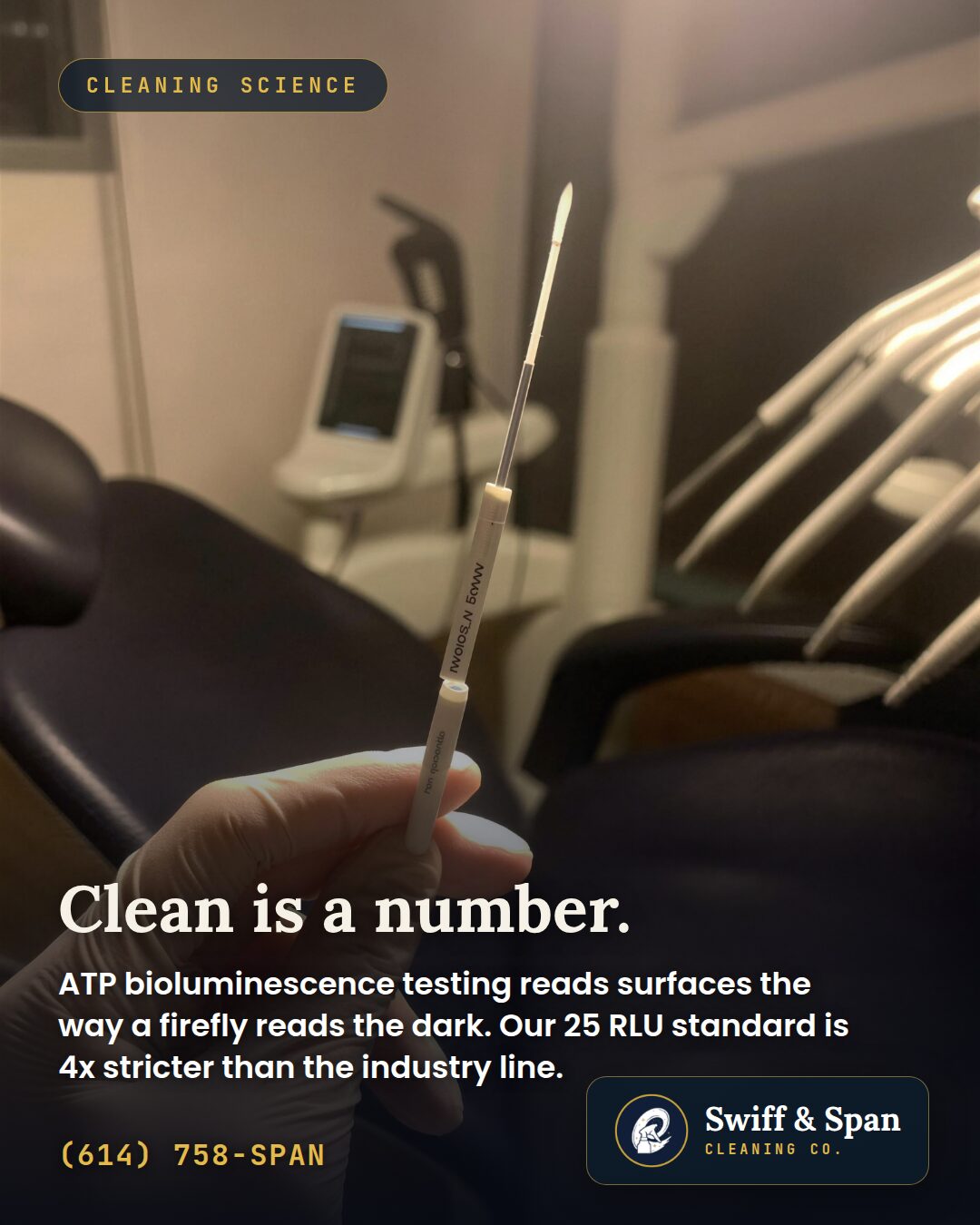
An ATP test works like a firefly in reverse. Instead of the organism making its own light, we supply the luciferin and luciferase in a test swab (a Hygiena UltraSnap, in our case) and let whatever ATP is on the surface provide the fuel. Swab the surface, snap the reagent bulb, insert the swab into a Hygiena SystemSURE Plus reader, and in about fifteen seconds the meter returns a number: Relative Light Units, or RLU.
More ATP on the surface means more light in the reaction. More light means a higher RLU score. A higher score means the surface is not as clean as it looks.
What do fireflies and ATP testing have in common?
Bioluminescence evolved independently at least fifty times across unrelated species. Fireflies use it to find mates. Anglerfish use it to lure prey. The bobtail squid uses it for camouflage. The chemistry persisted because it works: it converts chemical energy into visible light with almost no waste heat, which is why scientists call it one of the most efficient reactions in biology.
That efficiency is exactly what makes it useful on a dental chair arm. The reaction is so sensitive that it picks up ATP concentrations a human eye could never see. A countertop can look spotless, smell like disinfectant, and still read 300 RLU because the wipe moved the residue around instead of removing it. The bioluminescence reaction does not care what the surface looks like. It only cares what is still living on it.
What ATP testing measures and how RLU scores work walks through the full mechanics if you want the deeper version.
Why is 25 RLU stricter than the industry's 100?
Under 100 RLU is the number most of the cleaning industry considers “clean.” That is the general benchmark, and most commercial cleaning companies in Columbus treat it as the end of the conversation.
Swiff & Span holds every high-touch surface to 25 RLU.
The gap between those two numbers is not a rounding difference. It is the difference between a cleaning company that stops at the industry line and one that built its entire process to land well inside it. Most dental and medical offices we test for the first time read in the hundreds on their highest-touch surfaces. Nobody had ever measured them before, so nobody knew.
The bioluminescence reaction does not negotiate. It reads what is there. And the number it returns after we clean is the number we photograph, document, and hand to you.
How do you get a surface from 300 RLU to 25?
A low RLU reading is not the result of scrubbing harder. It is the output of a specific, repeatable process.
Electrostatic coverage. A cloth cannot get even contact on a curved dental chair arm or an equipment housing. Electrostatic application charges the disinfectant so it wraps around three-dimensional surfaces instead of pooling on the flat parts. What electrostatic spraying actually does covers the physics.
Named EPA-registered chemistry at full dwell time. The disinfectant has to match the surface risk, and it has to sit wet for the full contact time printed on its label. Our rotation includes PDI Super Sani-Cloth, Diversey Oxivir Tb, Clorox Healthcare Bleach Germicidal, and Spartan TB-Cide Quat. Clean versus disinfect, and why dwell time decides it explains the distinction.
Documented SOPs. Color-coded microfiber so a restroom cloth never touches a reception counter. Two-bucket method so a tool never re-dips into clean solution. Top-to-bottom, clean-to-dirty sequencing so nothing already finished gets re-soiled. HEPA vacuums on carpeted areas. The color-coded microfiber map and two-bucket method shows the full system.
Each step matters on its own. Together, they are why the bioluminescence reaction returns a number you can trust, visit after visit.
Do patients notice how clean a room is?
Nobody sits in a dental chair and thinks about luciferin. But patients form an instant, wordless judgment the moment they settle into a room, and that judgment shapes how much they trust everything that happens next.
The surfaces that drive that feeling are the ones touched between appointments: the door handle, the chair arm, the light switch by the restroom. A room that reads 25 RLU and a room that reads 200 RLU can look identical to the eye. They do not feel identical. One invites a patient to relax. The other makes them notice the corners, even if they could not explain why.
We would rather hand you the reading than ask anyone to trust the feeling.
Does every practice get the same standard?
This is the verification we bring to every clinical account across New Albany, Dublin, the Short North, Columbus, Upper Arlington, Bexley, Hilliard, and Worthington. The same meter, the same benchmark, the same documentation. It is built into how we handle dental offices, medical and clinical facilities, and wellness and med spa spaces.
If you want to see what a verification visit looks like before booking one, here is what happens in a complimentary ATP walkthrough, minute by minute.
Frequently Asked Questions
What is a safe RLU reading for a dental or medical office?
Under 100 RLU is generally considered clean industry-wide. Swiff & Span holds every surface to a tighter standard of 25 RLU, measured with a Hygiena SystemSURE Plus ATP meter and UltraSnap swabs on the cadence scoped at contract.
Why does Swiff & Span use ATP testing instead of visual inspection?
Visual inspection cannot detect bacteria, biofilm, or organic residue on a surface that looks clean. ATP bioluminescence testing measures what is actually there in about fifteen seconds, returning a number you can compare visit to visit. It is the difference between assuming a surface is clean and proving it.
Every Columbus dental, medical, and wellness practice gets the same offer: a complimentary 30-minute ATP walkthrough. We swab your highest-touch surfaces, on the spot, and hand you the readings. No obligation, no pitch required to see the number. Book your complimentary ATP walkthrough or text (614) 758-SPAN.
Erik Kuusisto, Owner
Swiff & Span Cleaning Company
Keep reading
- What ATP testing measures, and what an RLU score does not prove
- What does “clean” actually mean? Inside the ATP numbers
- What electrostatic spraying actually does
- Clean versus disinfect, and why dwell time decides it
- Color-coded microfiber and the two-bucket method
- What happens in a complimentary ATP walkthrough
- How we prove clean · FAQ · Contact