Nearly every disinfectant stored under a veterinary exam room sink is, mechanically speaking, designed to pop a balloon.
Enveloped viruses wrap themselves in a stolen scrap of host cell membrane. That membrane is lipid. Lipid is exactly what a quaternary ammonium compound is built to take apart, because a quat is a surfactant, and surfactants disassemble fat. Against an enveloped virus, a quat is a knife against a water balloon.
Canine parvovirus does not have a balloon. It is a bare protein shell around a short strand of DNA, and there is no lipid anywhere on it. The knife swings through empty air. That one structural fact, present or absent envelope, decides which bottle in your supply closet is doing work and which one is doing theater.
Why don't quats kill parvovirus?
Because quats are surfactants built to disassemble a lipid membrane, and canine parvovirus has none. It is a bare protein shell around a short strand of DNA, so there is nothing for the quat to attack.
The CDC's 2008 Guideline for Disinfection and Sterilization in Healthcare Facilities states it without decoration: "The quaternaries sold as hospital disinfectants are generally fungicidal, bactericidal, and virucidal against lipophilic (enveloped) viruses; they are not sporicidal and generally not tuberculocidal or virucidal against hydrophilic (nonenveloped) viruses."
The 2018 AAHA Infection Control, Prevention, and Biosecurity Guidelines put it in a table. Table 11, quaternary ammonium: "Limited impact on nonenveloped viruses, bacterial spores, dermatophytes. Inhibited by organic debris." The Merck Veterinary Manual skips the hedging entirely: "Quaternium ammonium disinfectants are not reliable disinfectants for parvovirus."
There is bench work behind the guidance. Eleraky, Potgieter, and Kennedy tested four disinfectants in the Journal of the American Animal Hospital Association in 2002 and reported that "the quaternary ammonium compound evaluated in this study and citricidal were not effective against feline calicivirus and feline parvovirus." Worth being precise about the scope, because a reader who pulls the paper will notice: that study used feline parvovirus, not canine. FPV is the standard surrogate and a close relative, and the structural argument is identical, but the sentence says parvovirus, so this article says parvovirus.
The same physics ends a second conversation. AAHA's hand hygiene section: alcohol-based hand sanitizer "is not effective against bacterial spores (e.g., Clostridium spp.), Cryptosporidium spp., and nonenveloped viruses (e.g., parvovirus)." Their follow-on instruction is one sentence long. "When these pathogens are suspected, washing hands with soap and water is encouraged." The pump bottle on your front desk in Worthington is excellent at what it does. What it does is not this.
How long does parvovirus survive on surfaces?
Indoors at room temperature, infectious CPV persists for at least two months. Held below minus 20 degrees Celsius it was still infective at roughly its starting titer after 12 months. Outdoors it faded past five months unless shielded from sunlight and drying.
Gordon and Angrick published the primary environmental persistence experiment in the American Journal of Veterinary Research in 1986. They started with an inoculum at a TCID50 of 10^5.5 per milliliter and then simply waited, at different temperatures, for a year.
Below minus 20 degrees Celsius, the virus was still infective at roughly its starting titer after 12 months. At 4 degrees Celsius it fell to a TCID50 of 10^2.3 per milliliter over the same 12 months. At room temperature, 20 degrees Celsius or warmer, it dropped below a TCID50 of 10^1 per milliliter in under 2 months. Outdoors it was not infective past 5 months, with one exception: material shielded from sunlight and drying.
Merck's summary matches: "Infectious CPV can persist indoors at room temperature for at least 2 months; outdoors, if protected from sunlight and desiccation, the virus can persist for many months and possibly years." The AVMA notes the virus "is resistant to heat, cold, humidity, and drying, and can survive in the environment for long periods," and pointedly attaches no number to that.
Which means the folklore you have heard at conferences, parvo lives a year in your lobby, parvo lives seven years in soil, has no experiment underneath it. The real finding is more useful anyway. Your indoor exam room at 21 degrees is a comparatively hostile environment. The shaded strip of mulch by your side entrance, where a dog squats out of the sun, is the one that holds.
What bleach dilution kills parvovirus?
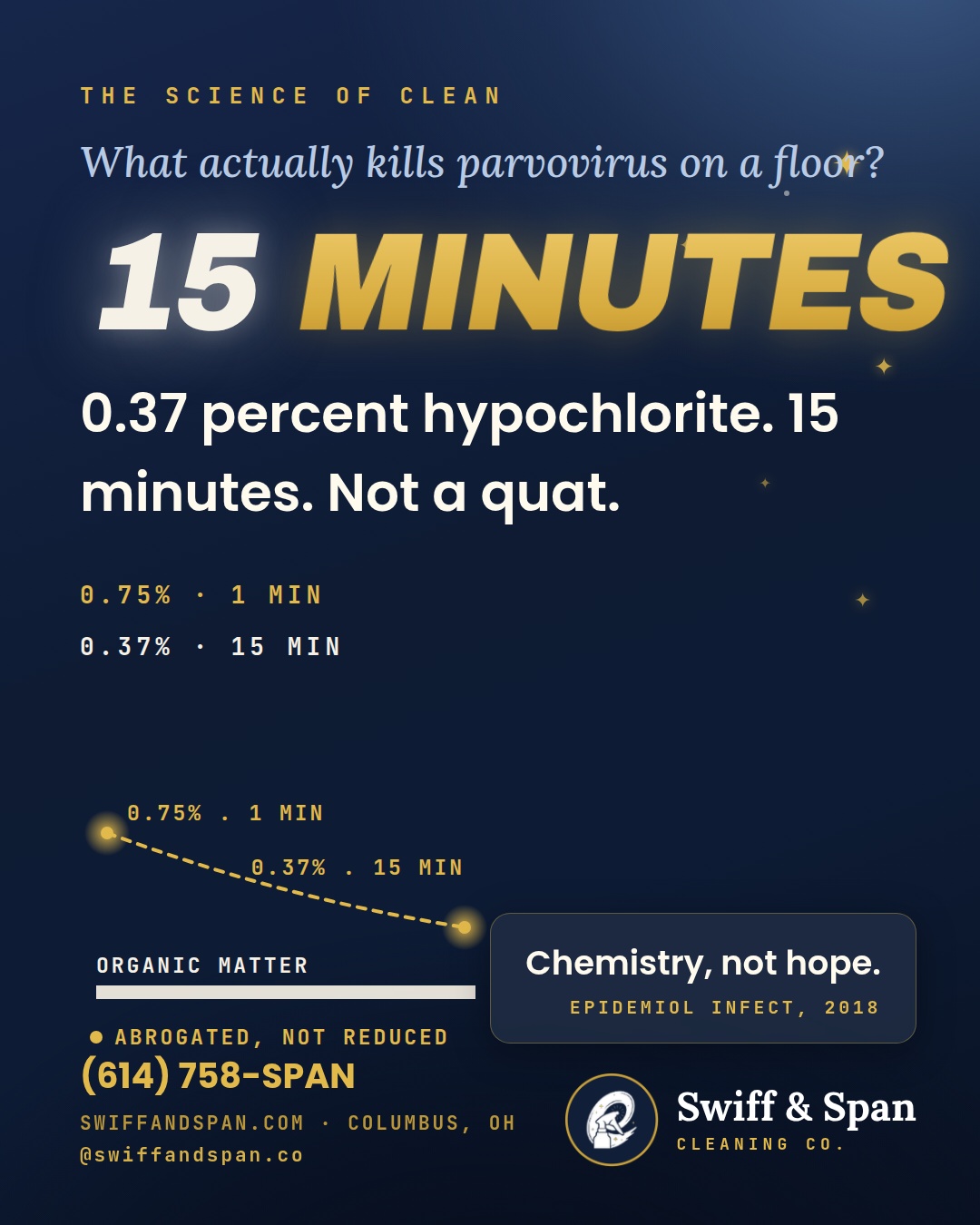
0.75% sodium hypochlorite in 1 minute, or 0.37% held for 15 minutes. With household bleach at 5 to 6%, that is roughly 1 part bleach to 7 or 8 parts water, or 1 part to 14 or 16.
There is exactly one published concentration-by-contact-time study for CPV-2: Cavalli and colleagues, Epidemiology and Infection, 2018. Their conclusion, verbatim:
"The data indicate that using a 0.75% sodium hypochlorite solution for a short contact time (1 min) can reduce significantly the CPV-2 titers and that even lower concentrations, i.e. 0.37%, can efficiently inactivate the viruses provided that the contact time is extended to 15 min."
That is the trade the whole protocol turns on. Concentration and time are interchangeable currency, and you get to choose which one you can afford in a real clinic.
Cavalli reports percentages, and your janitorial closet holds a jug labeled in nothing of the kind, so here is the conversion done out loud. Household bleach runs about 5 to 6% sodium hypochlorite. To reach 0.75%, you are diluting roughly 1 part bleach to 7 or 8 parts water. To reach 0.37%, roughly 1 part to 14 or 16. Those are the two solutions with published CPV-2 evidence behind them, at 1 minute and at 15 minutes respectively.
Why do parvo disinfection guidelines conflict?
Because the dilutions in circulation were never tested at the contact times quoted alongside them. That is the uncomfortable part most vendors will not raise with you.
AAHA's Table 11 lists household bleach at 1:10 to 1:50 dilution with a contact time of 1 to 5 minutes. Merck cites 1:30 or 1:32. Run the arithmetic on 1:32 against a 5% stock and you land near 0.16% sodium hypochlorite, which is meaningfully weaker than the lowest concentration Cavalli found effective, and Cavalli only found that concentration effective when it sat for 15 minutes.
So the widely circulated 1:32 is not an experimentally validated CPV kill dilution. It is conventional guidance. It may well work in practice at longer dwell times, and the field has used it for decades without disaster. But if you are the person signing the disinfectant order for a clinic in Dublin or Clintonville, you should know that the number on the wall chart and the number in the peer-reviewed literature are not the same number, and the literature is the more demanding of the two.
If bleach does not suit your surfaces, two other chemistries have real support. Potassium peroxymonosulfate (Virkon, Trifectant) "completely inactivated" all three viruses in the Eleraky study at manufacturers' recommended dilutions, and AAHA lists it as broad spectrum against nonenveloped viruses at a 10 minute contact time. Accelerated hydrogen peroxide (Rescue, Prevail, Accel) appears in AAHA Table 11 as broad spectrum against nonenveloped viruses at 1 to 10 minutes. One flag on that last one: there is no peer-reviewed CPV-2 efficacy study for accelerated hydrogen peroxide. The familiar 1:16 at 5 minutes for canine parvovirus is an EPA-registered label claim, not a journal finding. Label claims are regulated and are not nothing. They are also not the same evidentiary object as Cavalli.
What kills canine parvovirus on surfaces?
Sodium hypochlorite kills canine parvovirus on hard surfaces, at 0.75% for 1 minute or 0.37% for 15 minutes, on a surface that has already been physically cleaned. Potassium peroxymonosulfate and accelerated hydrogen peroxide are the leading alternatives for surfaces bleach would damage. Quaternary ammonium disinfectants and alcohol hand sanitizer do not reliably inactivate parvovirus, because the virus has no lipid envelope for them to attack.
Why must you clean before disinfecting for parvo?
Cavalli's paper contains one more sentence, and it is the most important one in this article: "Results also confirm the importance of cleaning before disinfection since the presence of organic matter totally abrogated the virucidal activity of sodium hypochlorite solutions against the three CPV-2 strains."
Not reduced. Not diminished. Abrogated.
A film of feces, saliva, or serum on a kennel floor does not handicap your hypochlorite. It nullifies it. Which reframes what cleaning is. Cleaning is not tidiness performed before the serious chemistry begins. Cleaning is the precondition that makes the chemistry possible at all, and a disinfectant applied to a soiled floor is a bucket of expensive water.
How do you fit 15 minutes of dwell time into a clinic day?
Here is where the science collides with a Tuesday in a full clinic off Henderson Road. Fifteen minutes of wet dwell time on a kennel floor means fifteen minutes during which that floor stays wet, no one walks it, no cart rolls across it, and no dog goes back in. A quick mop that flashes dry in four minutes is not a shorter version of the protocol. It is a different protocol with no published support behind it.
AAHA names canine parvovirus explicitly as a fomite-transmitted disease. Fomites are shoes, wheels, clipboards, and hands. A room disinfected in the wrong order, or wiped before it was cleaned, looks exactly like a room done correctly. That is the problem with the entire category. The failure mode is invisible.
Can ATP testing detect parvovirus?
ATP bioluminescence testing does not detect parvovirus, and any vendor who tells you otherwise is selling something. ATP measures organic residue. But since organic matter is the exact variable Cavalli showed abrogates hypochlorite activity, an ATP swab answers the one question that determines whether your disinfectant had a chance: was this surface actually clean when the chemical hit it?
That is why our work for veterinary clients across Upper Arlington, Grandview, New Albany, and Hilliard is ATP-Verified and built around OSHA and CDC conscious protocols, with cleaning sequence and dwell time treated as the measured steps they are.
If you want to see what your kennel floor reads before disinfection rather than after, Swiff & Span offers a complimentary ATP walkthrough of your Columbus clinic.
Frequently Asked Questions
Does alcohol hand sanitizer work against parvovirus?
No. AAHA's hand hygiene guidance states that alcohol-based hand sanitizer is not effective against nonenveloped viruses such as parvovirus, along with bacterial spores and Cryptosporidium. When these pathogens are suspected, the guidance is to wash hands with soap and water.
Sources
- Gordon JC, Angrick EJ. Canine parvovirus: environmental effects on infectivity. American Journal of Veterinary Research, 1986.
- Cavalli A, Marinaro M, Desario C, et al. In vitro virucidal activity of sodium hypochlorite against canine parvovirus type 2. Epidemiology and Infection, 2018.
- Eleraky NZ, Potgieter LN, Kennedy MA. Virucidal efficacy of four new disinfectants. Journal of the American Animal Hospital Association, 2002.
- Stull JW, Bjorvik E, Bub J, et al. 2018 AAHA Infection Control, Prevention, and Biosecurity Guidelines. Journal of the American Animal Hospital Association, 2018.
- CDC Guideline for Disinfection and Sterilization in Healthcare Facilities, 2008.
- Merck Veterinary Manual, canine parvovirus.