NASA has photographed it, measured it, blamed it for destroying its own hardware, and published papers about it since the early 2000s. NASA still cannot tell you why it grows.
The "it" is a zinc whisker: a single crystal filament of metal that sprouts, unassisted and unpowered, out of electroplated zinc surfaces. Nobody applies voltage. Nobody adds heat. The whisker simply extrudes itself out of the plating over months or years, like the world's slowest and least welcome houseplant. The leading explanation, carried over from the better-studied tin whisker literature, is compressive stress relief in the electroplated layer. NASA's own language is careful about this. Jay Brusse's 2003 Goddard Space Flight Center awareness paper says the stress-relief model is "the most plausible mechanism for tin whiskers" and "may be the case also for zinc whiskers." By the 2004 IT Pro article he co-authored with Michael Sampson, the precise growth mechanism "remains unknown today."
An agency that lands instruments on other planets does not know why the floor of its server room grows metal. That is the honest state of the science, and it is the most interesting sentence in this article.
What are zinc whiskers?
Dimensionally, a zinc whisker is unimpressive. NASA describes them as typically less than a few millimeters long and only a few thousandths of a millimeter wide, which puts the diameter well below that of a human hair. Growth rates have been observed as high as 1 millimeter per year, though typically slower. One documented sample reached 0.3 millimeters after a year in service. Another exceeded 2 millimeters. Before any of that starts, there is an incubation period that NASA describes as "months or even years," which is why a floor can be perfectly clean for a decade and then quietly stop being clean.
Zinc is not alone in doing this. Tin, tin alloys, cadmium, indium, antimony, and silver all grow whiskers under the right conditions. Zinc gets the attention in data centers for one reason: the electroplated zinc coating applied to the underside of raised access floor tiles, and to the pedestals and stringers holding them up. That is a large surface area of the exact metal in question, sitting directly in the supply air path, in the dark, for twenty years.
The density is the part that stops people. NASA reported observations of millions of whiskers per single floor tile. A standard tile is 4 square feet.
How do zinc whiskers cause equipment failures?
A whisker is conductive. When it comes to rest across two exposed conductors inside a power supply or a line card, it forms a short circuit. Here is where the physics gets interesting, and where the failure mode stops resembling ordinary dust.
If the available current is low enough, the whisker does not burn away. It just sits there as a stable short, and the equipment misbehaves in ways that resist diagnosis. NASA's Electronic Parts and Packaging program has documented that it takes more than 50 milliamps to fuse open a tin whisker. Fifty milliamps is nothing in a power supply.
If the whisker does vaporize, the outcome is worse than a blown filament. The metal vapor ionizes into a conductive plasma, and that plasma can sustain an arc carrying hundreds of amperes for several seconds. Engineers call it a metal vapor arc. In practical terms, a strand of metal too small to see reliably without a flashlight can open a channel that conducts current on the order of a welding machine, long enough to destroy everything on the other side of it.
What damage have zinc whiskers actually caused?
A library data center with zinc-plated access floor tiles installed roughly 20 years earlier logged 10 catastrophic server failures in 2 to 3 months at approximately $20,000 each, plus about 12 catastrophic router failures over 18 months at $500 to $1,500 each. Remediation of the floor, including reconstruction, equipment teardown, and cleanout, ran roughly $100,000.
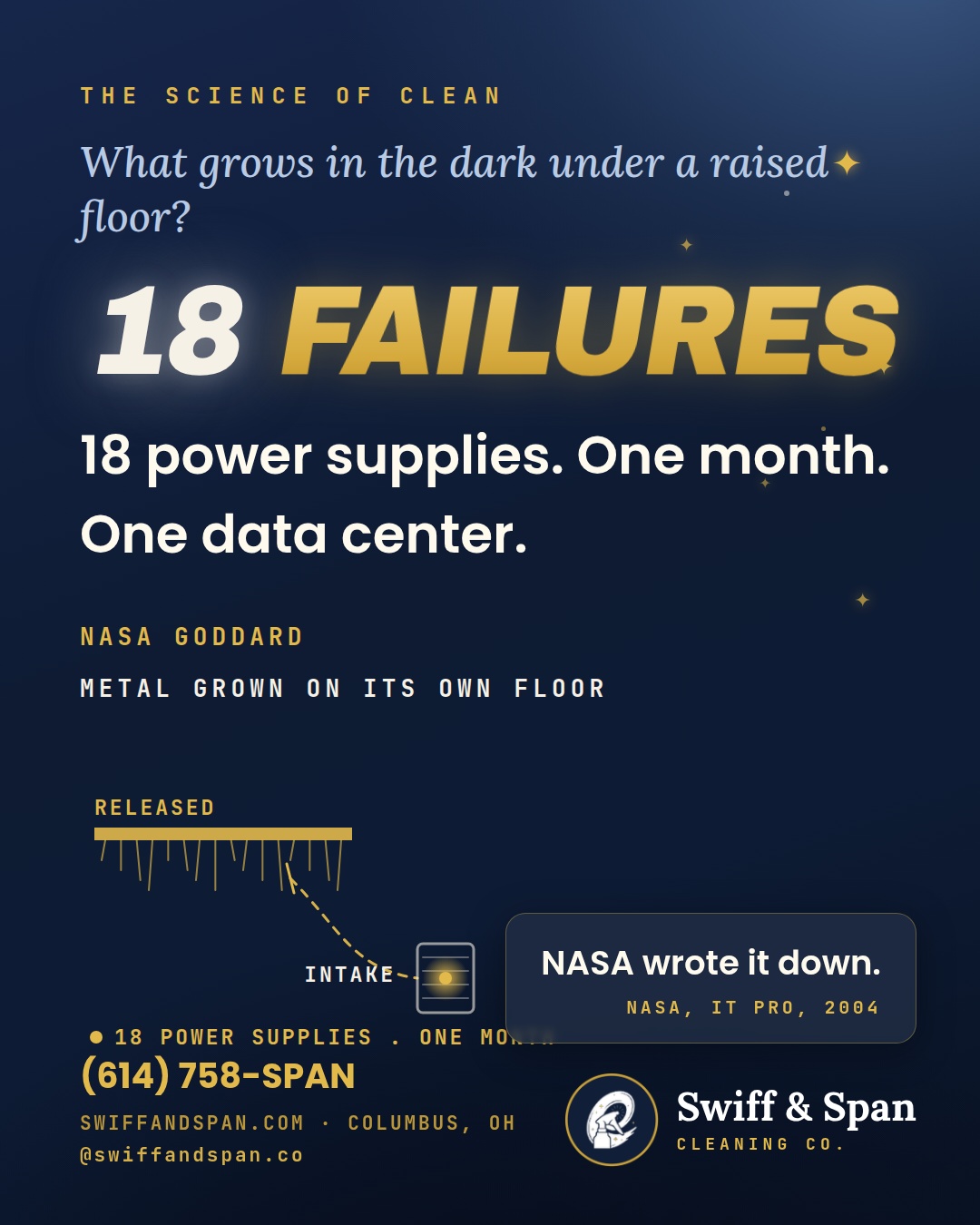
Then there is NASA's own house. At Goddard Space Flight Center, in a data center with floor tiles roughly 10 years old, Brusse and Sampson documented at least 18 catastrophic power supply failures in a single month.
18 power supplies. One month. At an organization staffed by people who wrote the papers on this failure mode.
A third case is a state Secretary of State's office data center incident, reported by the Denver Post and cited in NASA's 2004 IT Pro article. That is the extent of what is verifiable, so that is the extent of what gets said here.
The pattern in all three: the tiles were old. Whiskers had been incubating and growing for a decade or two before anything failed. The floor was not deteriorating suddenly. It had been loading itself, silently, the entire time.
What releases zinc whiskers into the air?
Whiskers growing on the underside of a tile are, by themselves, doing nothing to your equipment. They are attached. The failure sequence requires a second step, and this is the part that determines who is actually responsible for the risk.
The whiskers get dislodged. Tiles are lifted for a cable pull. A pedestal gets bumped. Someone slides a tile aside to trace a run and sets it down on its face. The mechanical disturbance frees the filaments, the underfloor plenum is a pressurized air supply by design, and the cooling system does exactly what it was engineered to do: it distributes airborne particulate evenly throughout the room and pulls it into equipment intakes.
The forced-air cooling system is the delivery mechanism. The person handling the floor is the trigger.
This is the operationally uncomfortable conclusion in NASA's guidance. The hazard is not created by the whiskers. It is created by untrained handling of the floor. Most janitorial crews working white space have never encountered the phrase "zinc whisker," which means the person most likely to disturb a tile at 2am is the person least equipped to know why it matters.
NASA's remediation guidance is specific: thorough cleaning of the data center environment using vacuums with HEPA filters, controlled removal of affected tiles, and replacement with aluminum or epoxy-coated steel. And a warning worth quoting exactly, because it kills the cheap fix: "Simply washing whisker-infested materials is not an effective long-term remedy. Whiskers can grow back."
ASHRAE TC 9.9's 2011 gaseous and particulate contamination guidelines put it in five words: "Data centers must be free of zinc whiskers." The prescribed detection method is a flashlight held at a low angle against the underside of a lifted tile. No instrument. A flashlight.
What cleanliness standard should a data center meet?
A data center should be cleaned and maintained to ISO 14644-1 Class 8. That is the level ASHRAE TC 9.9 recommends in its 2011 contamination guidelines, and it is what IBM states in its Power Systems environmental design criteria: "Data centers must meet the cleanliness level of ISO 14644-1 class 8."
ISO 14644-1:2015, second edition, defines Class 8 by cumulative particle count per cubic meter of air: a maximum of 3,520,000 particles at 0.5 micron or larger, 832,000 at 1.0 micron, and 29,300 at 5.0 micron. ASHRAE adds that room air may be continuously filtered with MERV 8 filters, and air entering the space filtered at MERV 11 or MERV 13.
That 3,520,000 figure sounds permissive until you notice it is per cubic meter and cumulative, and that everything your cleaning process lifts into the air counts against it.
Why does data center cleaning need HEPA?
No standard mandates HEPA vacuums in data center white space by name. What exists is NASA's peer-reviewed remediation guidance specifying vacuums with HEPA filters, and ASHRAE's ISO Class 8 target, which a conventional vacuum will actively work against by exhausting fine particulate back into a room that has no way to get rid of it.
The EPA, citing the Department of Energy definition, states that a HEPA filter can theoretically remove at least 99.97% of dust, pollen, mold, bacteria, and other airborne particles 0.3 microns in size. The counterintuitive detail: 0.3 micron is not the smallest thing a HEPA filter catches. It is the most penetrating particle size, the worst case. Larger particles get intercepted, smaller ones move erratically enough by diffusion to collide with fibers, and both are captured at higher efficiency than the 0.3 micron figure implies. The number you see quoted is the filter's weakest point, advertised as its headline.
What ESD limits apply to data center floors?
ANSI/ESD S20.20-2021, Table 3, sets flooring resistance limits below 1.0 x 10^9 ohms point to point and point to ground, with the same limit for worksurfaces.
What S20.20 does not contain is any requirement governing cleaning chemicals, wipes, or vacuums. There is no such thing as an S20.20 approved cleaner, and a data center white space is not automatically an ESD Protected Area. Anyone who tells you otherwise is selling something.
The real point is an engineering consequence, not a citation: any cleaning product that leaves an insulative film changes the measured resistance of the floor. A dissipative floor finished with the wrong general-purpose cleaner can measure outside the stated limit while looking cleaner than it did before. The chemistry is the variable. Nobody re-measures after a floor scrub.
There is also a personnel dimension. ASHRAE TC 9.9's 2015 storage equipment white paper ties low-humidity operation to mandatory ESD controls in a footnote: conductive flooring, grounded footwear for all personnel, conductive or dissipative mobile equipment, and wrist straps during hardware maintenance. "All personnel" includes whoever is walking a floor machine or a cart through your white space at 2am.
What else does ASHRAE TC 9.9 specify?
ASHRAE TC 9.9's 2011 guidance sets gaseous severity at ANSI/ISA 71.04 Class G1: copper reactivity under 300 angstroms per month, silver reactivity under 200. The recommended thermal envelope is 18 to 27 degrees Celsius, or 64.4 to 80.6 Fahrenheit.
The humidity criterion is the elegant one. The deliquescent relative humidity of settled particulate must be above 60%, meaning the dust on your boards must not be capable of absorbing enough atmospheric moisture to turn conductive. ASHRAE's practical translation: "Keeping the relative humidity in a data center below about 60% will keep the leakage current from settled fine dust within the acceptable sub-microamp range."
Dust that stays dry is inert. Dust that gets damp becomes a resistor you did not design in.
Your Next Concrete Move
If you operate or manage a facility in New Albany, Hilliard, Dublin, or Licking County, the first step costs nothing and takes an afternoon. Lift a tile in the oldest section of your floor, look at the underside at a low angle with a bright flashlight, and note the install date. If the plating is zinc and the tiles predate your tenure, you have an incubation clock you have never checked.
The second step is knowing what your cleaning crew does when they encounter that floor.
Swiff & Span Cleaning Co. is an OSHA and CDC conscious, ATP-Verified commercial cleaning company serving Columbus and central Ohio, and we offer a complimentary walkthrough of your facility.
Frequently Asked Questions
How do you inspect a raised floor for zinc whiskers?
Lift a tile in the oldest section of the floor and look at the underside at a low angle with a bright flashlight. That flashlight inspection is the detection method ASHRAE TC 9.9 prescribes, and no instrument is required. Note the install date while you are there, because whiskers incubate for months or years before anything fails, so the oldest tiles carry the most risk.
Can zinc whiskers be washed off instead of replacing the tiles?
No. NASA's guidance states that simply washing whisker-infested materials is not an effective long-term remedy because whiskers can grow back. Its remediation guidance calls for thorough cleaning of the data center environment using vacuums with HEPA filters, controlled removal of affected tiles, and replacement with aluminum or epoxy-coated steel.
Sources
- NASA Goddard Space Flight Center, Brusse 2003
- Brusse & Sampson, IT Pro, November/December 2004
- NASA NEPP (Electronic Parts and Packaging program)
- ASHRAE TC 9.9, 2011 Gaseous and Particulate Contamination Guidelines for Data Centers
- ISO 14644-1:2015
- ANSI/ESD S20.20-2021
- US EPA