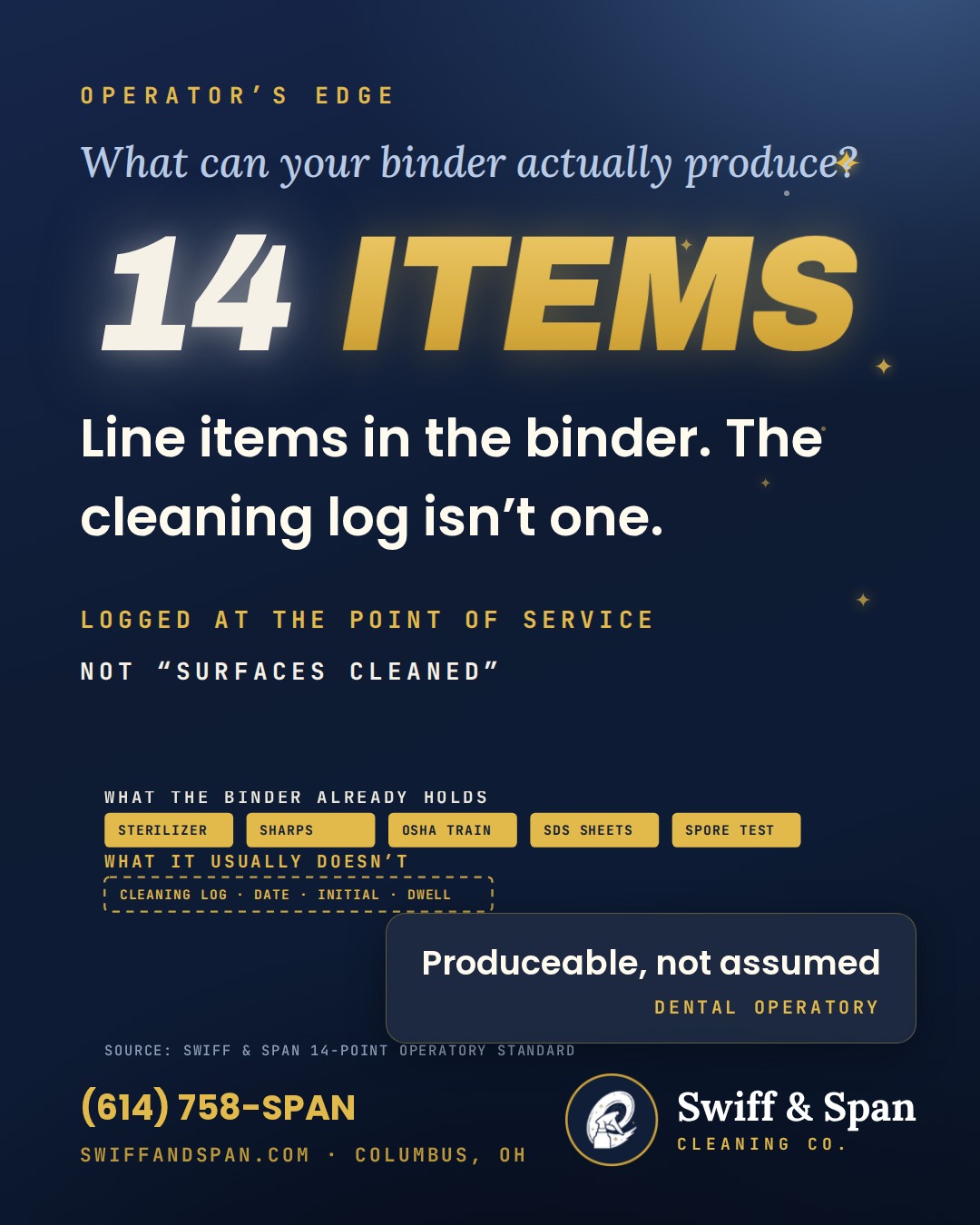
A dental practice’s compliance binder is, in most offices, in good order. Spore testing logs for the autoclave, printed and initialed on schedule. Sharps disposal records with pickup dates attached. OSHA bloodborne pathogen training sign-off sheets, one per staff member, current. Safety data sheets for every product in the supply closet. Autoclave monitoring strips taped in with a date and a pass mark next to them. Ask a practice manager to produce any one of these and a hand goes on it in under a minute.
Ask for the record of what happened to Operatory 3 between the 2:00 and 2:30 patients on a Tuesday, and the binder usually has nothing to show.
That gap has little to do with whether the room got wiped down. It almost certainly did. It has to do with whether there is a line for it: a date, a set of initials, the product used, and how long it sat wet on the surface. An inspector does not walk into a room and judge whether it looks clean. They ask to see the record. And the one part of the room most practices cannot produce a record for is the cleaning itself.
What the binder is already built to answer
Most of what sits in a dental compliance binder traces back to a specific, published requirement. OSHA’s bloodborne pathogen standard is why the training sign-off sheets exist. Sharps disposal rules are why the pickup log has a date column. Autoclave monitoring is a sterilization assurance step most state dental boards expect a practice to be able to show. None of that is optional, and none of it is new to anyone reading this.
CDC’s infection control guidance for dental health care settings places environmental surface disinfection inside the same framework as hand hygiene, personal protective equipment, sharps safety, and instrument sterilization. It calls for a written protocol and staff who follow it. What it does not do is hand a practice a log template. The guidance describes the practice. It leaves the paperwork up to the office. That is a reasonable thing to leave open, and it is also exactly where a written policy quietly becomes an unwritten routine.
The paperwork that already exists
- Spore testing log for the autoclave, dated and initialed
- Sharps container disposal records with pickup dates
- OSHA bloodborne pathogen training sign-off sheets, current per staff member
- Safety data sheets for every chemical on the premises
- Autoclave monitoring strips or printouts, filed with a pass mark
Each of these answers a direct question a state board or an OSHA compliance officer can ask on a walk-through. They exist because someone, at some point, built the form.
The line that is usually missing
Terminal cleaning between patients rarely has an equivalent line. No date. No initials. No note on which EPA-registered disinfectant was used or whether it sat on the surface for its full dwell time. The room gets cleaned. What does not get recorded is that it happened, who did it, and how.
The question worth asking before an inspector does
If your OSHA binder or an ADA quality review ever gets pulled, ask a plain question first: could someone reconstruct the last week of operatory turnovers, room by room, from paper alone? Not “was the room clean,” which nobody can verify after the fact anyway, but “is there a written trail that says a terminal clean happened on this date, at this time, with this product, held for its full dwell time.” For a lot of practices, the honest answer is no, not because the cleaning was skipped, but because nobody built a place to write it down.
This is the same insight that shapes the rest of the binder. A spore test that nobody logs is functionally invisible to an inspector, even if the autoclave ran perfectly. A terminal clean that nobody logs sits in exactly the same spot.
Our answer: a 14-point operatory standard, logged at the point of service
We built our own 14-point operatory cleaning standard so a terminal clean leaves the same kind of paper trail the sterilizer already leaves. It gets logged and initialed at the point of service, room by room, the same day the clean happens.
| # | Point | What it captures |
|---|---|---|
| 1 | Date and time | When the terminal clean happened, tied to the appointment block it followed |
| 2 | Staff initials | Who performed the clean, matched against training already on file |
| 3 | Product used | The EPA-registered disinfectant applied, by name |
| 4 | Dwell time held | How long the product stayed wet on the surface, not just when it was applied |
| 5 | Clean-to-dirty sequence | Surfaces worked in the same top-down, clean-first order every time |
| 6 | Barrier surfaces changed | Which barriers were pulled and replaced rather than wiped |
| 7 | Dental chair | Headrest, armrests, and chair-side switches |
| 8 | Light handles | Handle and switch surfaces on the operatory light |
| 9 | Delivery unit and bracket tray | Tray and hose surfaces within reach of the patient |
| 10 | Countertops and cabinet pulls | Work surfaces and the hardware hands touch to open them |
| 11 | Sink and faucet handles | Wet-hand contact points at the operatory sink |
| 12 | Sensor housings and peripherals | X-ray sensor housing, keyboard, mouse, and monitor touched mid-appointment |
| 13 | Cloth used | Color-coded microfiber assigned to the operatory, never carried into a restroom |
| 14 | Re-clean note | Whether a surface needed a second pass before the room was marked ready |
The first five points are the ones a binder audit actually checks: who, when, with what, for how long, in what order. The next eight are the operatory itself, broken into the specific surfaces a patient or a clinician touches inside a single appointment, so nothing gets waved through under a general “surfaces cleaned” line. The last point is the honest one: if a surface needed a second pass, the log says so, rather than quietly disappearing.
Where this sits next to what a practice already runs
None of this is a substitute for anything already in the binder, and it does not claim to be. A cleaning log does not make a practice compliant with OSHA, HIPAA, or the ADA on its own, any more than one spore test makes an autoclave permanently trustworthy. What it does is put the terminal clean on the same footing as the rest of the infection control program: an OSHA-Aware, CDC-informed protocol that is written down, dated, and produceable, not just a room that looked fine on the way out.
For practices in Upper Arlington and across Columbus that already run tight autoclave and sharps documentation, the terminal clean is often the one habit built entirely on trust rather than paper. A two-bucket method and color-coded microfiber protect the room from cross-contamination between the operatory and everywhere else in the office. A logged dwell time protects the practice from having to take anyone’s word for it later. Both matter. Only one of them has, until now, had a line in the binder.
There is a second reason to want the log, and it has nothing to do with inspections. Cleaning vendors change. Crews change inside a vendor. When the only record of how a room was terminal cleaned lives in the habits of whoever held the cloth, that knowledge walks out with them, and the practice starts over teaching the standard to someone new. A written, initialed log is the part of the arrangement that stays with the practice rather than with the contractor.
Frequently Asked Questions
Does OSHA require a written log of operatory cleaning between patients?
OSHA's bloodborne pathogen standard requires a written exposure control plan and documented decontamination of surfaces after contact with blood or other potentially infectious materials, but it does not specify a per-appointment log format. Many practices meet the letter of the standard with a general policy and still have no record of which room was cleaned, when, or with what. A log closes that gap without changing what the standard already requires.
What does CDC guidance say about documenting dental operatory cleaning?
CDC's infection control recommendations for dental settings place environmental surface disinfection inside the same standard precautions framework as hand hygiene and instrument sterilization, and call for a written protocol staff follow consistently. The guidance describes the practice itself, not a required paperwork format, which is why so much of it lives as routine rather than as a dated, initialed record a practice can hand over.
Does a cleaning log make a dental practice compliant?
No single log makes a practice compliant with anything on its own. A terminal cleaning record is one piece of documentation supporting an OSHA-Aware, CDC-informed infection control program, the same way a spore test supports sterilization assurance rather than proving it outright. Compliance is a determination made by the relevant agency or inspector, not a claim a cleaning log or a cleaning company can issue.
How does Swiff & Span log operatory terminal cleaning?
Our 14-point operatory standard is logged and initialed at the point of service, recording the date, the product used, the dwell time held, and each surface cleaned inside the room, from the chair and light handles to sensor housings and countertops. It is built to sit next to a practice's sterilization and OSHA paperwork, so the terminal clean carries the same kind of documentation as a spore test.
Who should keep the operatory cleaning log, the practice or the cleaning provider?
Either can, as long as one party owns it consistently. Some practices keep the log at the front desk and have the cleaning team initial it in person after each appointment block. Others ask their cleaning provider to maintain and date the record and hand over copies on request. What matters for an inspection is that the log exists and can be produced, not which desk it lives on.
Every Columbus dental, medical, wellness, and commercial facility gets the same offer: a complimentary 30-minute ATP walkthrough. We swab your highest-touch surfaces, on the spot, and hand you the readings. No obligation, no pitch required to see the number. Book your complimentary ATP walkthrough or text (614) 758-SPAN.
Erik Kuusisto, Owner
Swiff & Span Cleaning Company