Stand in the lobby of any medical office building in Columbus for ten minutes and count the hands. The oncology patient on the third floor, the parent with a toddler headed to pediatrics, the pharmaceutical rep, the courier, the tenant’s own staff coming back from lunch. Every one of them presses the same button. Then they touch a door handle, a check-in pen, a chair arm, and eventually their own face.
In 2014 three infectious disease researchers in Toronto decided to find out what was living on that button. Christopher Kandel, Andrew Simor and Donald Redelmeier swabbed 120 elevator buttons and 96 toilet surfaces across three large urban teaching hospitals and cultured everything they collected. The results ran in the journal Open Medicine.
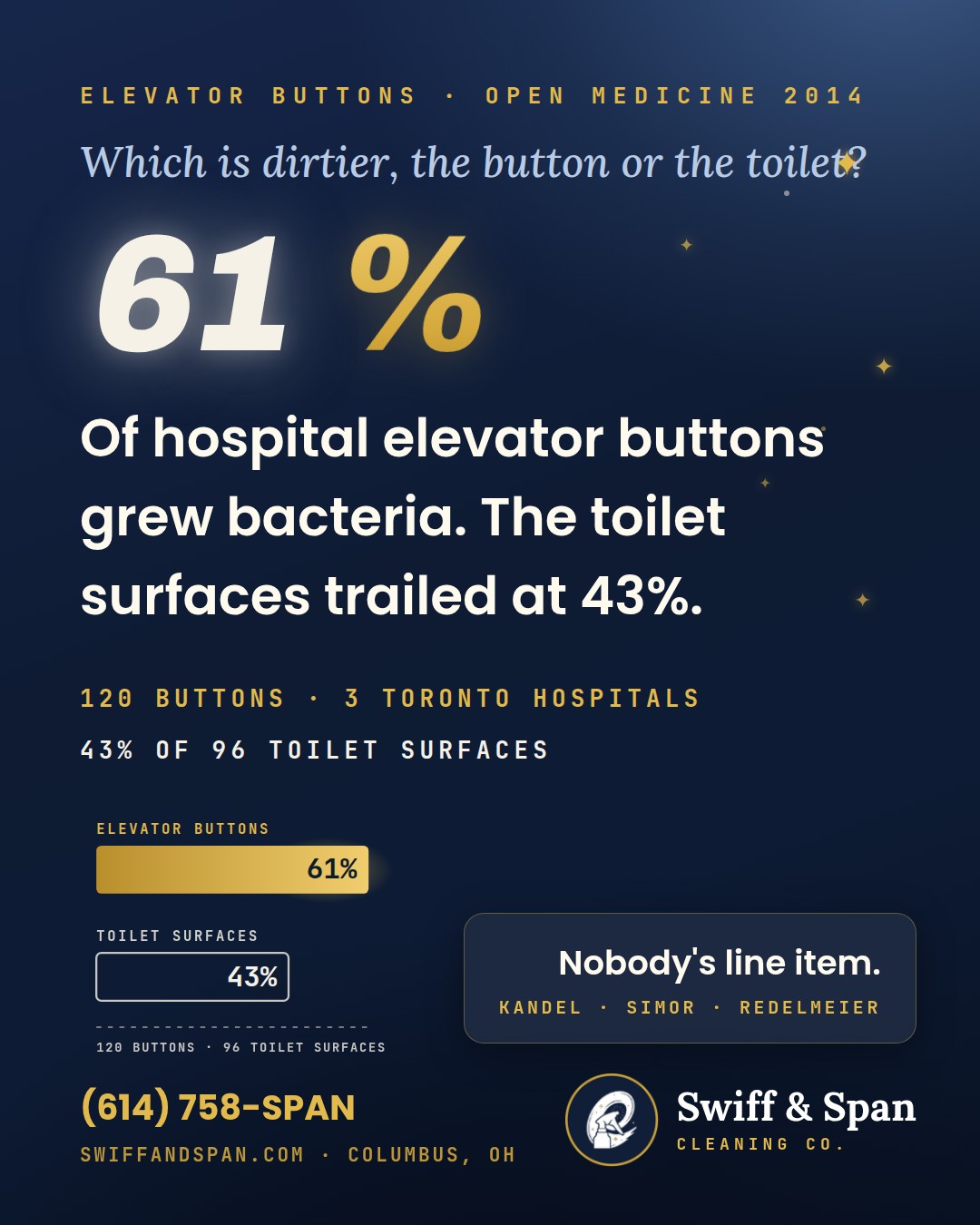
The buttons lost. 61% of the elevator buttons grew bacteria. 43% of the toilet surfaces did. The difference was not noise: the p value came in at 0.008.
What the study actually did
The team sampled buttons inside the cabs and on the call panels outside them, on weekdays and weekends, at different times of day. The 61% figure held steady no matter where the button was, which day it was swabbed, or what time. This was not one bad elevator on one bad afternoon. It was the baseline.
What grew was mostly ordinary. The most common organism was coagulase-negative staphylococci, the skin bacteria every human carries. Streptococcus and Pseudomonas species showed up behind it. The authors said plainly that most of what they found was not clinically relevant, and that deserves to be said just as plainly here. Nobody should read this and picture an outbreak riding the elevator.
Read it instead as a study about attention. In a hospital, the toilet is a monitored surface. It has a cleaning cadence, a product, a checklist line and a supervisor who walks past it. The elevator button is touched by more people than any toilet in the building and belongs to nobody. That is why the toilet won.
Attention follows the checklist
We have written about this pattern before. In office buildings, the break room faucet handle failed an ATP test 75% of the time while the restroom scored better, for the same reason: restrooms generate complaints, so they get minutes and product. Nobody complains about an elevator button. It never looks dirty. Stainless steel hides fingerprints from across a lobby, and a button that works is a button nobody thinks about.
So the button lives outside the scope. Pull the common-area cleaning agreement for most medical office buildings in Dublin, Worthington or Upper Arlington and you will find the lobby floor, the glass, the restrooms and the trash. You will rarely find the words “elevator call panel, every floor, nightly.” When a surface is not written down, it is cleaned when someone remembers, with whatever cloth is in their hand.
And that cloth matters. If the crew works the restroom first and the elevator second with the same rag, the elevator is not being cleaned. It is being seasoned.
Why a medical office building is different from an office tower
A downtown office tower fills its elevator with healthy adults on the way to a desk. A medical office building fills its elevator with the people the tenants exist to treat. Infusion patients, dialysis patients, post-surgical follow-ups, newborns, people on immunosuppressants. The Spaulding classification the CDC still uses calls a button a noncritical surface, because it touches intact skin. Noncritical is a risk class, not a ranking. The same CDC guidance names frequently touched surfaces as the route by which hands and equipment get contaminated, and the elevator button is the most frequently touched surface in the building.
The tenant practices cannot fix this. Their scope stops at the suite door. The property manager owns the common areas, and the common areas are where the building’s cleanliness is judged, by every patient, before they ever reach a waiting room. A practice can run a flawless operatory and still hand its patients a lobby that has not been written down.
What the authors recommended
Kandel and his colleagues suggested the fixes an engineer would: larger buttons that can be pressed with an elbow, touchless sensors, alcohol-based hand sanitizer mounted beside the elevator, and signage. Good ideas, all of them, and most buildings will get to none of them this year.
A cleaning scope can do something tonight. Four lines.
- Name the surface. Elevator call panel on every floor, the button panel inside every cab, and the door edges at hand height. Written as a line item, not implied by “lobby.”
- State a cadence that matches traffic. Nightly at minimum. In a building with an infusion center or a dialysis suite, a midday pass on the ground floor and clinic floors during the season.
- Name the product and the time. An EPA-registered hospital disinfectant, with its registration number in the scope and the surface kept wet for the labeled contact time. On brushed stainless that usually means a wipe, a wait and a second wipe, not a spray and a swipe.
- Separate the cloth. Color-coded microfiber, with the elevator cloth never having been in a restroom. If the crew cannot tell you which color goes where, they are using one.
How we check it
A scope tells you what was supposed to happen. A reading tells you what did. On a complimentary ATP walkthrough of a medical office building, the ground-floor call panel is one of the first surfaces we swab, because it is the one surface every tenant shares and the one most likely to have been skipped.
ATP testing measures adenosine triphosphate, the energy molecule in every living cell, and reports it in relative light units in about fifteen seconds. It does not count germs and it does not prove disinfection. What it tells you is whether the cleaning step removed what hands left behind, and cleaning is the step that has to succeed before any disinfectant can do its job. A button that reads high after the nightly service was wiped, at best. The number is yours whether you hire us or not.
The one-sentence version for your property manager
Three hospitals swabbed their elevators and found bacteria on 61% of the buttons, more than on the toilets, and the fix is a line in the cleaning scope that costs nothing to write. Send that, and ask which cloth touches the button.
Frequently asked questions
Are hospital elevator buttons dangerous?
The Toronto study found bacteria on 61% of elevator buttons, but the authors were clear that most organisms were common skin bacteria with little clinical relevance. The finding is about attention, not alarm: a surface touched by every visitor was cleaned less reliably than the toilet.
Why did the toilet surfaces score better than the buttons?
Restrooms have a line in every cleaning scope, a checklist and a cadence, so they get product and minutes every night. Elevator call panels are rarely named in a common-area scope, so they are wiped when someone remembers. Attention follows the checklist, and the checklist follows complaints.
What should a medical office building cleaning scope say about elevators?
Name the surfaces: the call panel on every floor and the button panel inside each cab. State a cadence that matches traffic, an EPA-registered disinfectant with its labeled contact time, a dedicated microfiber cloth that never comes from the restroom kit, and a verification method.
Does an ATP reading tell me the button is disinfected?
No. ATP measures organic residue in relative light units, not germs and not chemical activity. A high reading on a button means the cleaning step left residue behind, which is the step that has to succeed before any disinfectant can work. It is a cleaning check, not a sterility claim.
Every Columbus medical, dental, wellness, and commercial facility gets the same offer: a complimentary 30-minute ATP walkthrough. We swab your highest-touch surfaces, on the spot, and hand you the readings. No obligation, no pitch required to see the number. Book your complimentary ATP walkthrough or text (614) 758-SPAN.
Erik Kuusisto, Owner
Swiff & Span Cleaning Company
Sources
- Kandel CE, Simor AE, Redelmeier DA. Elevator buttons as unrecognized sources of bacterial colonization in hospitals. Open Medicine. 2014;8(3):e81-e86. PMID 25426176.
- CDC. Guideline for Disinfection and Sterilization in Healthcare Facilities: the Spaulding classification and environmental surfaces.