A research team led by Dr. Charles Gerba at the University of Arizona swabbed close to 5,000 surfaces in office buildings that house roughly 3,000 workers. Law firms. Insurance companies. Manufacturers. Call centers. Healthcare firms. The kind of buildings we walk through every week in Columbus.
They did not judge those surfaces by sight or smell. They used ATP meters, the same instrument we carry on every walkthrough, which reads the organic residue left on a surface and reports it as a number in relative light units. In that study, a reading of 300 or higher flagged a surface the researchers considered at high risk for passing illness around an office, and 100 to 300 marked the caution zone.
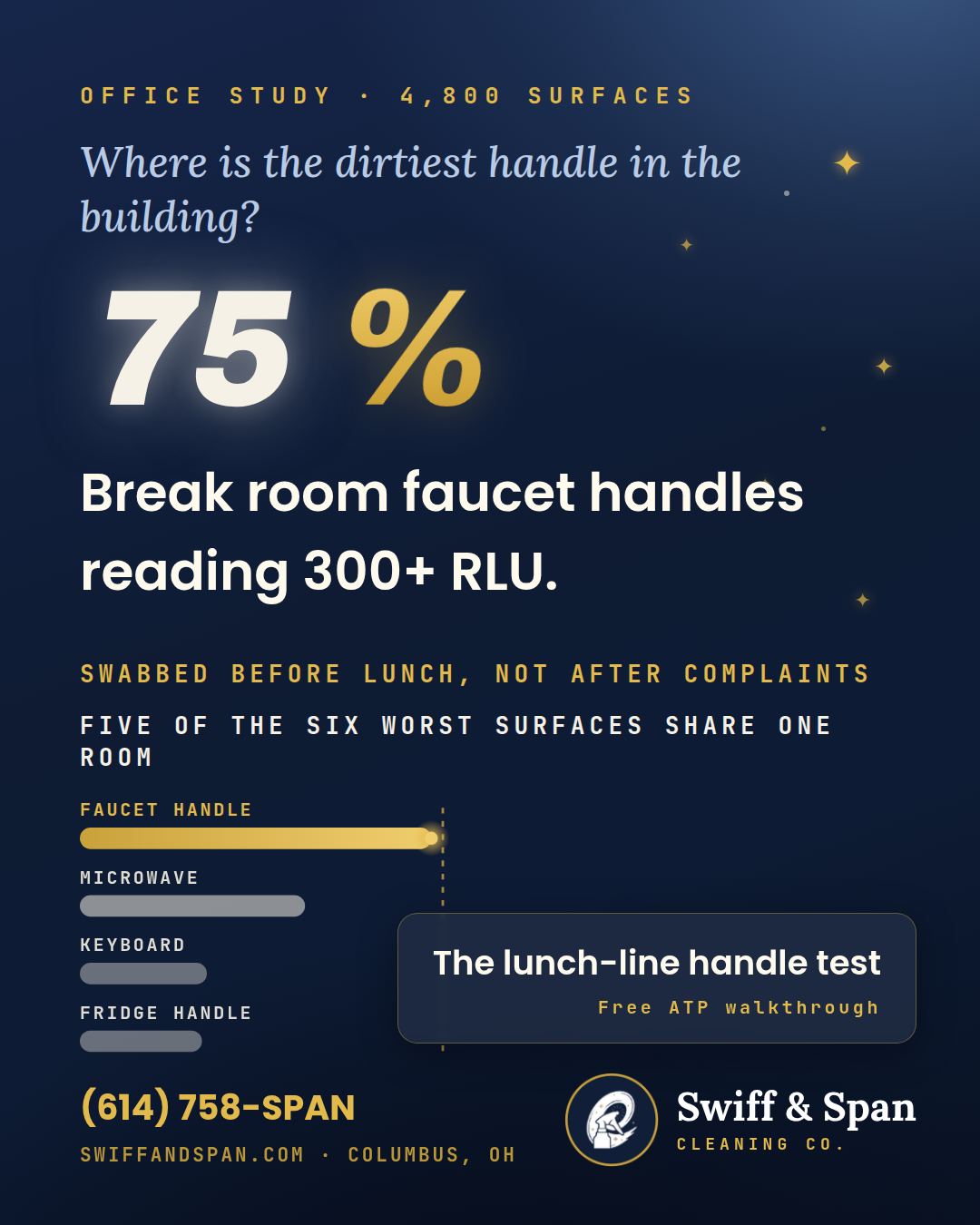
The worst surface category in the entire data set was not in the restroom. It was the break room sink faucet handle. Seventy-five percent of them read 300 or above.
The restroom gets the attention. The break room gets the traffic.
Think about how your building’s cleaning scope is written. The restroom has its own section. Named fixtures, named chemicals, a daily cadence, sometimes twice daily. It earns that attention the same way it always has: restrooms generate complaints, and complaints write checklists.
Now find the break room in that same scope. In most contracts we review on walkthroughs, it gets a line like wipe counters, empty trash, mop floor. The sink faucet, the microwave handle, the refrigerator door, the vending buttons, the coffee pot handle usually appear nowhere at all.
The traffic tells a different story. Nearly everyone in the building touches the break room at least once a day, right before they eat. The restroom ends in a handwash. The break room starts a meal.
What the numbers said, surface by surface
The study published the failure rates, meaning the share of each surface type reading 300 RLU or higher:
| Surface | Share reading 300+ |
|---|---|
| Break room sink faucet handles | 75% |
| Microwave door handles | 48% |
| Keyboards | 27% |
| Refrigerator door handles | 26% |
| Water fountain buttons | 23% |
| Vending machine buttons | 21% |
Read that list top to bottom and one pattern jumps out. Five of the six worst surfaces live in or next to the break room, and every one of them is a handle or a button. Small, gripped, shared, and invisible on a walkthrough that relies on eyes.
A faucet handle is the mechanically perfect offender. It is the one object everyone touches with unwashed hands, on purpose, right before food. The handle collects what every hand brings, and a paper towel pass at the end of the day does not reset it.
An ATP number is residue, not a diagnosis
We want to be precise about what those readings mean, because the precision is the point. An ATP meter measures adenosine triphosphate, the energy molecule in organic material. Food film, skin oils, and microbial residue all contribute. A high reading does not tell you which organisms are present. It tells you the surface is carrying organic soil, which is both a food source and a hiding place, and that whatever cleaning was supposed to happen there did not remove it.
That is exactly why the instrument is useful to a building manager. You do not need a lab culture to make a purchasing decision. You need to know whether the surfaces your people touch before lunch are actually being cleaned, and residue is the honest witness. Low number, the wipe happened and worked. High number, it did not, no matter what the schedule says. We walked through the mechanics of the instrument in what ATP testing actually measures.
Why your current vendor’s checklist misses this
Nobody wrote the break room out of the scope on purpose. Scopes grow from complaints, and the break room rarely generates one. It looks fine. Crumbs get noticed and wiped. The counters shine. The floor gets mopped. Every visible signal reads clean, so the room earns two minutes and the crew moves on to the restroom, where the complaints live.
The study result is what that logic produces after a few years: the most complained-about room in the building carrying better numbers than the room where everyone eats. Attention works. The restroom proves it. The break room just never got any.
There is a second reason, and it is structural. A scope written per square foot prices floors, because floors are where the square footage is. A faucet handle is maybe four square inches. On a per-square-foot bid it rounds to zero, so it gets rounded to zero minutes. We took that pricing problem apart in what a per square foot bid actually prices.
What a fix looks like, in one visit
This is not a rip-up-the-contract problem. It is a scope amendment and a verification habit.
- Name the six surfaces. Faucet handles, microwave handle, refrigerator handles, coffee equipment, vending and fountain buttons, and the door hardware into the room. Once they are named, they get minutes.
- Put them on daily cadence with a proper wipe, full wetted contact, not a dry pass. These are ten-second tasks once they are on the list.
- Verify with a number. Swab three of them monthly. The reading takes fifteen seconds per surface, and the trend line tells you whether the amendment is being worked or just filed.
When we run a walkthrough in a Columbus office building, the break room faucet is one of the first swabs we take, because it is the fastest way to show a facilities manager the gap between looks clean and reads clean. The meter does the arguing for us.
Frequently Asked Questions
What is a normal ATP reading for an office break room surface?
On the scale used in the office study, under 100 RLU is the target for a cleaned surface, 100 to 300 is a caution zone, and 300 or higher flags a fail. Meters vary by manufacturer, so the comparison that matters most is the same surface, same meter, over time.
Does a high ATP reading mean people will get sick?
Not by itself. ATP measures organic residue, not specific germs. The study treated 300+ as a high-risk marker because heavy residue means cleaning is not removing what hands leave behind, and shared handles touched before eating are an efficient route for whatever is circulating in the building.
How often should break room touch points be cleaned?
Daily, minimum, and the six handle-and-button surfaces should be listed by name in the cleaning scope. Surfaces touched by many hands right before food justify the same cadence a restroom fixture gets.
Can I test my own building without hiring anyone?
Yes. Handheld ATP meters and swabs are commercially available. Or ask us to do it for free: our 30-minute ATP walkthrough swabs your highest-touch surfaces, including the break room, and you keep the readings whether or not we ever clean the building.
Every Columbus dental, medical, wellness, and commercial facility gets the same offer: a complimentary 30-minute ATP walkthrough. We swab your highest-touch surfaces, on the spot, and hand you the readings. No obligation, no pitch required to see the number. Book your complimentary ATP walkthrough or text (614) 758-SPAN.
Erik Kuusisto, Owner
Swiff & Span Cleaning Company