Ask a practice manager who cleans the endoscopes and you will get a precise answer: a trained person, a validated process, a log. Ask who cleans the exam room counter and the answer is usually a company name and a shrug. The gap between those two answers is not carelessness. It is a framework doing exactly what it was designed to do, and almost nobody outside infection control has read it.
Earle Spaulding was a microbiologist at Temple University. He first proposed his system in 1939 and formalized it in 1957. The idea is simple enough to fit on an index card: sort every item that touches a patient by how much harm it could do if it were contaminated, then match the level of disinfection to the risk. The CDC still builds its Guideline for Disinfection and Sterilization in Healthcare Facilities on it, and calls it so clear and logical that it has been retained, refined, and successfully used for decades.
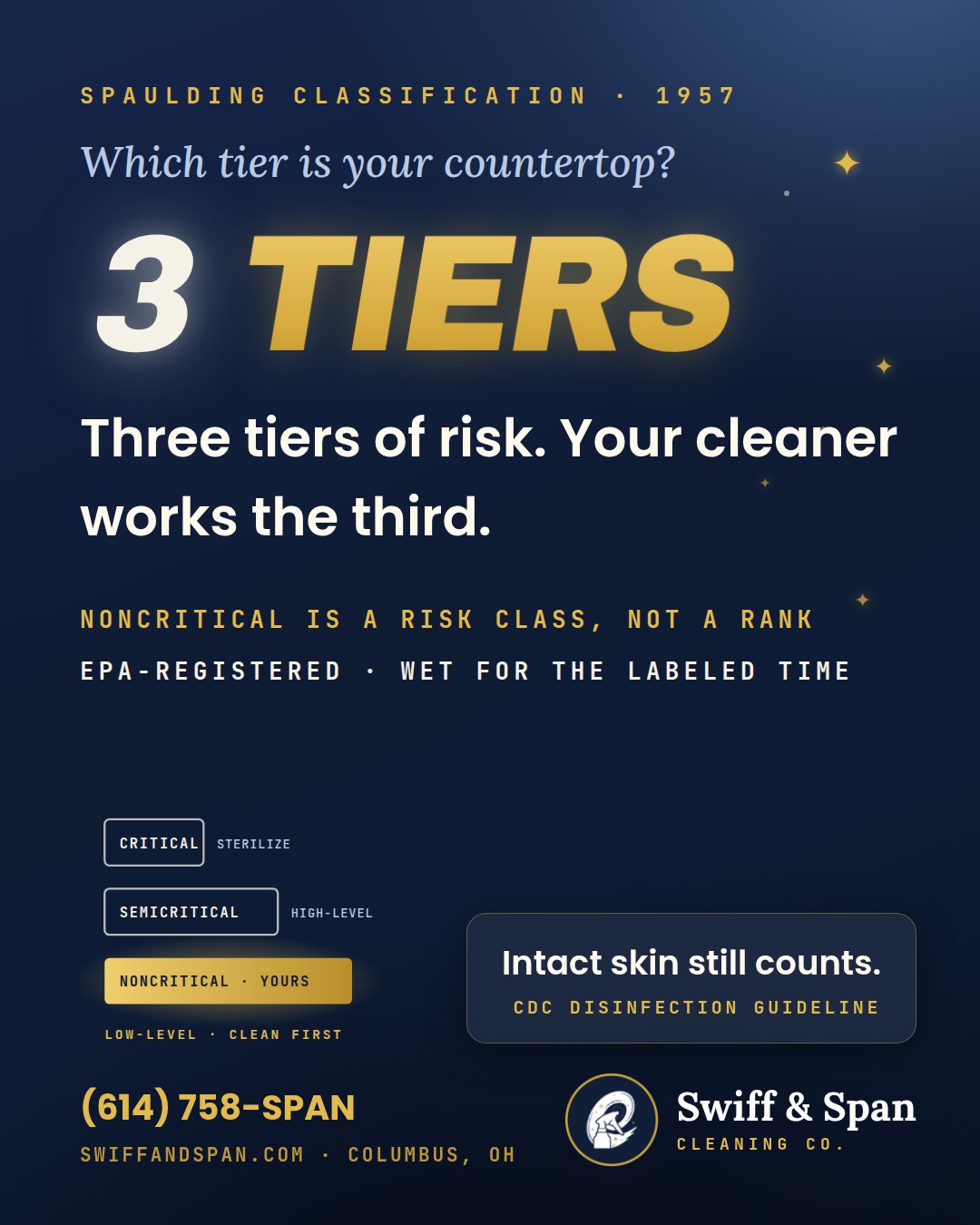
The 3 tiers
| Tier | What it touches | Minimum process | Examples |
|---|---|---|---|
| Critical | Sterile tissue or the bloodstream | Sterilization | Surgical instruments, implants, dental burs |
| Semicritical | Mucous membranes or non-intact skin | High-level disinfection | Endoscopes, laryngoscope blades, ultrasound probes |
| Noncritical | Intact skin only | Low- or intermediate-level disinfection | Blood pressure cuffs, bed rails, counters, floors |
The first two tiers are clinical work. They happen in a reprocessing room with FDA-cleared chemistry, exposure times measured in minutes, and a training requirement. The CDC notes that some hospitals require a three-hour class before a staff member is allowed to high-level disinfect a probe.
The third tier is where your cleaning company lives. Every counter, every chair arm, every door handle, the exam table, the floor, the sink, the light switch. Noncritical.
Noncritical is a risk category, not a priority ranking
Here is where the word does damage. Noncritical sounds like unimportant, and a cleaning vendor who has heard the word once will use it that way. Spaulding meant something narrower. A noncritical item touches intact skin, and intact skin is a good barrier. The CDC states that virtually no risk has been documented for transmission of infectious agents to patients through noncritical items when they are used as noncritical items and do not contact non-intact skin or mucous membranes.
Read the qualifier. When they are used as noncritical items. A counter does not infect anyone by being a counter. The same guideline, one paragraph later, explains the route that does matter: noncritical environmental surfaces frequently touched by hand can contribute to secondary transmission by contaminating the hands of healthcare workers, or by contacting medical equipment that then contacts patients.
So the counter is not the risk. The hand that touches the counter, then the cuff, then the patient, is the risk. The third tier exists because the first two tiers depend on it. Nobody sterilizes an instrument and then sets it down on a surface they trust because it looked fine.
What the third tier actually specifies
The CDC guideline is more specific about noncritical surfaces than most cleaning contracts are.
- The product is an EPA-registered hospital disinfectant. Low-level means it carries no tuberculocidal claim. Intermediate-level means it does. Both are regulated by the EPA, not the FDA, and both require the surface to stay wet for the labeled contact time, which for low-level products the guideline lists as at least one minute.
- Cleaning comes first. A disinfectant applied over visible soil is working on the soil, not the surface. The guideline is blunt that meticulous cleaning must precede any disinfection process, at every tier.
- Frequency follows hand contact. The guideline splits noncritical surfaces by how often hands touch them. High-touch surfaces such as bed rails, door knobs, and light switches get more frequent attention than walls and floors.
- In dental settings the CDC goes one step further and divides noncritical surfaces into clinical contact surfaces, which are likely to be hit by spray or spatter during a procedure, and housekeeping surfaces such as floors, walls, and sinks. Clinical contact surfaces get a barrier or a hospital disinfectant after every patient. Housekeeping surfaces get a schedule.
Now compare that to the line in most cleaning scopes we review on Columbus walkthroughs: wipe down exam rooms. No product named. No contact time. No distinction between the counter the cuff sits on and the wall behind it. The clinical staff are running a 1957 framework with a training log. The cleaning vendor is running a sentence.
The handoff nobody wrote down
In a private practice, the third tier is split between two teams that rarely speak. Clinical staff handle the between-patient wipe of the exam table and the cuff, because the CDC says noncritical patient-care items can be decontaminated where they are used. The evening crew handles everything else. The exam table gets wiped twice a day by two different people with two different products, and the counter underneath the glove box gets wiped by nobody, because each team assumes it belongs to the other.
We see this on almost every walkthrough. The surfaces with the highest readings are rarely the ones anyone considers dirty. They are the ones that fell into the gap between the clinical wipe and the janitorial wipe. The keyboard on the rolling cart. The back of the exam room door. The underside of the counter lip where every hand rests while someone types.
What we bring to a medical office scope
Our answer is to write the third tier down the way the first two are written down.
- A named product with its EPA registration number, and the contact time from its label, in the scope. Not hospital-grade. A number.
- A surface list for each room type, split the way the CDC splits it: clinical contact surfaces the clinical team owns, housekeeping surfaces we own, and a short list of shared high-touch surfaces where both teams wipe and neither assumes.
- Cadence by hand contact. Door hardware, light switches, counter edges and chair arms daily. Walls and vents on a stated periodic schedule, not annually by default.
- Verification with a number. An ATP meter reads organic residue in relative light units. It does not tell us which tier a surface belongs to, and it does not diagnose anything. It tells us whether the wipe removed what hands left behind, and it does that in 15 seconds, on site, in front of the practice manager.
Spaulding built a framework where the level of effort matches the level of risk. Noncritical surfaces get the lowest level of chemistry because intact skin is a good barrier. They still get a level. The failure we see is not that practices treat counters like endoscopes. It is that the third tier gets treated like it has no requirements at all, when the same guideline that defines it spells them out. If you want to know what the counter reads before and after your current crew works it, that is what the walkthrough is for. We covered the chemistry side of this in what hospital-grade actually means.
Frequently Asked Questions
Is a noncritical surface safe to ignore?
No. The CDC classifies counters, chairs, bed rails and floors as noncritical because they touch intact skin, and documents very low direct transmission risk from them when used that way. The same guideline identifies frequently touched noncritical surfaces as a route for contaminating hands and equipment, which is why they are assigned a disinfectant class and a cadence.
What is the difference between a low-level and an intermediate-level disinfectant?
Both are EPA-registered hospital disinfectants. An intermediate-level product carries a tuberculocidal claim on its label; a low-level product does not. The CDC dental guidance calls for intermediate-level when a surface is visibly contaminated with blood, and either level for routine clinical contact surfaces.
Who should clean the exam table in a medical office?
The clinical team between patients, because the CDC allows noncritical patient-care items to be decontaminated where they are used. The evening cleaning crew handles the room’s housekeeping surfaces and a stated list of shared high-touch surfaces. The scope should say which team owns which surface, in writing.
Does ATP testing tell me whether a surface was disinfected?
No. ATP measures organic residue, not germs or chemical activity. It tells you whether the cleaning step removed what hands and use left behind, which is the step the CDC requires before any disinfectant can do its job.
Every Columbus medical, dental, wellness, and commercial facility gets the same offer: a complimentary 30-minute ATP walkthrough. We swab your highest-touch surfaces, on the spot, and hand you the readings. No obligation, no pitch required to see the number. Book your complimentary ATP walkthrough or text (614) 758-SPAN.
Erik Kuusisto, Owner
Swiff & Span Cleaning Company