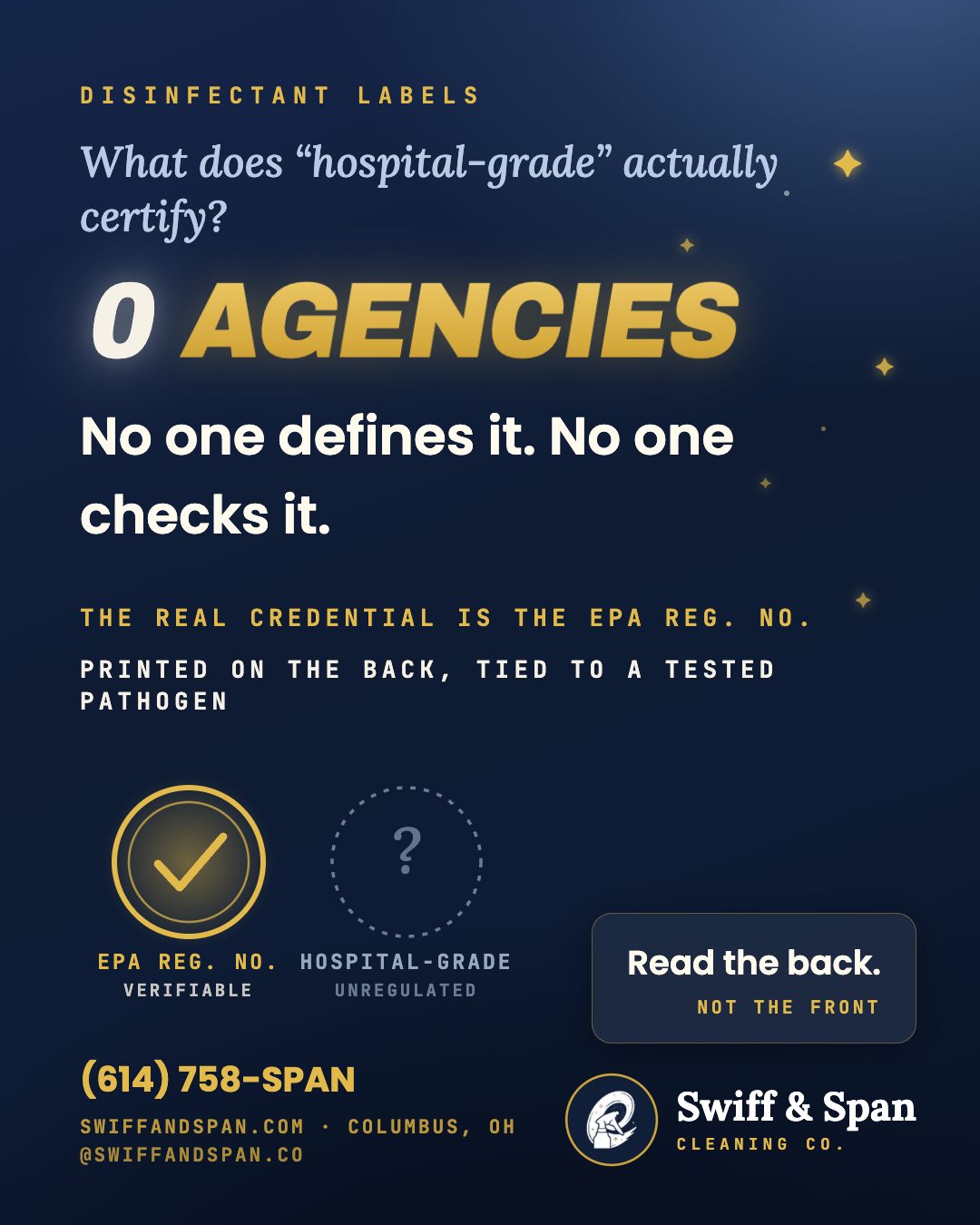
“Hospital-grade” is a marketing phrase, not a regulated category. No federal agency defines it, certifies it, or checks a manufacturer’s claim before it goes on a label, which means any company selling a spray bottle can call it hospital-grade, whether or not the product has ever been near a hospital. What does carry legal weight is the EPA registration number printed on the back of that same bottle, tied to specific, tested pathogens and a required contact time. One of those phrases is designed to make you feel confident. The other is designed to be checked.
I’ve walked into more than a few medical and dental offices around Dublin and New Albany where the disinfectant on the supply shelf was chosen because the label says “hospital-grade” in bold letters on the front, right above a generic name nobody would recognize. It’s an understandable instinct, the phrase sounds authoritative, and it usually sits next to products that don’t say it, which makes it feel like a meaningful upgrade. It might be. It might also mean nothing at all. There’s no way to know from that phrase alone, and that’s exactly the problem worth explaining.
Who actually regulates disinfectant claims?
In the United States, disinfectants are regulated as antimicrobial pesticides by the Environmental Protection Agency under the Federal Insecticide, Fungicide, and Rodenticide Act. Before a manufacturer can claim a product kills a specific pathogen, they have to submit efficacy data to the EPA and receive an EPA registration number, an EPA Reg. No., formatted as a set of digits separated by dashes, printed on the label. That number is the actual credential. “Hospital-grade” is not issued by the EPA, the CDC, or any hospital accreditation body. It’s a phrase a marketing department is free to use, with or without a registration to back it up, because nothing legally stops them from using it.
What should you actually check on the label instead?
Skip the adjectives on the front and go straight to three things on the back:
- The EPA registration number. If it’s missing, the product isn’t a registered disinfectant at all, it may be a cleaner or a sanitizer wearing disinfectant language, which is a different, weaker claim entirely.
- The named pathogen list. A real disinfectant label lists the specific organisms it’s tested and approved to kill, not “germs,” but named bacteria and viruses. If a product claims to address a pathogen relevant to your setting, it will say so by name.
- The contact time. Every kill claim on that pathogen list is tied to a required number of minutes the surface has to stay wet. A product with an impressive pathogen list and a ten-minute contact time nobody follows is functionally no stronger than a weaker product used correctly.
What is EPA List N, and why does it matter here?
EPA List N is the agency’s registry of disinfectant products that meet its criteria for use against SARS-CoV-2, the virus that causes COVID-19. It was built as a practical answer to a real question, which registered products are appropriate against this specific virus, and it remains a useful, checkable reference for exactly that question, the same way a product’s full EPA registration is checkable for any other named pathogen. The value of List N isn’t that it makes a product superior across the board. It’s that it’s verifiable. You can look up a registration number and see what the EPA actually reviewed, which is the one thing “hospital-grade” can’t offer you.
Why does this distinction matter more for healthcare and commercial operators?
For a dental, medical, or veterinary practice, disinfectant choice isn’t a preference, it’s part of an infection-control standard that gets referenced if something ever goes wrong: a complaint, an inspection, a claim. “We used a hospital-grade product” is not a sentence that holds up well under a direct follow-up question, because it doesn’t name a registration number, a kill claim, or a contact time. “We used [product], EPA Reg. No. [number], labeled for [named pathogens], applied for the required contact time” is a sentence that answers the follow-up before it’s asked. For a commercial operator managing a building’s liability exposure, the same logic applies one level up, a vendor who can produce that specific information on request is a vendor who can be verified. One who reaches for “hospital-grade” as the explanation usually can’t be.
Marketing Phrase vs. Verifiable Standard
| “Hospital-Grade” | EPA-Registered Disinfectant | |
|---|---|---|
| Who defines it | No one, a marketing phrase | The EPA, under FIFRA |
| Can you verify it | No | Yes, registration number is checkable |
| Tells you what it kills | No | Yes, named pathogens on the label |
| Tells you how to use it correctly | No | Yes, required contact time |
| Holds up under a follow-up question | Rarely | Yes |
This is also why we don’t lean on the phrase ourselves. Every surface we service across Dublin, New Albany, and the Short North gets an EPA-registered product used according to its label, and then we check the actual outcome with ATP bioluminescence testing, a swabbed, photographed number delivered after every visit. That’s not a stronger version of “hospital-grade.” It’s a different, checkable claim entirely: here is the product, here is its registration, and here is the number that shows what happened on your surface today.
If your practice or facility has been buying “hospital-grade” without ever seeing a registration number behind it, we’re opening the Founder’s Deal to ten new accounts across Central Ohio, three-month start, fourth month free, rate locked permanently at the founding price. The walkthrough is complimentary and includes a live ATP test on your own surfaces. Call (614) 758-SPAN.
A label that says “hospital-grade” is asking you to trust an adjective. A label with an EPA registration number, a named pathogen list, and a contact time is giving you something you can actually check. In a dental office or a commercial building where “prove it” is a real question someone might eventually ask, only one of those labels answers it.
Frequently Asked Questions
What does "hospital-grade disinfectant" actually mean?
It's a marketing phrase with no legal or regulatory definition, no government body certifies a product as "hospital-grade" before it's printed on a label. The claim that actually carries regulatory weight is the EPA registration number, tied to specific, tested pathogen kill claims.
Is "hospital-grade" the same as EPA-registered?
Not necessarily. A product can say "hospital-grade" and still be EPA-registered, but the phrase itself isn't what makes it registered, the EPA registration number on the back label is the actual credential, independent of any marketing language on the front.
What is EPA List N?
EPA List N is the agency's registry of disinfectant products that meet its criteria for use against SARS-CoV-2. It's a checkable, specific reference point for that purpose, unlike a general marketing phrase, and it's one place to verify a product's registration status.
What should a dental or medical office actually check before buying a disinfectant?
Check for an EPA registration number, confirm the specific pathogens named on the label, and note the required contact time for those kill claims. Those three details answer the "prove it" question a marketing phrase like "hospital-grade" cannot.
Why does an EPA registration number matter more than the word "hospital-grade" on a label?
Because the registration number is verifiable, it reflects data the EPA reviewed about what the product actually kills and under what conditions. "Hospital-grade" is unregulated language that any manufacturer can use regardless of what testing, if any, stands behind it.
Every Columbus dental, medical, wellness, and commercial facility gets the same offer: a complimentary 30-minute ATP walkthrough. We swab your highest-touch surfaces, on the spot, and hand you the readings. No obligation, no pitch required to see the number. Book your complimentary ATP walkthrough or text (614) 758-SPAN.
Erik Kuusisto, Owner
Swiff & Span Cleaning Company
Keep reading
- What does “clean” actually mean? Inside the ATP numbers
- Clean versus disinfect, and why dwell time decides it
- Bleach is not a magic wand: four common mistakes
- What electrostatic spraying actually does
- Color-coded microfiber and the two-bucket method
- What happens in a complimentary ATP walkthrough
- How we prove clean · FAQ · Contact