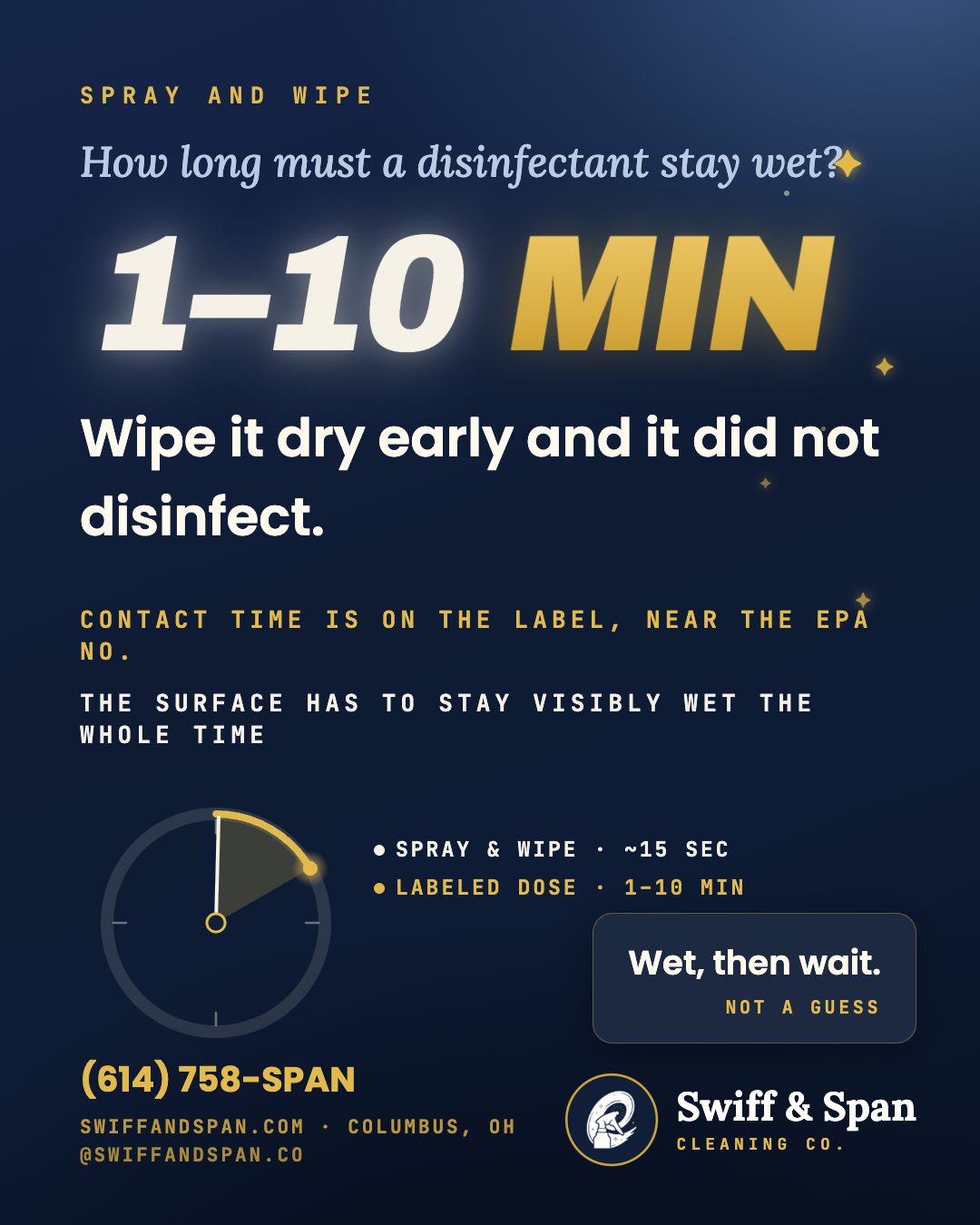
Contact time, also called dwell time, is the number of minutes a disinfectant must remain visibly wet on a surface to kill the pathogens listed on its label. It’s printed on the product itself, tested by the manufacturer, and reviewed by the EPA before that label can make a kill claim. Skip it, and the chemistry never finishes the reaction it needs to work, which means a sprayed and immediately wiped surface was never actually disinfected, regardless of which product came out of the bottle.
Watch what happens on a typical turnover: spray, count to three, wipe, move on. That gap between spray and wipe is the disinfection process’s most common, least-discussed failure point, and it’s happening in offices, clinics, and rentals across Central Ohio right now, usually by people who fully believe they just disinfected something.
What is contact time, exactly?
When a disinfectant manufacturer registers a product with the EPA, they submit lab data showing the chemical kills specific, named pathogens if it’s applied and left wet on a surface for a specific number of minutes. That number becomes the contact time printed directly on the label, often broken out by pathogen, a shorter time for common bacteria, a longer time for tougher targets like norovirus or tuberculosis. The claim on the front of the bottle, some version of “kills germs”, only holds if the surface met that back-of-label contact time. Nothing about a kill claim is instant.
Why does wiping too soon break the entire process?
Because the kill claim isn’t about the chemical touching the surface, it’s about the chemical staying on the surface, wet, for the full reaction window. Most people spray a surface and, out of habit or a rush to finish a room, wipe it dry within a few seconds. At that point, the chemical has been removed before it did the job printed on its own label. Visually, the surface looks and smells clean. Chemically, the pathogen list on the back of the bottle was never actually addressed. This is the least visible failure in cleaning, precisely because it leaves no evidence, no residue, no missed spot, nothing a walkthrough would catch. It only shows up if someone swabs the surface and measures what’s actually there.
How long does contact time actually take?
It depends on the product and the target pathogen, and the range is wider than most people assume, commonly somewhere between about one minute and ten minutes, according to the label directions on most EPA-registered surface disinfectants. A product might need one minute to address common bacteria but five or ten minutes for a broader viral or tuberculocidal claim. Compare that to how fast a thin layer of disinfectant actually air-dries on a laminate countertop or an exam table under normal room airflow, often less than the shortest contact time on the label. That gap, between how long the chemical needs and how long it naturally stays wet, is the entire problem in one sentence.
How do cleaning crews actually hit the required time?
There are only a few honest ways to do it, and none of them involve wiping faster:
- Reapply, don’t wipe. If a surface starts to dry before the contact time is up, mist it again rather than wiping it away early. This keeps the surface wet through the full window instead of interrupting it.
- Sequence the work so time passes naturally. A trained crew sprays a batch of surfaces, moves to the next task, and circles back to wipe once contact time has elapsed, rather than spraying and immediately wiping each single surface.
- Choose the product for the job. Some EPA-registered disinfectants are formulated for shorter contact times specifically because they’re meant for high-turnover environments. Picking the right product for the required speed is a legitimate strategy. Pretending a ten-minute product only needs thirty seconds is not.
- Time it, don’t guess it. The only way to know contact time was actually met is to track it, a timer, a checklist, a process, not a felt sense that it was probably enough.
Why does this matter more in some settings than others?
In a dental or medical office, contact time isn’t a nice-to-have, it’s the mechanism behind infection control between patients, and it’s the kind of detail a health inspector, an insurer, or opposing counsel will eventually ask about directly: not “did you clean the room,” but “what product, and for how long.” In a short-term rental, a guest never sees the contact time gap, but they may feel its consequence during flu season or in a review that mentions something “off.” In a general office, the exposure is lower-stakes day to day, but it compounds, a break room counter wiped for three seconds, four times a day, every day, is a counter that has never actually been disinfected, just repeatedly sprayed.
What This Looks Like in Practice
| Step | What most crews do | What actually meets label claims |
|---|---|---|
| Apply | Spray surface | Spray surface fully, no dry patches |
| Wait | Wipe within seconds | Leave wet for the full label contact time |
| Dry check | None | Reapply if the surface dries early |
| Verification | None | Timed, tracked, or measured |
This is exactly the kind of gap ATP bioluminescence testing exposes, not because the swab knows chemistry, but because it measures the actual result on the surface after the process, not the process someone believes they followed. Across Dublin, New Albany, and the Short North, our team swabs surfaces on every visit and photographs the reading, so contact time isn’t a step we take on faith, it’s a number we can show you afterward. The same team returns each visit too, which matters here specifically: a rotating crew has little reason to slow down for a step nobody’s checking, but a team that knows their work gets measured has every reason to.
If your current cleaning contract has never been checked against something as basic as contact time, we’re opening the Founder’s Deal to ten new accounts across Central Ohio: three-month start, fourth month free, rate locked permanently at the founding price. The walkthrough is complimentary and includes a live ATP test on your own surfaces, so you see what’s actually happening before you commit. Call (614) 758-SPAN.
Spray and wipe feels like disinfecting. It has the motion, the smell, the visible result. What it usually doesn’t have is the one variable the entire kill claim depends on: time. That’s the part nobody sees, and it’s the part that decides whether a room was actually disinfected or just recently sprayed.
Frequently Asked Questions
What is contact time for a disinfectant?
Contact time, also called dwell time, is the number of minutes a disinfectant must stay visibly wet on a surface to kill the pathogens listed on its label. It's determined by the manufacturer's testing and printed directly on the product.
Why does wiping a surface dry too soon matter?
If a surface is wiped dry before the label's contact time has passed, the chemical reaction that kills the listed pathogens is interrupted before it finishes. The surface may look and smell clean, but the disinfection claim on the label was never actually met.
How long should a disinfectant stay wet on a surface?
It depends on the specific product and pathogen, but many EPA-registered disinfectants list contact times ranging from about one minute to ten minutes. The exact time is printed on the product label and varies by the claim being made.
Do all disinfectants have the same contact time?
No. Contact time varies by product and often varies within a single product depending on which pathogen is targeted, a shorter time for common bacteria, a longer time for tougher targets like viruses or tuberculosis. Always check the specific label rather than assuming a standard time.
How can I tell if my cleaning service is actually meeting contact time?
Ask directly what their process is for keeping surfaces wet through the labeled contact time, and whether that step is tracked or just assumed. A service that can show you a timing process, or measured results like ATP testing, is treating contact time as a requirement, not a guess.
Every Columbus dental, medical, wellness, and commercial facility gets the same offer: a complimentary 30-minute ATP walkthrough. We swab your highest-touch surfaces, on the spot, and hand you the readings. No obligation, no pitch required to see the number. Book your complimentary ATP walkthrough or text (614) 758-SPAN.
Erik Kuusisto, Owner
Swiff & Span Cleaning Company
Keep reading
- What does “clean” actually mean? Inside the ATP numbers
- Clean versus disinfect, and why dwell time decides it
- Bleach is not a magic wand: four common mistakes
- What electrostatic spraying actually does
- Color-coded microfiber and the two-bucket method
- What happens in a complimentary ATP walkthrough
- How we prove clean · FAQ · Contact