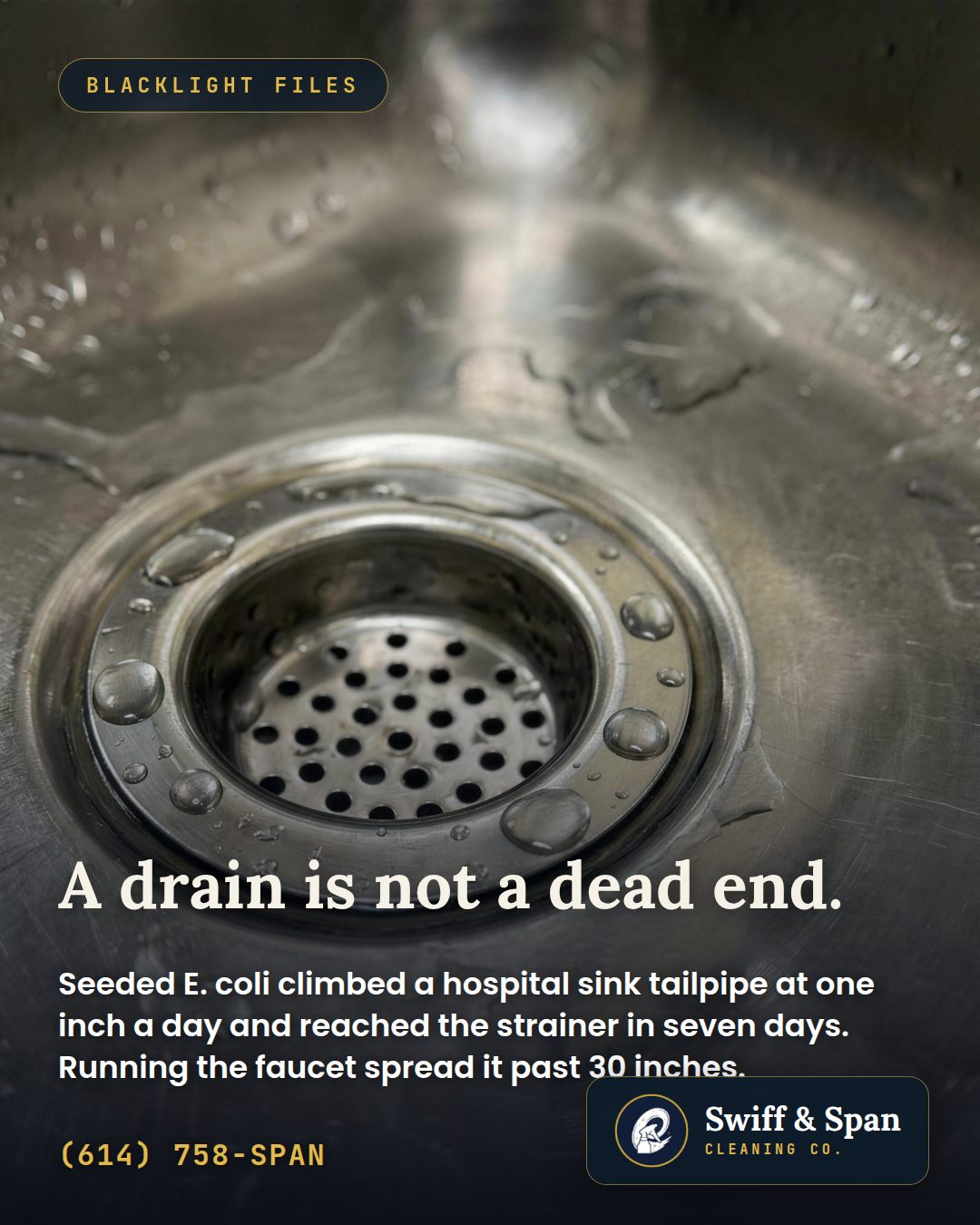
At the University of Virginia, a team poured Escherichia coli engineered to glow green into the P-trap of a hospital hand-wash sink, fed the drain the way a real drain gets fed, and went looking for it every day for a week.
They did not have to look far. The organism refused to stay in the trap water where they put it. It went up.
Over seven days, the green colonies advanced up the drain pipe toward the sink strainer at approximately 1 inch a day. Not a burst. Not an accident. A steady, measurable ascent of about a thumb-width every twenty-four hours, in the dark, inside a pipe, in a room where people wash their hands in order to stop being contaminated.
Then the researchers turned the faucet on. Once the organism was established at the strainer, ordinary faucet operation dispersed it to surrounding surfaces more than 30 inches away.
The sink was not a drain. It was a sprinkler with a delay.
What is actually growing inside a hand-wash sink drain?
Biofilm. A P-trap is a section of pipe engineered to hold standing water forever, and that water receives soap, skin cells, saliva, blood residue, dumped coffee and rinse water all day. That is not waste. To a bacterium, that is catering.
The trap reservoir is one of the few places in a clinical building that is permanently wet, permanently dark, permanently fed and permanently unreachable. Bacteria there do not drift as free cells. They attach to the pipe wall and build a polysaccharide matrix over themselves, a slime layer that shrugs off the disinfectant that would kill the same organism on a countertop in ninety seconds.
If that sounds familiar, it is the mechanism we have written about in dental unit waterlines. Narrow lumen, stagnant water, a community that builds a roof over itself. The waterline version gets attention because it ends at a patient's mouth. The drain version gets none, because everyone assumes a drain runs one way.
It is not a one-way street. That is the whole article.
How fast do drain bacteria reach the sink strainer?
About 1 inch a day. In the Virginia study, GFP-expressing E. coli seeded into the P-trap and given a nutrient supply grew up the drain tailpipe toward the strainer at approximately an inch per day over a seven-day period.
That is not a probability. It is a rate, with a direction, and the direction is toward the room.
Run the arithmetic on your own fixture. The distance from strainer to trap in a standard basin is inches, not feet. So the interval between an organism arriving in the trap and an organism sitting at the drain opening, in the splash path of a faucet, is days. Not months. Days.
And nothing about the fixture announces it. There is no odor at 1 inch a day, no discoloration, no slow drain, no mark on the porcelain. The strainer of a colonized sink looks exactly like the strainer of a clean one.
How far does a running faucet spread drain bacteria?
Beyond 30 inches. Once the organism established at the strainer, faucet operation dispersed it to surfaces more than 30 inches from the drain. The stream hits the strainer, breaks apart, and throws what is living there outward as droplets.
Thirty inches is not an abstraction. Stand at the hand-wash sink in your operatory or exam room and hold an arm out. Thirty inches is the soap dispenser, the corner of counter where the gauze lives, the glove box, the cup of coffee somebody set down at 8:15, and the wrapped cassette waiting to be carried in.
We notice this constantly on walkthroughs, in Dublin and Clintonville practices alike. The sink counter is the most convenient horizontal surface in the room, so it becomes staging. Clean things land within arm's reach, because arm's reach is where a human wants to set things down. The ergonomics and the microbiology point in opposite directions.
And what lands there does not expire on a schedule that helps you. CDC's hepatitis B guidance notes that HBV "remains viable on environmental surfaces for at least seven days." Different organism, different route, same uncomfortable principle: the splash field keeps what it catches.
Was any of this measured in a dental operatory?
No. The model was a hospital hand-wash sink at the University of Virginia, not a dental operatory or a private exam room. Extending it to those rooms is an inference, and we would rather name that than launder it.
Here is what we think travels. The plumbing is the same plumbing. A P-trap in a Worthington family medicine suite runs on identical physics to one in a teaching hospital: standing water, a vertical tailpipe, a strainer, a faucet aimed more or less at it. Biofilm in a permanently wet dark pipe is not hospital-specific, and neither is droplet dispersion from a stream striking a fixed surface.
Here is what does not. A hospital sink sits in a building dense with colonized patients, invasive devices and antibiotic pressure, which is where drain-associated outbreaks come from. A New Albany dental practice is not carrying that load. The right reading here is not "your sink harbors resistant pathogens." It is "your sink is a growth habitat with a delivery mechanism attached, and the direction of travel is out."
That is still enough to change where you put the gauze.
What should a dental or medical practice actually do about the sink?
Treat the 30 inches around every hand-wash sink as a contaminated zone. Store nothing clean inside it, and put the basin, strainer, faucet handles and surrounding counter on a named cleaning schedule instead of a visual one.
Clear the zone, then keep it clear. Highest-value move here, and it is free. Gauze, glove boxes, wrapped instruments, clean linen, patient product, staff drinks: none of it belongs within arm's reach of a drain opening. Most practices we walk have at least one item in that radius that would horrify whoever put it there.
Clean the fixture as a high-touch surface, not as plumbing. The strainer, basin lip and faucet handles get touched more than most door hardware and are almost never scoped by name. Cleaning first, then an EPA-registered disinfectant held for its full label dwell time, the step people skip and the reason we wrote a whole article on dwell time.
Check what your product is rated to kill. CDC states plainly that for Candida auris, "products solely dependent on quaternary ammonia compounds (QACs) are NOT effective." If the wipe living at your sink is a plain quat, know what it is and is not doing.
Swab the splash field, not just the basin. ATP bioluminescence testing reads organic residue in about fifteen seconds, and Swiff & Span holds tested high-touch surfaces to an internal standard of 25 RLU. The informative swab is not the sink. It is the counter two feet to its left, the towel dispenser lever and the soap pump, because those tell you whether your scope treats the splash field as sink or as furniture.
Can a cleaning company disinfect a P-trap?
No. Plumbing is not cleaning. No spray bottle, wipe or electrostatic sprayer reaches a trap reservoir, and drain remediation is a plumbing and engineering question that belongs to a plumber, an infection preventionist and a facilities budget.
We would rather say that out loud than sell around it. Plenty of contractors will quote "drain sanitizing" as a line item. That usually means pouring something down a drain and hoping, which does not touch an established biofilm on a pipe wall.
What Swiff & Span owns is everything above the strainer: the basin, the strainer face, the faucet and its handles, the counter, the dispensers and the full 30-inch splash field, cleaned in a named order, with dwell time observed, and with the discipline of never staging clean supplies inside a zone we just called contaminated. We are OSHA and CDC conscious, and ATP-verified when scoped. We are not a remediation firm.
Your next move
Walk to the hand-wash sink in your busiest treatment room. Not the break room sink, the clinical one. Look at what sits within arm's reach of the strainer right now, at 8:30 on a Tuesday, and ask whether you would have put it there if the drain were labeled a source instead of a destination.
Then ask whoever cleans your practice one question: is the sink counter scoped separately from the sink? If the answer is a shrug, the splash field is being wiped by accident rather than on purpose, and accident is not a schedule.
If you want numbers instead of assurances, Swiff & Span runs a complimentary ATP walkthrough for practices in Columbus, Upper Arlington, Bexley, Hilliard, Westerville and Licking County. We swab your surfaces, you watch the readings, and you keep them either way. Call (614) 758-SPAN, or read what the walkthrough actually involves before you book it.
Frequently Asked Questions
How fast do bacteria travel up a hand-wash sink drain?
About 1 inch a day. In a University of Virginia study, green fluorescent protein-expressing E. coli was seeded into the P-trap of a hospital hand-wash sink and fed nutrients, and the organism grew up the drain tailpipe toward the sink strainer at approximately an inch per day across seven days.
How far can a running faucet spread bacteria from a sink drain?
Beyond 30 inches. In the same study, once the organism had established itself at the strainer, normal faucet operation dispersed it to surrounding surfaces more than 30 inches away from the drain. The water stream is the delivery mechanism, not the source.
Does sink drain contamination research apply to dental operatories and exam rooms?
Not directly. The model was a hospital hand-wash sink at the University of Virginia, not a dental operatory or a private exam room. Extending it to those rooms is an inference. The plumbing and the physics are the same, but the organism pressure in a hospital is not the organism pressure in a Bexley dental office.
Can a cleaning contractor disinfect a P-trap?
No. Plumbing is not cleaning. No spray bottle, wipe or electrostatic sprayer reaches a trap reservoir, and drain remediation is a plumbing and engineering question. What a cleaning contractor owns is the basin, the strainer, the faucet handles and the surrounding splash field.
What should a medical or dental office keep away from a hand-wash sink?
Anything clean, sterile, edible or headed for a patient. Treat the 30 inches around the strainer as a contaminated zone: no gauze, no glove boxes, no instrument cassettes, no unwrapped supplies, no staff drinks, and no clean linen staged on the counter beside the basin.
Sources
- Kotay S, Chai W, Guilford W, Barry K, Mathers AJ. Spread from the Sink to the Patient: In Situ Study Using Green Fluorescent Protein (GFP)-Expressing Escherichia coli To Model Bacterial Dispersion from Hand-Washing Sink-Trap Reservoirs. Applied and Environmental Microbiology, 2017;83(8):e03327-16. DOI 10.1128/AEM.03327-16
- Centers for Disease Control and Prevention. Prevention of Hepatitis B Virus Infection in the United States: Recommendations of the Advisory Committee on Immunization Practices. MMWR Recommendations and Reports, 2018;67(1). cdc.gov
- Centers for Disease Control and Prevention. Infection Prevention and Control for Candida auris. cdc.gov