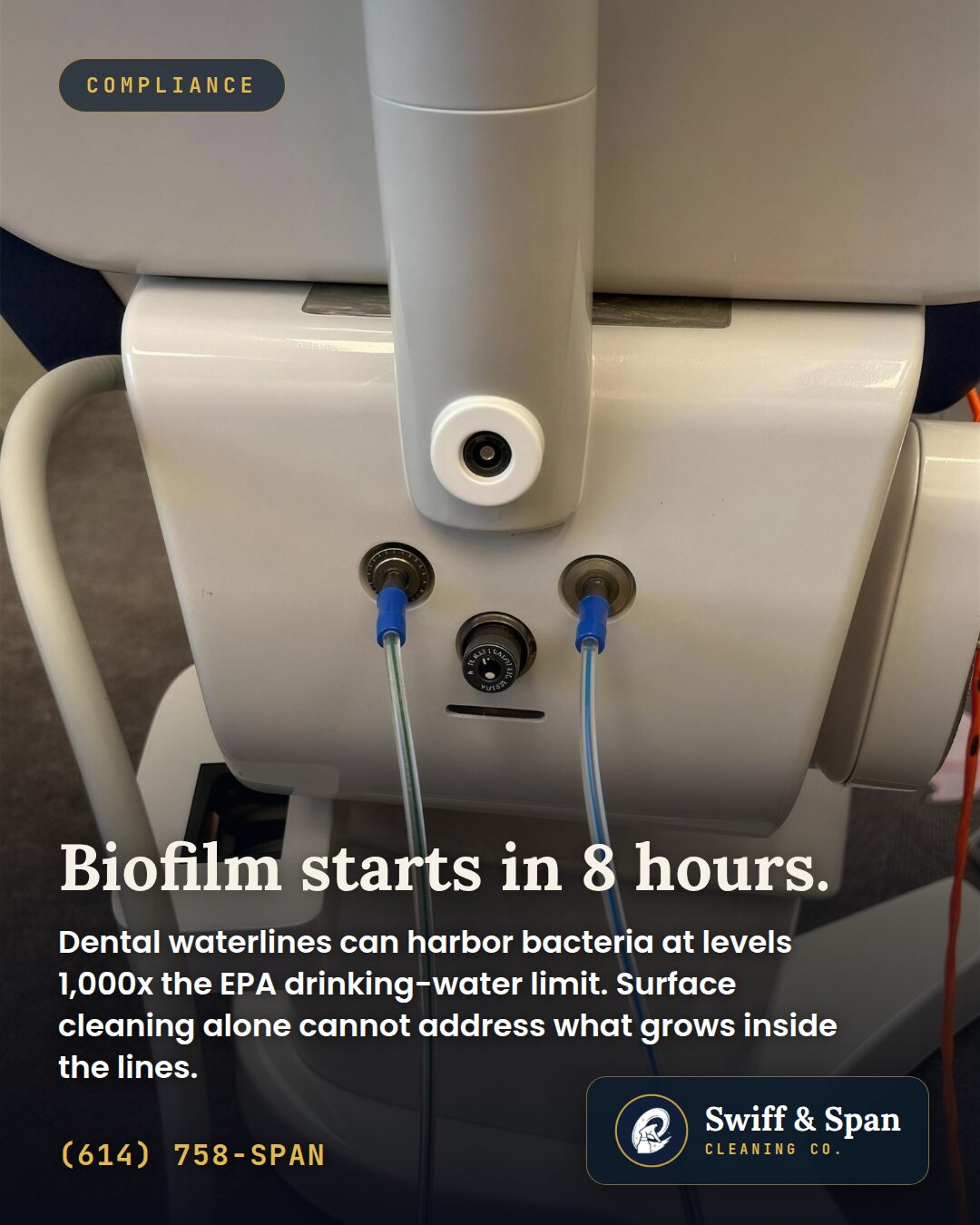
Municipal tap water enters your building at somewhere around 0 to 50 colony-forming units per milliliter. The EPA ceiling for safe drinking water is 500 CFU/mL. The water that comes out of an untreated dental handpiece can carry 200,000 CFU/mL or more.
That is not because the water supply is contaminated. It is because of what happens inside the tubing between the supply and the handpiece: a narrow, warm, slow-flowing environment that is almost perfectly designed to grow biofilm.
How does biofilm form in dental waterlines?
Biofilm is not loose bacteria floating in water. It is a structured community of microorganisms that adheres to the inner wall of a surface, surrounded by a self-produced matrix of proteins and polysaccharides that protects it from flushing, chemical treatment, and even some disinfectants.
Dental unit waterlines are typically 1/16 to 1/8 inch in internal diameter. That narrow bore creates a high ratio of surface area to volume, which means proportionally more wall for biofilm to anchor to. Add in water that sits stagnant overnight and warms to room temperature, and you have a growth environment that amplifies bacterial counts exponentially between uses.
The bacteria living in dental waterline biofilm are mostly heterotrophic: organisms that feed on organic matter in the water. Common species include Pseudomonas, Methylobacterium, and in some cases Legionella, the bacterium responsible for Legionnaires’ disease. While the risk to a healthy patient from a brief dental procedure is considered low, immunocompromised patients and dental staff who breathe aerosolized water all day face a meaningfully higher exposure.
What is the CDC standard for dental waterlines?
The CDC’s 2003 Guidelines for Infection Control in Dental Health-Care Settings recommend that water used during nonsurgical dental procedures meet the EPA drinking water standard: no more than 500 CFU/mL of heterotrophic bacteria. For surgical procedures, sterile water delivered through a separate system is the recommendation.
Meeting that 500 CFU/mL threshold requires active waterline treatment: regularly running a chemical agent (tablet, cartridge, or continuous dosing system) through the lines, plus testing the output water on a schedule to verify the treatment is working. Flushing the lines at the start of the day helps, but flushing alone does not remove established biofilm. It just pushes water past it.
Some practices treat their waterlines diligently. Others assume that the water coming out of their municipal supply is fine and that the tubing is just a pipe. The difference between those two assumptions is the difference between 50 CFU/mL and 200,000.
How does waterline quality relate to surface cleaning?
Waterline treatment controls what comes out of the handpiece. Environmental cleaning controls what sits on every surface the water and aerosol lands on.
When a high-speed handpiece runs, it generates a plume of aerosol that settles on the operatory chair, the delivery unit tray, the countertop, the light handle, and the floor within a roughly six-foot radius. If the water in that aerosol carries elevated bacteria, the surfaces in the operatory carry them too, even if someone wiped the chair between patients.
A practice can maintain pristine waterlines and still have contaminated surfaces if the end-of-day environmental clean is not scoped for the aerosol zone. Conversely, a practice that ignores its waterlines and relies on surface cleaning alone is fighting half the battle.
This is why we think of environmental cleaning as the other half of infection control, not the whole thing. We do not treat waterlines. We verify the surfaces the water lands on. What a dental operatory terminal clean actually involves covers the full end-of-day scope.
What RLU reading counts as clean?
Under 100 RLU is the number the cleaning industry calls “clean.” That is the general ATP benchmark.
Swiff & Span holds every high-touch surface to 25 RLU.
We use a Hygiena SystemSURE Plus ATP meter with UltraSnap swabs to verify the surfaces in the aerosol zone on the cadence scoped at contract. The reading tells us whether the organic residue, including anything deposited by aerosolized waterline bacteria, has actually been removed. What “clean” actually means walks through the standard in full.
The disinfection side uses EPA-registered chemistry matched to each surface: PDI Super Sani-Cloth on patient contact areas, Diversey Oxivir Tb for broad-spectrum coverage, Clorox Healthcare Bleach Germicidal on non-porous hard surfaces, and Spartan TB-Cide Quat on general environmental surfaces, each held at its full label dwell time. Clean versus disinfect, and why dwell time decides it explains the selection logic.
This is the standard we bring to every dental account across New Albany, Dublin, the Short North, Columbus, Upper Arlington, Bexley, Hilliard, and Worthington.
Who cleans the surfaces the aerosol lands on?
If you have invested in waterline treatment and compliance testing, you already understand that what looks clean and what tests clean are not the same thing. That same principle applies to the surfaces around the chair. Ask your cleaning vendor what your operatory surfaces read on an ATP meter after a clean. If they do not know what you are asking, that is the answer.
Frequently Asked Questions
Can Legionella grow in dental unit waterlines?
Yes. Legionella species have been detected in dental unit waterline biofilm. While the risk to healthy patients from brief procedures is low, immunocompromised patients and dental staff with prolonged aerosol exposure face higher risk. Maintaining waterline quality below 500 CFU/mL reduces this risk.
Every Columbus dental practice gets the same offer: a complimentary 30-minute ATP walkthrough. We swab your operatory surfaces, on the spot, and hand you the readings. No obligation, no pitch required to see the number. Book your complimentary ATP walkthrough or text (614) 758-SPAN.
Erik Kuusisto, Owner
Swiff & Span Cleaning Company
Keep reading
- What a dental operatory terminal clean actually involves
- OSHA bloodborne pathogen standards for dental cleaning
- What does “clean” actually mean? Inside the ATP numbers
- Fireflies, deep-sea squid, and your exam table
- Clean versus disinfect, and why dwell time decides it
- What happens in a complimentary ATP walkthrough
- How we prove clean · FAQ · Contact