Every week a practice manager asks me some version of the same thing. How often does this place actually need to be cleaned? Not what the vendor brochure says. What does it actually need.
The honest problem with that question is that most vendors answer it with a package name. Standard, premium, deluxe. Those words describe a price tier, not a protocol. So here are the five questions I get asked most by dental and orthodontic practices around Columbus, and the answers I give at the front desk.
The short version
| Area | Frequency | What drives it |
|---|---|---|
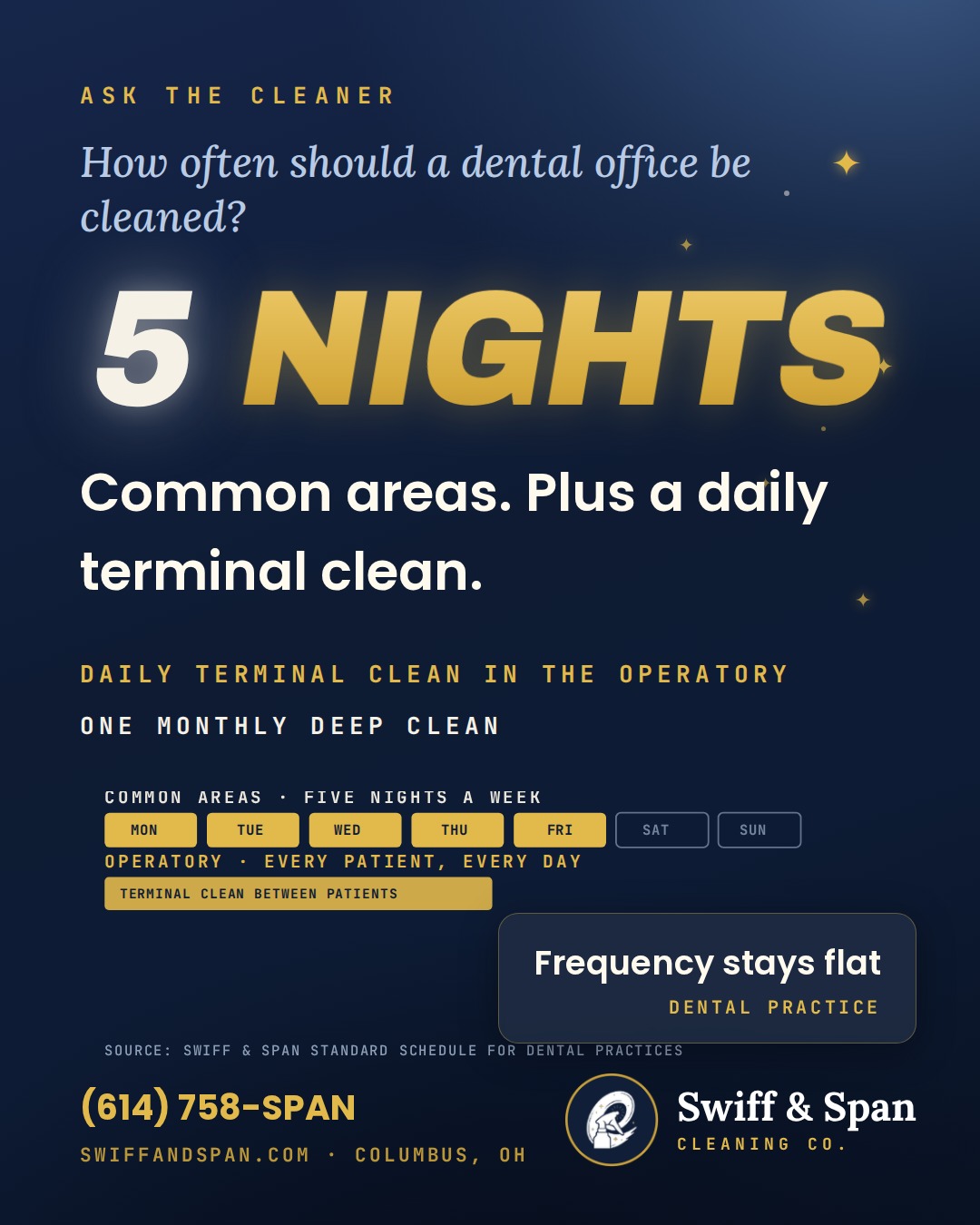
| Operatory and sterilization corridor | Daily terminal clean, end of day | Patient flow, splatter radius, handoff zones |
| Reception, restrooms, hallways, breakroom | 5 nights a week | Foot traffic and shared touch points |
| Vents, baseboards, vertical surfaces, floor detail | Monthly | Accumulation you stop seeing |
| Cleaning verification | Periodic ATP check | Confirms the schedule is holding |
Now the reasoning.
Question 1: How often does the operatory really need a full clean?
Daily. End of day, every operating day, without a version of the schedule where it slips to three times a week.
Here is the flip, though. Most practices ask about operatory frequency as if it were a dial you turn up or down. It is not a frequency question at all. A terminal clean is a defined end of day procedure: clear the counters, clean before you disinfect, apply an EPA registered disinfectant and let it sit for its full dwell time instead of wiping it off at twenty seconds, then work top down and clean to dirty so nothing travels backward.
The reason it has to be daily is not that one skipped night makes a room dirty. It is that a protocol you run four nights out of five is not a protocol. It is a habit with holes in it, and the holes always land on the same surfaces: the chair base, the light handle stem, the lower cabinet pull, the underside of the tray arm.
Your clinical team already handles between patient turnover. The end of day terminal clean is the layer under that, and it is the one that gets quietly traded away when a cleaning contract is priced down.
Question 2: Do the common areas need that same daily treatment?
Five nights a week, matched to your operating days. That is the answer for almost every dental practice I walk through in Dublin, Westerville or Upper Arlington.
Common areas fail differently than operatories. Nobody is worried about the waiting room the way they worry about a chair. But the waiting room is where your patient forms an opinion before anyone in scrubs says hello, and it takes on soil in a pattern that is easy to miss: the arm rests, the door push plate, the check in counter edge, the restroom light switch, the water cooler spigot.
Five nights covers it because that is your traffic cycle. Soil accumulates while the practice is open and gets reset while it is closed. A three night schedule means two mornings a week you open on yesterday’s floor.
What a five night rotation should include:
- Restrooms cleaned and disinfected with dedicated tools, never the cloth that touched anything clinical
- Color coded microfiber so a restroom cloth and an operatory cloth are physically different objects
- Two bucket mopping so you are not redistributing the first room across the last one
- HEPA filtered vacuuming on carpet and entry mats
- High touch points logged as a list, not left to memory
- Trash, including the clinical stream handled per your own internal procedure
The breakroom belongs in this rotation too. It is the most neglected room in a dental office and the one your team spends unmasked time in.
Question 3: Where does the monthly deep clean fit, and is it real?
Once a month, and yes, it is real work rather than an upsell line.
Nightly service holds the horizontal plane: counters, floors, touch points, the things at eye level and hand level. The monthly visit takes the plane nobody looks at. Supply vent grilles and return grilles. Baseboards and the floor to wall junction. The vertical face of cabinetry. Behind and under the sterilization counter. Door frames and the tops of door casings. Light diffusers. Chair upholstery seams.
The flip here is worth sitting with. Deep cleaning is not nightly cleaning done harder. It is a different list entirely, aimed at surfaces that accumulate on a slow curve. You stop seeing them precisely because they change so gradually. A vent grille never looks dirty on a Tuesday. It looks dirty in a photo from eleven months ago.
Monthly also gives you a natural inspection rhythm. Someone is on a ladder, under a counter, behind the autoclave line, seeing things a nightly tech moving at pace will not see. That is how you catch a slow sink leak or a floor seam starting to lift before it turns into a repair.
Question 4: Can we scale back during a slow week?
No, and this is the question where I push back hardest.
The assumption is that cleaning demand tracks patient volume. Fewer patients, less soil, less cleaning needed. It is intuitive and it is wrong on the part that matters.
Patient volume drives some of your load. It does not drive all of it. Residue that is left in place does not wait for you to get busy again. It binds. A protein film on a counter edge at day one wipes away with normal chemistry and normal dwell time. That same film at day five has had time to set, and the same wipe now leaves something behind. Dust settles on a calendar, not a schedule. HVAC runs whether or not the chairs are full.
There is a second reason, and it is operational. A variable schedule cannot be trained. The moment the frequency flexes, the checklist flexes with it, and the team stops running a procedure and starts making judgment calls at 7 PM. Flat frequency is what makes the standard repeatable. It is also what makes a slow month cheap to stay on top of instead of expensive to recover from.
If a practice near New Albany tells me August is quiet, my answer is that August is when we get ahead on the monthly list, not when we skip nights.
Question 5: How do we know the schedule is actually holding?
You check it. Periodically, with a swab, instead of assuming.
ATP testing measures organic residue on a surface and reports it as an RLU number. It is a cleaning verification tool. It tells you whether cleaning actually removed what was on that surface, on that day, at that spot. It is the difference between a surface that looks clean and a surface with a number attached to it.
Our ladder is published and fixed. 25 RLU is the Swiff & Span Cleaning Target Threshold. 0 to 100 reads as Acceptable or Pass. 101 to 299 is Caution, which means re clean and retest on the spot. 300 and above is a Fail.
Be precise about what that number is and is not. ATP measures organic residue for cleaning verification. It does not prove disinfection, it does not measure pathogen kill, it does not demonstrate sterilization, and it does not make any practice compliant with anything. A high reading tells you cleaning missed. A low reading tells you cleaning worked on that surface. That is the whole claim, and it is a useful one.
What a periodic check does for a practice manager is remove the argument. You are no longer relying on a walkthrough where two people disagree about whether a counter looks fine. You have a reading, a date, and a surface.
The part nobody scopes for
Every dental practice I have walked, in the Short North or in a suburban office park, has the same blind spot. It is not the operatory. Operatories get attention because they are visibly clinical.
It is the corridor between the operatory and the sterilization area. The handoff zone. It is a traffic lane where gloved hands touch door frames, cabinet pulls and cart handles on the way to and from the autoclave line, and it almost never appears as its own line item on a cleaning scope. It gets treated as hallway.
Ask your current provider to show you where that corridor appears on their checklist. If the answer is a vague gesture at hallways, you have found the gap.
What good documentation looks like
A schedule you can audit beats a schedule you were promised. That means a room by room checklist, photo documentation timestamped to the visit, and the same team in the building each time rather than a rotating crew relearning your floor plan every quarter.
We work OSHA Aware and HIPAA Aware, with bloodborne pathogen trained staff, because a dental office is not a regular office and the person cleaning it should know the difference between a noncritical surface and a semicritical one before they pick up a cloth.
Frequently Asked Questions
How often should a dental office be professionally cleaned?
A dental practice needs a daily end of day terminal clean in every operatory, professional service in common areas 5 nights a week matched to operating days, and one monthly deep clean covering vents, baseboards, vertical surfaces and floor detail. That cadence should stay flat regardless of patient volume, because residue and dust accumulate on a calendar rather than on a patient count.
Is nightly cleaning enough, or do we still need a monthly deep clean?
Both, because they cover different surfaces. Nightly work holds the horizontal plane: counters, floors, restrooms and high touch points. The monthly visit targets surfaces that build up slowly and stop registering visually, including vent grilles, baseboards, cabinet faces, door casings and the area behind the sterilization counter. Skipping the monthly list does not show up for months, then shows up all at once.
Can we reduce cleaning frequency during a slow patient month?
Reducing frequency costs more than it saves. Organic residue binds in place over days, so a film that wipes away easily at day one resists normal chemistry by day five. Dust and HVAC deposition continue regardless of appointments. A flat schedule also keeps the checklist trainable, which is what makes the standard repeatable instead of a nightly judgment call.
What does an ATP test actually tell a dental practice?
ATP testing measures organic residue on a specific surface and reports it as an RLU reading, which verifies whether cleaning removed what was there. Swiff & Span uses a 25 RLU Cleaning Target Threshold, with 0 to 100 Acceptable, 101 to 299 Caution requiring a re clean and retest, and 300 or above a Fail. It does not prove disinfection, pathogen kill, sterilization, or regulatory compliance.
What is the most commonly missed area in a dental office cleaning scope?
The corridor between the operatory and the sterilization area. It is a handoff zone where gloved hands contact door frames, cabinet pulls and cart handles all day, but it is usually scoped as generic hallway rather than as its own checklist item. Ask any provider to point to where that corridor appears on their written room by room checklist.
Every Columbus dental, medical, wellness, and commercial facility gets the same offer: a complimentary 30-minute ATP walkthrough. We swab your highest-touch surfaces, on the spot, and hand you the readings. No obligation, no pitch required to see the number. Book your complimentary ATP walkthrough or text (614) 758-SPAN.
Erik Kuusisto, Owner
Swiff & Span Cleaning Company