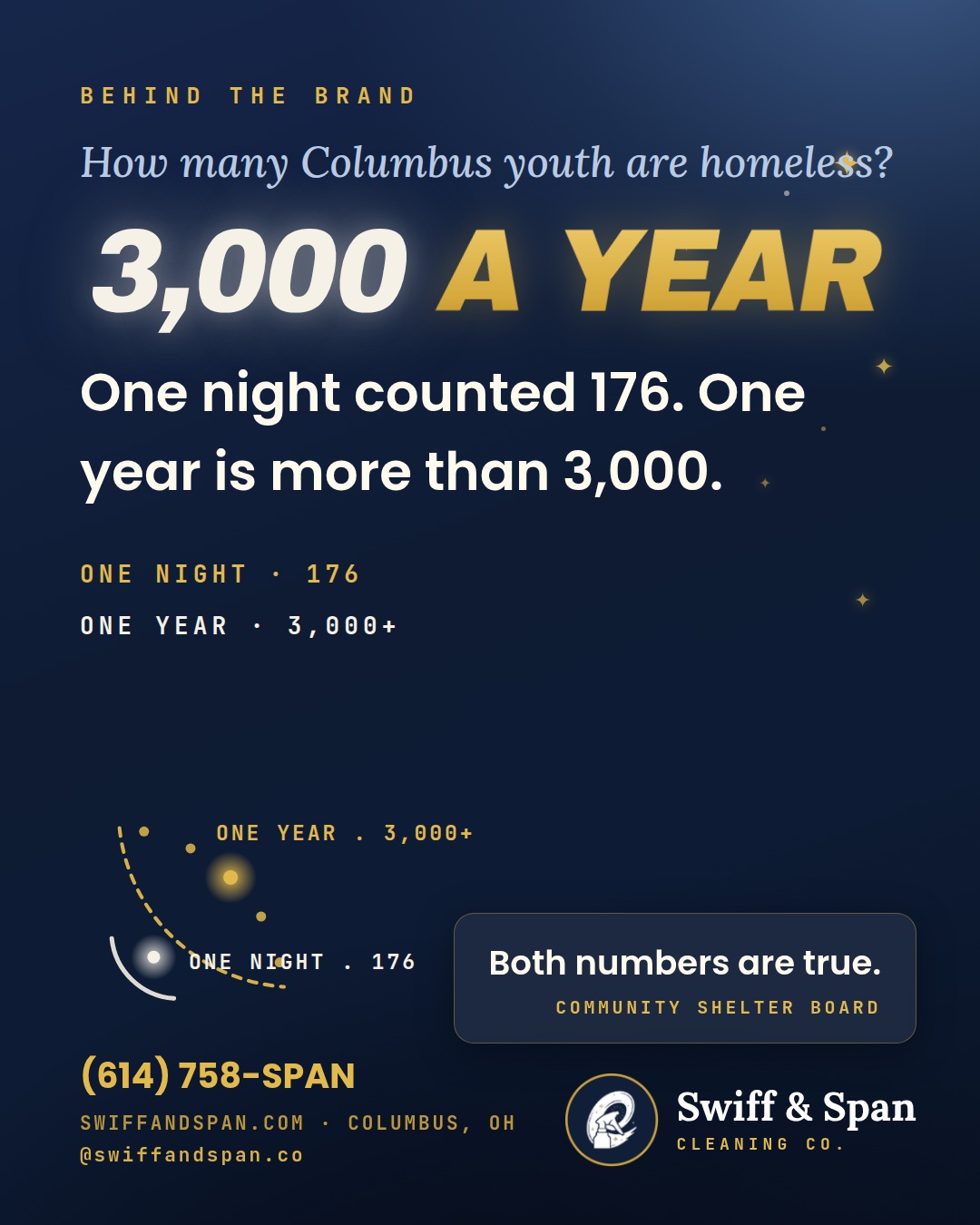
On the night of January 22, 2026, the count in Franklin County found 176 unaccompanied young people, ages 18 to 24, experiencing homelessness. Across a full year, the estimate for youth in this county is more than 3,000. Both figures come from careful work by serious people. Neither is a lie. The distance between them is the subject of this article.
That gap will look familiar to anyone who has ever stood in a lobby at 7 a.m., looked at the floor, and pronounced it clean.
What is the difference between the 176 and 3,000 figures?
The 176 comes from the Point-in-Time count, a single-night census that every community receiving federal homelessness funding is required to conduct each January. In Columbus and Franklin County, Community Shelter Board coordinates it. The 2026 count happened on January 22 and the results were released on May 6.
The topline: 2,587 people experiencing homelessness on that night, up 1.2% from 2025. Of those, 1,936 were sheltered, down from 2,101 the year before. 651 were unsheltered, up from 455, a 43% increase and the largest single-year jump since 2023. Family homelessness fell 3.8%, its second consecutive annual decline. Among young people, CSB counted 176 unaccompanied youth ages 18 to 24 and 45 parenting youth.
Here is a small thing we are not going to do. We are not going to give you a year-over-year percentage change for youth, because CSB's 2026 materials list a 2025 youth baseline of 230 while WOSU's reporting from 2025 put the figure at 207. Those are almost certainly two different definitions rather than two different realities, but we have not confirmed which, so the percentage would be decoration rather than information. We will tell you the 2026 figure and where it came from.
The Point-in-Time count is not a bad instrument. It is a precise instrument answering a narrow question: how many people, on one specific night in January, were in a shelter bed or found outside by a volunteer with a clipboard. It is not designed to answer the broader question of how many young people move through homelessness over twelve months. When you use the first number to answer the second question, the number does not become wrong. It becomes misleading, which is worse, because it still looks like evidence.
Why does a January count miss young people?
Adults experiencing homelessness are more likely to be in the places a street-and-shelter methodology can see. Young people are not. They are on a friend's couch for nine days, then a cousin's floor, then a car, then a different couch. They are doubled up in an apartment that is already over capacity. They are, in the language of the count, sheltered by nobody the count can find.
Huckleberry House, which has been working with Columbus youth since 1970, has said this publicly and without hedging. After the 2024 count reported only four unsheltered minors in the county, Interim Executive Director Lynda Leclerc responded: "The claim that only four minors are unsheltered misrepresents the reality we face."
The same pattern shows up in school data. The Ohio Department of Education and Workforce reports that students experiencing homelessness make up about 1.5% of Ohio's student population, and then adds a caveat that deserves more attention than it gets: the figure is likely an undercount, because more than half of Ohio's 611 school districts reported fewer than ten homeless students. Columbus City Schools runs a McKinney-Vento program called Project Connect specifically because identification is the hard part. A district reporting a small number may have a small number. It may also have a small counting apparatus.
How many young people experience homelessness in Columbus?
More than 3,000 youth are estimated to experience homelessness annually in Franklin County, according to Community Shelter Board. CSB estimates that another 1,400 young people in the county are at high risk of homelessness.
That 3,000 figure comes from "A Place to Call Home for Youth," the youth plan adopted by CSB and the Columbus & Franklin County Continuum of Care, developed with input from more than 250 stakeholders including young people with lived experience of homelessness. Huckleberry House independently cites the same magnitude: over 3,000 young people facing homelessness in Franklin County each year.
A prevalence figure and a snapshot figure are both real. One tells you the depth of the water tonight. The other tells you how many people went through the river this year.
What programs serve homeless youth in Columbus?
Huckleberry House operates four programs. A Teen Crisis Program provides safe temporary shelter for ages 12 to 17. Housing Programs serve ages 18 to 24 with case management and independent living skill building. A Counseling Center works with youth and families. A Youth Outreach Program brings resources to where young people already are, which is the part of the model that acknowledges the counting problem directly.
Their published figures: 404 minors relied on Huckleberry House's shelter in fiscal year 2024. Up to 14 minors seek shelter on a given day. Huckleberry House is also a funded partner in CSB's Youth Homelessness Demonstration Program, alongside Community Housing Network, Home for Families, and the YMCA of Central Ohio.
Elsewhere in the city, Star House, a drop-in center, served over 1,500 individual youth ages 14 to 24 in 2024, up from 819 in 2021. Some of those young people appear in more than one organization's numbers, which is what a functioning network looks like and also why you cannot add these figures together and expect a total.
Why does a cleaning company fund youth homelessness work?
Our entire business rests on one refusal. We will not tell you a room is clean.
The cleaning industry has a proud tradition of the unfalsifiable claim. Sparkling. Spotless. Hospital-grade, a phrase with no governing body. A lemon scent is not a measurement, it is a mood. So we swab surfaces with ATP bioluminescence testing, which detects adenosine triphosphate, the molecule present in all living cells and in the organic residue they leave behind. The reader returns an RLU figure. Our internal standard is 25 RLU. You get the number whether it flatters us or not, which is the only thing that makes the number worth anything.
Then we noticed we had a page about supporting Columbus youth experiencing homelessness that contained no measurement of any kind.
It said the true thing in the same shape as the industry's favorite lie. It described a commitment, invited you to feel warmly about it, and gave you nothing you could check. If a client had handed us that as a cleanliness report, we would have laughed and asked for the swab data.
So the commitment now gets the same treatment as the RLU reports. Our clients receive their measurements every month. What went to youth homelessness work in Columbus gets published too. Not a range, not a vibe, not the word "portion." The figure, whether it is a strong one or an embarrassing one.
We want to be precise about the scale of this, because inflating it would defeat the point. A small commercial cleaning company in Columbus supporting a Columbus organization is a small input to a number above 3,000. It does not solve youth homelessness. It does not meaningfully move the annual prevalence estimate. The only thing separating it from a marketing line is that it is stated as a quantity, in public, by a company that can be held to it.
The 3,000 stays the spine because the 176 is easier to live with. A single-night count fits in a headline and produces a manageable feeling. The annual figure is the one that describes a year in Franklin County, and it is the one Huckleberry House staff are actually working against when 14 minors show up in a day.
Two numbers, both true. Ask which question each one answers, and you have learned the whole method.
Ask for the number
Ask your cleaning vendor what "we support local causes" converts to in dollars, ask us the same question at swiffandspan.com or (614) 758-SPAN, and then go look at what Huckleberry House does with it at huckhouse.org.
Frequently Asked Questions
What did the 2026 Point-in-Time count find in Franklin County?
On the night of January 22, 2026, the count found 2,587 people experiencing homelessness in Columbus and Franklin County, up 1.2% from 2025. Of those, 1,936 were sheltered and 651 were unsheltered, a 43% increase and the largest single-year jump since 2023. Among young people, the count recorded 176 unaccompanied youth ages 18 to 24 and 45 parenting youth.
How does Swiff & Span support youth homelessness work in Columbus?
The company publishes what goes to youth homelessness work in Columbus as a specific figure rather than a range or the word 'portion,' the same discipline it applies to ATP readings for clients. It is deliberately described as a small input: a small commercial cleaning company does not solve youth homelessness or move the annual prevalence estimate. The difference from a marketing line is that the figure is stated as a quantity that can be checked.
Sources
- Community Shelter Board, 2026 Point-in-Time count and "A Place to Call Home for Youth" (2026)
- Huckleberry House, program and shelter figures (2024, 2025)
- WOSU Public Media, Point-in-Time count reporting (2025)
- Ohio Department of Education and Workforce, student homelessness data, 2023 to 2024 school year