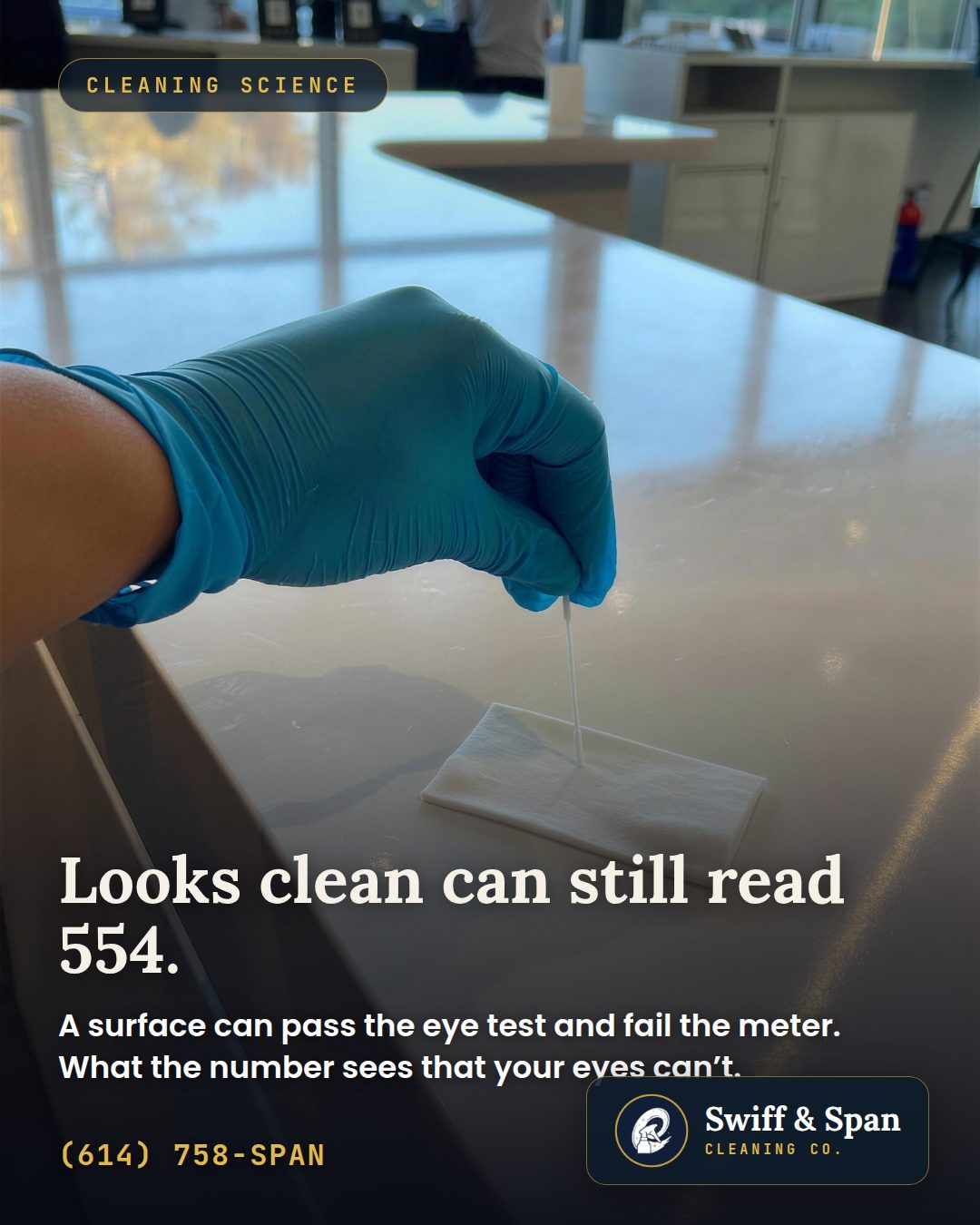
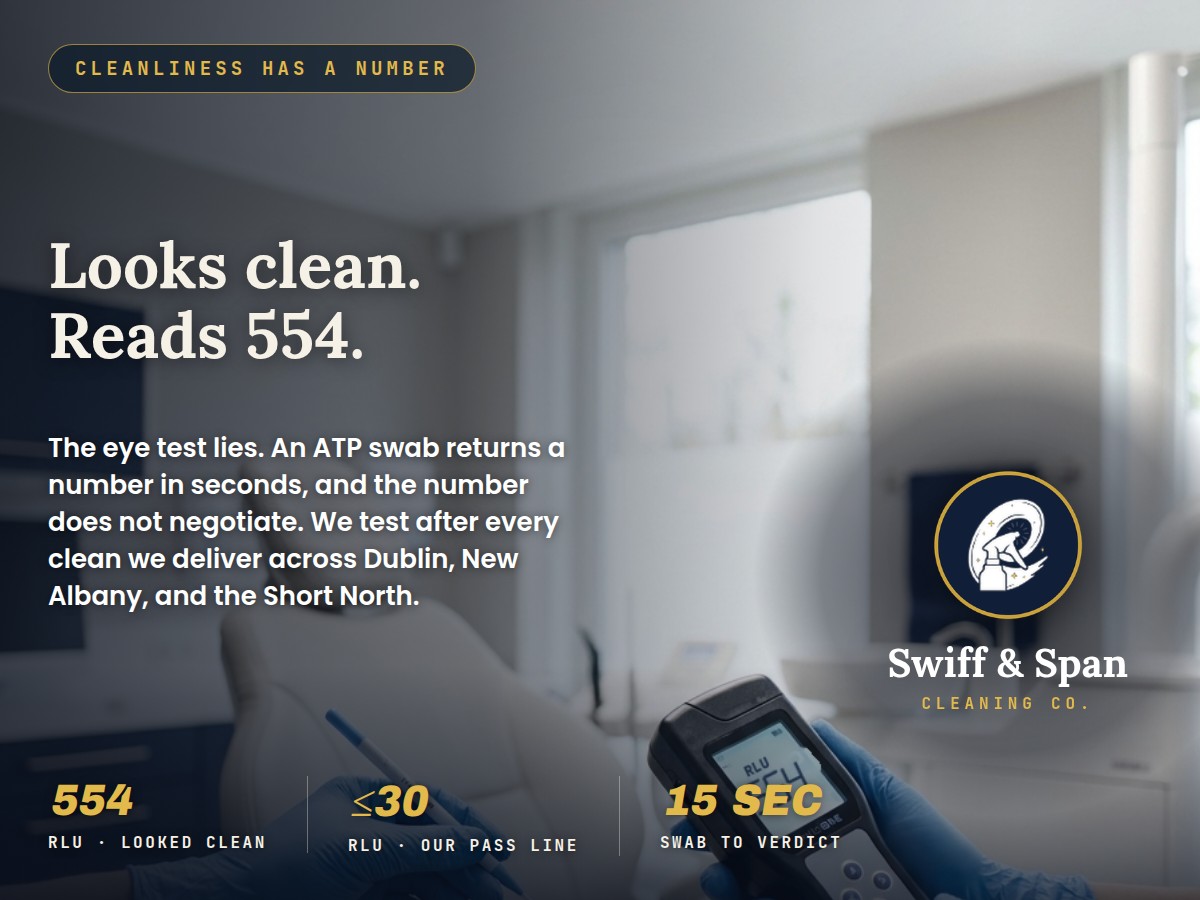
Walk into a freshly serviced dental operatory and it looks flawless. The chair is wiped, the counters gleam, the room smells faintly of disinfectant. Every visual cue your brain uses to judge cleanliness is checked. Then a technician swabs the armrest, drops the swab into a handheld meter, and the screen shows a number in the hundreds. That number is not an opinion. It is the amount of organic residue still living on a surface that, to the human eye, was already clean.
This is the gap at the center of commercial cleaning, and almost nobody talks about it: looking clean and being clean are two different measurements, and only one of them is visible.
Can a surface look clean but still be dirty?
Visual inspection is good at exactly one thing, detecting visible soil. Dust, smudges, crumbs, streaks. What it cannot see is the layer that actually matters in a healthcare or wellness setting: bacteria, biofilm, and the organic film left behind by hands, saliva, and product. That residue is microscopic. It reflects light the same way a truly clean surface does. A counter can be shining and loaded at the same time, and your eyes will report both as spotless.
That is not a failure of attention. It is a failure of instrument. You are being asked to detect something with a tool, human sight, that physically cannot register it. So the industry substitutes proxies: how shiny it looks, how strong it smells, how confident the crew sounds. None of those are the thing itself. We wrote a whole piece on the smell one, because a fresh scent is the proxy people trust most and it proves the least.
What does the meter read on a surface?
An ATP meter measures adenosine triphosphate, the energy molecule present in every living cell and in the organic matter cells leave behind. Swab a surface, insert the swab, and a bioluminescence reaction turns whatever residue is present into light. The meter counts that light and returns a number in Relative Light Units, or RLU, in about fifteen seconds.
Low is clean. High is not. It does not care what the surface looks like, what it smells like, or who cleaned it. On the high-touch surfaces that matter most, Swiff & Span works to a pass line at or below 25 RLU. A reading in the hundreds is not a close call. It is a surface that passed the eye test and failed the only test that counts.
“Clean is not a look or a smell. It is a number, and the number does not negotiate.”
Which rooms need ATP testing most?
In a warehouse break room, a high reading is unpleasant. In a dental operatory, a med spa treatment room, or a medical exam bay, it is a liability. These are rooms where the product itself is trust, where patients and clients assume the surfaces around them are safe. A facility that confuses looking clean with being clean is not cutting a small corner. It is leaving the most important part of the job unmeasured and hoping nobody ever swabs it.
The uncomfortable part is that a high reading is invisible until something goes wrong. There is no visual warning. The only way to know where your facility actually stands is to measure it before a problem does the measuring for you.
The fix is not a better wipe. It is a number.
The answer to an invisible problem is not to clean harder and hope. It is to make the invisible visible. Every Swiff & Span clean runs on a documented scope, the same trained team every visit, and an ATP reading on the surfaces that matter, swabbed, read, and logged. If a surface does not pass, it gets re-cleaned and re-tested until it does. That is the difference between a cleaning service and a cleaning standard.
We built the whole company on the opposite of "trust us." We would rather hand you a number. If you have ever wondered whether your facility is as clean as it looks, that question has an answer, and it takes fifteen seconds to get.
A portion of every clean supports Columbus youth facing poverty and homelessness. It is the reason we show up the way we do.