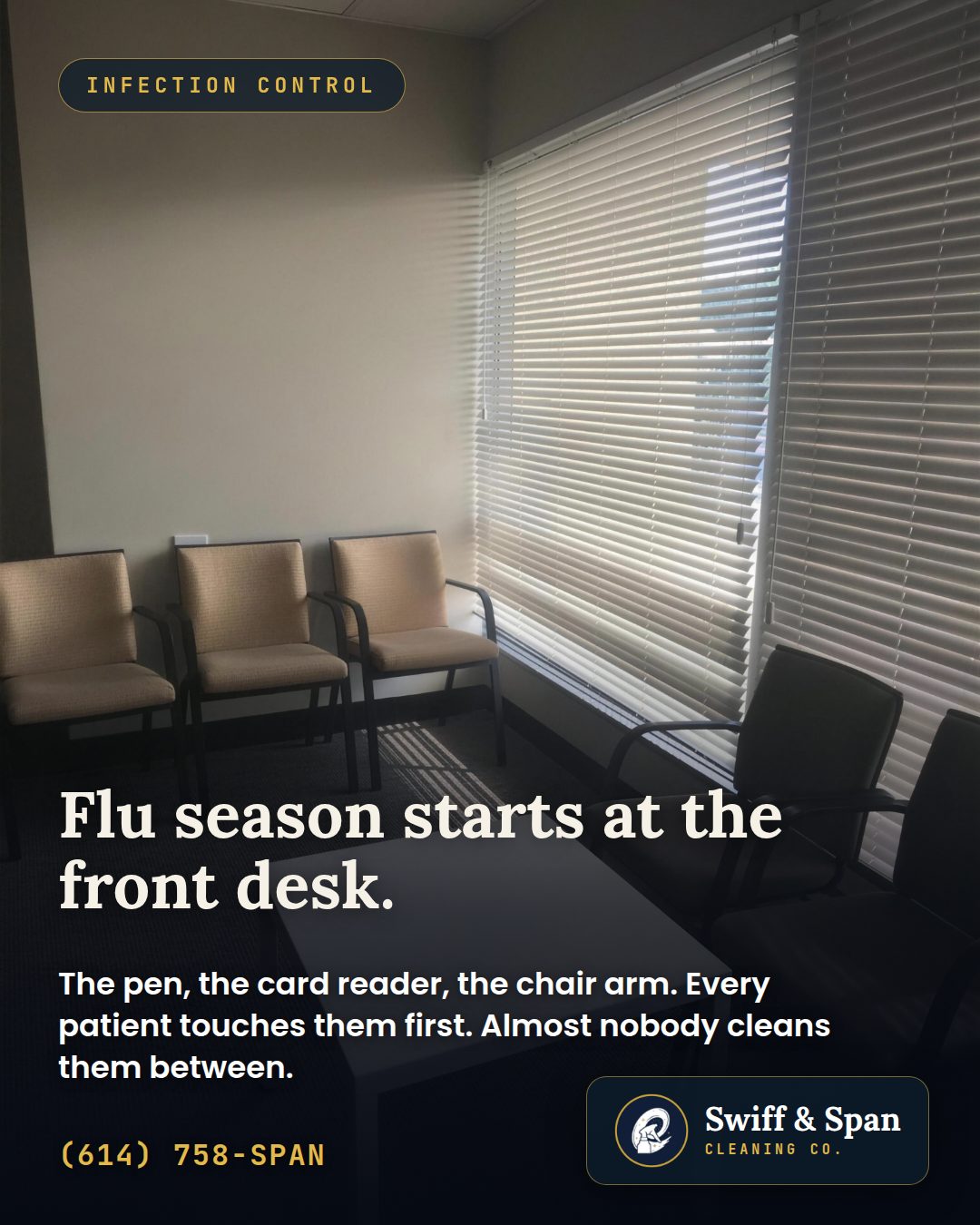
Respiratory-virus season does not arrive in October. It builds through the fall, and the first shared surface every patient touches on the way in is not the exam room. It is the front desk and the two feet of counter around it: the check-in pen, the clipboard, the card reader, the tablet, the chair arm in the waiting room. Those surfaces get touched more times in a Monday morning than an operatory sees in a week, and they are cleaned for how they look, not for what a hand leaves behind. August is the window to reset them, before the fall patient surge turns a missed touchpoint into a waiting room full of transmission. The reference point throughout is CDC’s guidance on environmental infection control, described here in general terms.
The short version. A front-desk reset is four moves, and none of them cost more product.
- Map the touchpoints, the specific front-desk and waiting-room surfaces hands actually land on, built from watching your own lobby at ten in the morning.
- Raise the cadence, so the highest-touch surfaces get wiped on a clock during check-in peaks, not once at close.
- Give the disinfectant its dwell time, because a surface wiped dry in three seconds was never disinfected.
- Verify with a swab, so “we cleaned it” becomes a number you can see.
Is the front desk cleaned for looks or for contact?
Walk any practice at seven in the morning and the front desk looks clean. The counter is wiped, the glass is clear, the pens are in the cup. That is the problem. The surfaces that carry a respiratory season are not the ones that show a smudge. They are the ones a hundred hands touch and nobody re-cleans between them: the pen passed to every patient who signs in, the clipboard returned to the stack, the card reader tapped by everyone with a copay, the check-in tablet, the counter edge people lean on while they talk. Under an ATP swab, those are the numbers that spike, and they spike on a counter that passed the eye test an hour earlier.
None of that is a chemistry problem. The disinfectant on the shelf handles the virus. The gap is that the touch-map was never written down, so the crew cleans the visible counter and skips the pen cup, the door pull, and the tablet that isn’t theirs to touch.
Which waiting room surfaces hold germs?
Past the desk, the waiting room is a bank of surfaces that hold what people bring in. Chair arms are the quiet one: every patient rests both hands on them, and no standard clean re-does them mid-day. Side tables, the water-cooler spigot, the light switch by the restroom, the interior door handle everyone pulls with a bare hand. In a pediatric office, add the toys, which are a shared surface by design and the single hardest thing in the building to keep at a defensible number. Loose magazines are worse than useless in a respiratory season; the low-cost move is to remove them entirely.
The point is not to clean everything constantly. It is to know which ten surfaces in the lobby carry the risk, and to put those ten on a schedule that matches how fast they get re-touched.
How do you reset a front desk for flu season?
1. Build the touch-map from your own lobby. Stand in your waiting room at ten in the morning and watch where hands land between the door and the desk. It will not be the list you expected. Write down the ten surfaces that get touched most, in your building, by your patients. Published guidance stops short of handing you a universal list for exactly this reason: what gets touched depends on how a room is used.
2. Raise the cadence on the top surfaces. The check-in pen, the card reader, the counter, and the interior door handle do not belong on a once-a-day route during flu season. They belong on a clock, wiped through the morning and afternoon check-in peaks. This is a scheduling decision, not a budget one.
3. Give the disinfectant its dwell time. Every EPA-registered disinfectant has a contact time on the label, usually somewhere between one and ten minutes, and it is the number most people skip. A surface sprayed and wiped dry in three seconds got cleaned, not disinfected. The reset is the moment to check that your product and your process actually leave the surface wet for the time the label requires. Clean and disinfect are two different jobs.
4. Verify with a swab. The only way to know the pen cup and the card reader are actually at a defensible level is to measure them. An ATP bioluminescence swab reads a surface in about ten seconds and returns an RLU number: below 25 is the benchmark we hold. Run it on the front desk before the surge and you stop guessing about the surface your whole lobby touches.
Who is responsible for cleaning the front desk?
The reason the pen cup and the card reader fall through is that nobody was ever assigned them. The clinical staff own the operatory. The cleaning crew owns the counter and the floor after hours. The check-in surfaces, touched all day while the office is open, sit in the gap between the two, and a surface with no owner gets cleaned by no one. The reset is the moment to write a name next to each front-desk touchpoint: which ones the front-desk staff wipe on a cadence during the day, and which ones the crew resets and verifies at night. It is a five-minute conversation, and it closes the gap that a whole flu season pours through.
What do front desk surfaces read on an ATP test?
The uncomfortable part is that the front-desk pen and the card reader are routinely the highest-RLU surfaces in a healthcare office, higher than the operatory, because the operatory gets sterilized between patients by protocol and the pen never gets touched by the cleaning scope at all. That is the whole argument for a reset. The clinical team already owns the back. The front desk is the surface nobody was scoped to own, and it is the first one every sick patient in your fall schedule is going to touch.
You do not need a bigger cleaning budget to fix it. You need a touch-map, a cadence that matches the season, dwell time honored on the label, and a swab that turns “it looks fine” into a number. That is the reset, and August is when it is worth doing, across Dublin, New Albany, and the Short North, before the waiting rooms fill.
Frequently Asked Questions
What are the highest-touch surfaces at a medical or dental front desk?
The check-in pen, the clipboard, the card reader, the check-in tablet or kiosk, the counter edge, and the interior door handle. Each is touched by nearly every patient who walks in and is rarely re-cleaned between them. Under an ATP swab these are routinely the highest-RLU surfaces in a healthcare office, higher than the operatory, because the operatory is sterilized between patients and the front desk usually is not scoped at all.
How often should front-desk surfaces be cleaned during flu season?
The top touchpoints, the pen, card reader, counter, and interior door handle, belong on a clock during morning and afternoon check-in peaks rather than a single wipe at close. Raising the cadence on ten surfaces is a scheduling decision, not a budget one.
Does spraying a disinfectant and wiping it off actually disinfect?
No. Every EPA-registered disinfectant has a contact or dwell time on its label, usually one to ten minutes, and the surface has to stay wet that long. A surface sprayed and wiped dry in three seconds was cleaned, not disinfected. Honoring dwell time is the step most often skipped.
How do you verify the front desk is actually clean?
With an ATP bioluminescence swab, which reads a surface in about ten seconds and returns an RLU number. Below 25 RLU is the benchmark Swiff & Span holds. Swabbing the pen cup and card reader before the fall surge turns “it looks fine” into a number you can act on.
Why does the front desk get missed when the rest of the office is clean?
Because no one owns it. Clinical staff own the operatory; the cleaning crew owns the counter and floor after hours; the check-in surfaces touched all day sit in the gap between them. A surface with no assigned owner gets cleaned by no one. Assigning each front-desk touchpoint a name closes the gap.
Keep reading.
- The dirtiest thing in your office is the pen you hand patients
- How far a sneeze actually travels in your waiting room
- Clean vs. disinfect, and the dwell time cleaners skip
- What ATP testing measures, and what an RLU score does not prove
- What actually happens in a complimentary ATP walkthrough
- Dental office cleaning · medical & clinical cleaning
- How we prove clean · FAQ · Contact