A burn ward in Winnipeg hung ten freshly laundered privacy curtains and then, for three weeks, did something nobody in healthcare does: it watched them.
Contact plates were pressed against the leading hem, the part of the fabric a hand actually grabs, at intervals across 21 days. Eight curtains hung around occupied patient beds. Two hung in an unoccupied staff room as controls. Nothing else about the ward changed. The curtains just did what curtains do, which is get pulled.
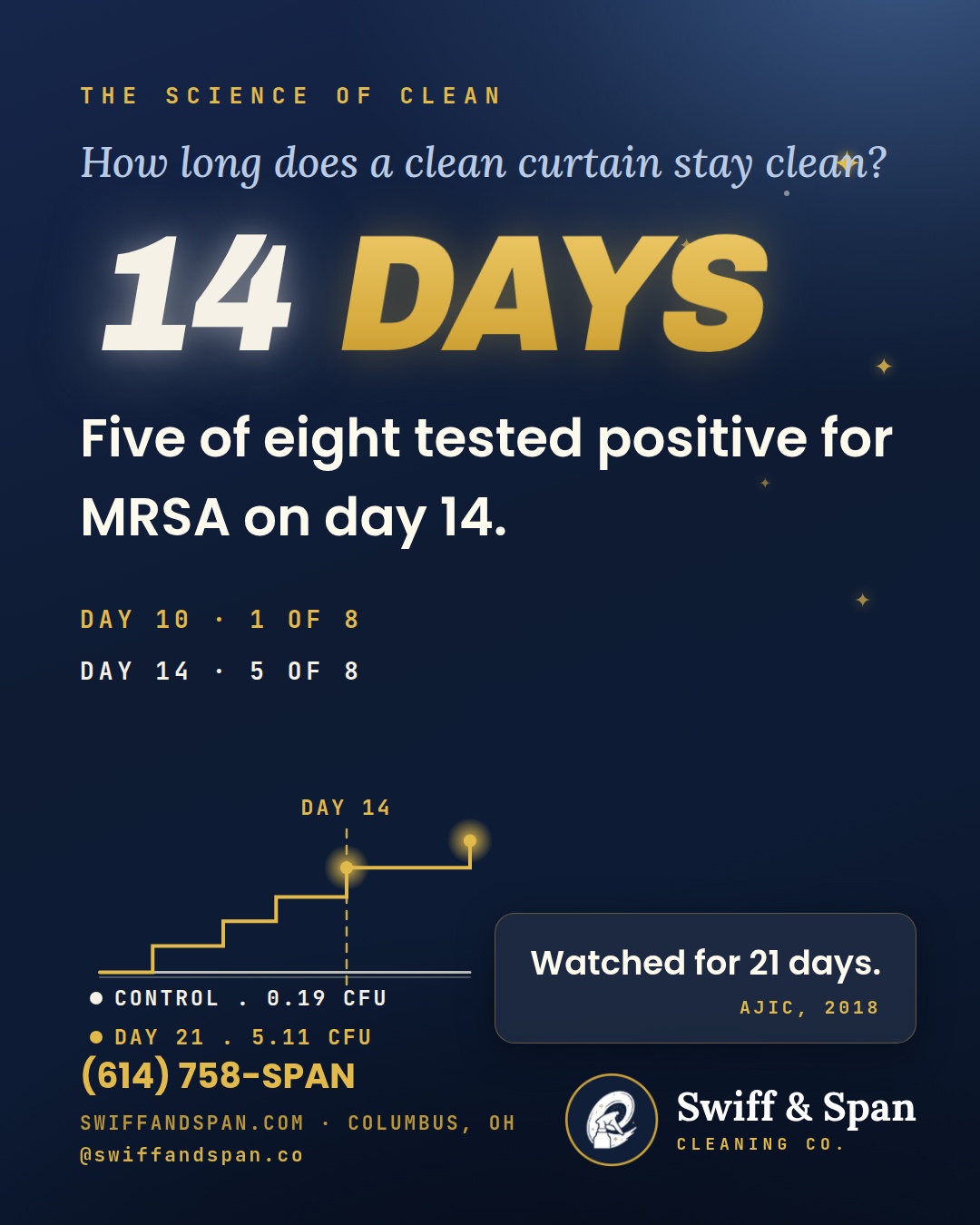
By day 3, the test curtains carried an average of 1.17 colony-forming units per square centimeter. The controls sat at 0.19. By day 17, the test curtains had climbed to 1.86. By day 21, they hit 5.11.
That is a fabric panel roughly the length of a hospital bed accumulating bacteria at a measurable, predictable, boring rate. And at no point in those 21 days did any of it become visible.
How do privacy curtains spread bacteria?
Consider what a privacy curtain actually is, structurally. It is a large, soft, porous polyester panel suspended at hand height, positioned so that the single most common way to interact with it is to grip it with a hand and drag it laterally.
Now consider when that grip happens. A hygienist finishes a scaling appointment and reaches for the curtain. A vet tech steadies a nervous cattle dog, then reaches for the curtain. A physician completes an exam, disposes of gloves, and reaches for the curtain on the way out, which reintroduces the hand to the surface the last set of hands touched.
Every other high-touch surface in that room has an owner. Counters get wiped. The exam table gets a barrier and a disinfectant pass. Door handles, light switches, faucet handles, the chair arm: all of these are hard, non-porous, and sit on somebody's checklist because they can be sprayed and wiped without consequence.
The curtain is soft goods. Soft goods do not go on the disinfectant checklist, because a spray bottle and a microfiber cloth are not what fabric is for. So the curtain occupies a strange category: touched constantly, cleaned never.
A 2015 study in the Journal of Hospital Infection put actual observers in patient rooms and recorded 1,107 person-episodes and 6,144 contact-episodes over 66 hours of direct watching. Bed curtains landed in the top 10 high-touch items. More importantly, they were among the items mutually touched by healthcare workers, patients, and visitors alike. Bedside rails topped that list at 13.6 contact-episodes per hour. The curtain is not far behind, and unlike the rail, nothing ever cleans it.
How fast do clean privacy curtains get contaminated?
Within days. In the Winnipeg longitudinal study, freshly hung test curtains averaged 1.17 colony-forming units per square centimeter by day 3 against 0.19 on the controls, and reached 5.11 by day 21.
Within days. In the Winnipeg longitudinal study, freshly hung test curtains averaged 1.17 colony-forming units per square centimeter by day 3 against 0.19 on the controls, and reached 5.11 by day 21.
The Winnipeg study, published in the American Journal of Infection Control in 2018, tracked more than raw bacterial load. It tracked what kind.
On day 10, 1 of the 8 test curtains was positive for methicillin-resistant Staphylococcus aureus. Four days later, on day 14, 5 of 8 were positive.
That is the spine of this article. Not the CFU curve, which climbs steadily and unremarkably, but the step change in the middle of the third week where a specific resistant organism goes from an outlier to a majority finding. The authors wrote it plainly:
"Between days 10 and 14 after being hung, curtains showed increased MRSA positivity. This may represent an opportune time to intervene, either by cleaning or replacing the curtains."
Read that again, because it is a rare thing in infection control literature. It is a specific window. Not "clean regularly." Not "as needed." A number, arrived at by watching fabric.
The finding is not an isolated one. A University of Iowa team sampled 43 curtains across 30 rooms and found that 41 of 43 were contaminated on at least one occasion. Of the 13 curtains newly placed during that study, 12 became contaminated within a single week, which is 92%. Twenty-one percent of the curtains carried MRSA. Forty-two percent carried vancomycin-resistant enterococci. An earlier study out of Cleveland found nearly identical VRE numbers, 42%, plus 22% MRSA and 4% Clostridium difficile, and demonstrated with hand imprint cultures that those organisms came off the fabric and onto hands without difficulty.
Then there is the emergency department study from 2016 that removed all ambiguity about transfer. Sixty participants handled curtains. Thirty of them, exactly half, acquired bacteria on their fingertips.
Why do cleaning checklists skip privacy curtains?
Because they are soft goods, and disinfectant checklists are built around hard, non-porous surfaces that can be sprayed and wiped. Counters, exam tables, and light switches all have an owner on the checklist. The curtain does not, so it lands in a strange category: touched constantly, cleaned never.
The national standard for this is CDC recommendation E.I.8 from the 2003 Guidelines for Environmental Infection Control in Health-Care Facilities, a Category II recommendation. Verbatim:
"Clean walls, blinds, and window curtains in patient-care areas when they are visibly dusty or soiled."
That is the whole instruction. And it is a reasonable one for walls and blinds, which do accumulate visible dust and do announce themselves when dirty.
But apply it to a privacy curtain and something quietly breaks. The trigger is visual. The contamination is not. A curtain at 5.11 CFU per square centimeter looks exactly like a curtain at 0.19. Polyester in a beige or sage weave is functionally a camouflage pattern for bacterial load. Nothing about day 14 announces itself. The MRSA does not change the drape.
So the practice manager in Dublin who reads her cleaning scope, sees curtains handled on a visibly-soiled basis, and signs it, has done nothing wrong. She has matched the national standard. The standard is simply built around a signal the surface does not emit.
How often should privacy curtains be cleaned?
Privacy curtains should be cleaned or replaced on a fixed schedule, not when they look dirty, and the published evidence points to an interval of roughly two weeks. The Winnipeg longitudinal study found MRSA positivity jumping from 1 of 8 curtains at day 10 to 5 of 8 at day 14, which is the window researchers themselves identified as the moment to intervene.
The follow-up work supports intervening rather than just laundering. A 2021 pilot randomized controlled trial published in Scientific Reports compared untreated control curtains against curtains treated with a disinfectant spray and curtains treated with a disinfectant wipe. At day 21, 64% of the control curtains carried MRSA. The spray-treated curtains: 10%. The wipe-treated curtains: 5%. Average bacterial load told the same story, 2.2 CFU per square centimeter on controls versus 1.3 and 1.5 on the treated groups.
Which means the fix is not exotic. It is a scheduled touch on a surface currently receiving none.
What does a curtain cleaning protocol include?
Three things separate a curtain protocol from a curtain intention.
A calendar interval, not a visual trigger. Soft goods in treatment areas get handled on a defined cycle, regardless of appearance. This is the entire lesson of the visibly-soiled gap.
Documentation that survives turnover. A protocol living in one senior tech's head is not a protocol. A dated log entry per curtain, per cycle, is the difference between a practice that can answer a question and one that can only reassure.
Measurement, so the interval is not a guess. ATP bioluminescence testing, the same firefly-enzyme chemistry used in food processing, gives a numeric readout of organic residue on a surface in about fifteen seconds. Swiff & Span holds an internal standard of 25 RLU on tested surfaces, and the reason to swab a curtain edge, a light switch, and a chair arm on the same visit is that the resulting numbers tell you which surfaces your current scope is actually reaching.
Nothing here is exotic. It is the ordinary discipline of treating a surface according to how often it is touched rather than how often it looks bad, applied to the one item in your operatory that has escaped that logic entirely.
Your next move
Walk into your busiest treatment room, a Grandview dental suite, a New Albany veterinary exam room, a Short North independent practice, and find out one thing: when was that curtain last taken down. If nobody can answer, you have your answer.
Then ask your current cleaning provider what their curtain interval is. Not whether they clean curtains. What the interval is, in days, and where it is written down.
If you want a number rather than an assurance, Swiff & Span runs a complimentary ATP walkthrough for Columbus-area practices, curtain edge included.
Frequently Asked Questions
What does the CDC standard actually say about curtain cleaning?
CDC recommendation E.I.8 from the 2003 Guidelines for Environmental Infection Control in Health-Care Facilities says to clean walls, blinds, and window curtains in patient-care areas when they are visibly dusty or soiled. That visual trigger works for walls and blinds, but bacterial contamination on a privacy curtain is invisible. A curtain at 5.11 CFU per square centimeter looks exactly like a curtain at 0.19.
Can bacteria transfer from a privacy curtain to hands?
Yes. A 2016 emergency department study had 60 participants handle privacy curtains, and exactly half of them acquired bacteria on their fingertips. An earlier Cleveland study used hand imprint cultures to demonstrate that organisms including MRSA and VRE came off the fabric and onto hands without difficulty.
Does treating curtains with disinfectant actually reduce MRSA?
The published evidence says yes. A 2021 pilot randomized controlled trial in Scientific Reports found that at day 21, 64% of untreated control curtains carried MRSA, against 10% of curtains treated with a disinfectant spray and 5% treated with a disinfectant wipe. The fix is not exotic. It is a scheduled touch on a surface currently receiving none.
Sources
- Shek K, Patidar R, Kohja Z, et al. Rate of contamination of hospital privacy curtains in a burns/plastic ward: A longitudinal study. American Journal of Infection Control, 2018.
- Ohl M, Schweizer M, Graham M, et al. Hospital privacy curtains are frequently and rapidly contaminated with potentially pathogenic bacteria. American Journal of Infection Control, 2012.
- Trillis F, Eckstein EC, Budavich R, et al. Contamination of hospital curtains with healthcare-associated pathogens. Infection Control & Hospital Epidemiology, 2008.
- Larocque M, Carver S, Bertrand A, et al. Acquisition of bacteria on health care workers' hands after contact with patient privacy curtains. American Journal of Infection Control, 2016.
- Cheng VC, Chau PH, Lee WM, et al. Hand-touch contact assessment of high-touch and mutual-touch surfaces among healthcare workers, patients, and visitors. Journal of Hospital Infection, 2015.
- Assessment of cleaning methods on bacterial burden of hospital privacy curtains: a pilot randomized controlled trial. Scientific Reports, 2021.
- Centers for Disease Control and Prevention. Guidelines for Environmental Infection Control in Health-Care Facilities, 2003.