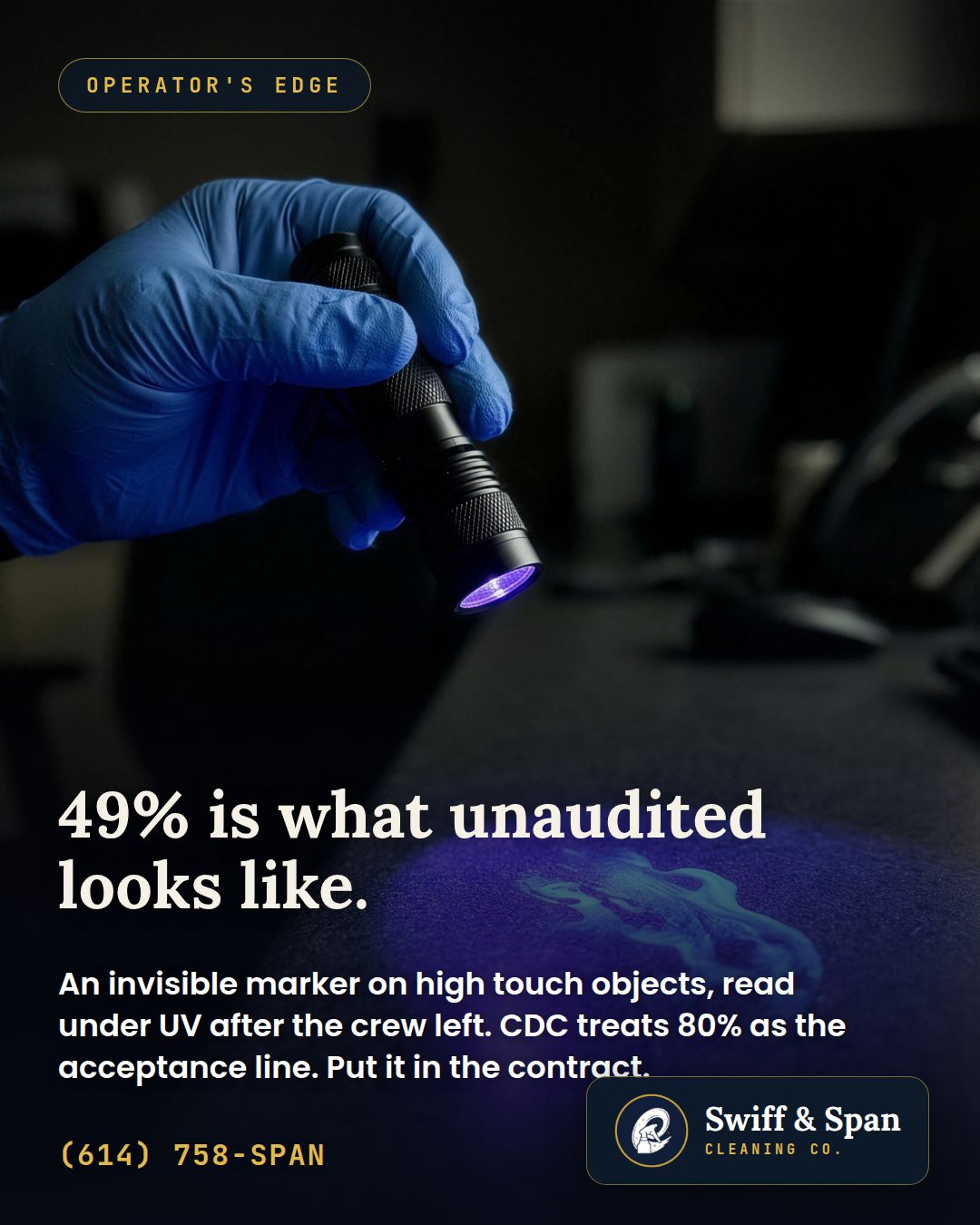
Somebody worked out how to grade a cleaning crew without watching them, without asking them, and without believing a single line written on a checklist. The tool is a marker. You cannot see what it writes.
The gel goes on clear, vanishes in room light, survives being brushed against, and comes off when a surface is actually wiped. You dot your high-touch objects after hours. The crew works. You come back with a UV flashlight. Every mark still glowing is an object a hand never reached.
Said out loud before anything else: this is hospital research. Paul Carling and colleagues ran it across 23 acute care hospitals and published it in 2008. A teller line is not a patient room and we will not pretend it is. What ports to your building is the method, not the numbers.
How do you know if your cleaning crew actually cleaned?
You mark high-touch objects with an invisible fluorescent gel before the crew arrives, then read them under UV afterward. The mark is gone or it is not. It measures whether the object was wiped, not whether the room looks good.
Across those 23 hospitals, only 49% of standardized environmental surfaces were cleaned during terminal cleaning. Individual hospitals ranged from 35% to 81%.
The spread matters more than the average. Had every hospital landed near 49%, you would conclude that this is simply what cleaning is. Instead one building hit 81% and another hit 35%, with comparable staff and comparable checklists. Thoroughness is a property of the building, not of the trade.
Which surfaces do cleaning crews miss the most?
The ones that never look dirty. In the hospital data, toilet handholds, light switches and doorknobs averaged below 30% cleaned. Sinks and toilet seats cleared 75%. The crew was cleaning to an appearance rather than to a standard.
A sink announces itself. A toilet seat announces itself with enthusiasm. A light switch never does. It looks identical whether it was wiped ten minutes ago or ten weeks ago.
So it gets skipped. Not out of laziness, and we say that as people who do this work. A crew skipping the switch plate is following its real instruction, which is make this room look finished. The marker is not a trap. It is a signal generator for surfaces that are otherwise silent.
What is a good thoroughness of cleaning score?
Eighty percent. The CDC's evaluation toolkit, written by Guh and Carling in December 2010, says it in one sentence: "When hospitals have achieved a thoroughness of cleaning rate of >80%, the number of surfaces to be monitored can be decreased."
Notice what that sentence does. It is not a compliment. It is a workload decision. Below 80% you keep watching. At 80% and above you can watch less.
Which makes it the most portable number in the literature. You are not claiming your dealership is a hospital. You are borrowing an acceptance criterion with a citation behind it.
How do you run the invisible marker test yourself?
Buy a UV-fluorescent gel marker and a 365nm UV flashlight. Mark 12 to 15 objects after hours, unannounced. Read them the next morning before anyone arrives. Divide marks removed by marks placed. That number is your thoroughness rate.
1. Buy the right light. A gel marker and a 365 nanometre UV flashlight run under forty dollars together. The 395nm blacklight torches wash everything in purple.
2. Pick 12 to 15 objects, not 40. Enough for a rate you can trust, few enough to read in ten minutes before the doors open.
3. Mark where a real wipe would land. The face of the switch plate, the shaft of the door lever, the top edge of the counter lip. Not the underside, not inside a seam.
4. Photograph every mark under UV. You will not remember where the fourteenth dot went, and an audit you cannot reconstruct is an argument you will lose.
5. Do not announce it. An announced audit measures the ceiling. You want the floor, which is an ordinary Tuesday when nobody is looking.
6. Score it binary. Removed or not removed. A smear counts as not removed, because a smear means the cloth touched the object and did not clean it.
7. Repeat in 30 days on different objects. One audit is an anecdote. Three are a trend line, and a trend line is what a crew gets managed against.
Which objects should you mark in your building?
The ones everybody touches and nobody watches. The list differs by facility, but the selection rule never does: pick objects that look identical dirty and clean.
Compounding pharmacy. The door pull between the retail floor and the anteroom, both sides. The card reader keypad. The will-call bin rails. The refrigerator handle. The anteroom light switch.
Bank branch teller line. The customer-side lip of the counter. The pen base. The drive-through drawer handle. The safe deposit lever, both sides. The light switch in the room where loans get signed.
Dealership service lounge. The coffee dispenser lever. The television remote. The arms of the two chairs nearest the door, which everyone takes. The service advisor's keyboard. The push plate to the shop floor.
Med spa treatment room. The table adjustment lever. The light switch inside the room. The cabinet pull on the consumables drawer. The cradle a handheld device rests in between clients. The door lever, both sides.
Corporate office suite. The conference room dimmer. The HDMI dongle. The kitchen faucet handle. The microwave keypad. The stairwell door handle nobody claims.
Notice what repeats: light switches, door levers, and whatever a hand rests on while waiting. Those categories are exactly where the hospital numbers collapsed, and none of them is clinical. A doorknob in Upper Arlington behaves like a doorknob on a ward.
How do you write a cleaning standard into your contract?
Put the number in the document. Thoroughness of cleaning, measured by unannounced fluorescent marker audit on no fewer than twelve high-touch objects, shall meet or exceed 80% removal.
A version you can hand to counsel:
"Thoroughness of cleaning will be verified by unannounced fluorescent marker audit on a rotating set of no fewer than twelve client-selected high-touch objects, conducted no more than once per calendar month. A removal rate at or above 80% is acceptable. A rate below 80% triggers a written corrective plan within five business days and a re-audit within fifteen."
Three things that clause does that a scope of work does not. It turns clean from an opinion into a measurement both parties read off the same flashlight. It caps the audit at monthly, so the tool cannot become harassment. And it offers a path back rather than a termination trigger, which is why a good vendor signs it. The rest of the terms worth arguing over are in seven cleaning contract clauses that should make you nervous.
One restraint. Do not fire anybody over a first read of 62%. The first audit is a baseline, taken against a scope nobody was measuring. The second is the fact.
What does ATP testing add to a marker audit?
The marker tells you whether an object was wiped. ATP tells you what is still sitting on it after the wipe. One measures coverage, the other measures result, and a surface can be fully wiped and still read high.
ATP bioluminescence borrows firefly enzyme chemistry to put a number on organic residue in about fifteen seconds, reported in RLU. We hold tested high-touch surfaces to 25 RLU. If you have never seen the scale, RLU scores explained covers where the thresholds sit and what the number cannot tell you.
Neither instrument answers "does it look clean," which is the only question most cleaning agreements in Dublin, Hilliard and Westerville currently ask. If you want to know what your own surfaces read, we wrote that one up as your facility may look clean, but what would the numbers say.
Run it on us
We have now handed you a forty dollar method for catching a cleaning contractor doing 49% of the job while the lobby looks excellent. We are aware that we are a cleaning contractor.
That is the point. Mark our objects. Read us in the morning. Hold us to 80% and write it into the agreement. A vendor who flinches at being measured has told you more than any walkthrough will, for the price of a flashlight.
Whether you run a pharmacy in Clintonville, a branch in Bexley, a dealership in Worthington, a studio in the Short North, a suite in New Albany, or a Licking County office, the test is the same and it runs Monday. If you would rather watch the numbers appear live, we bring the luminometer and you keep the readings. Call (614) 758-SPAN, or see what actually happens in a complimentary ATP walkthrough.
Frequently Asked Questions
What is the invisible marker test for cleaning?
It is an audit method that uses a gel marker invisible in room light and visible under UV. You place a dot on high-touch objects before the crew arrives and read the objects under a UV flashlight afterward. A mark that survives means the object was never wiped.
What percentage of surfaces do cleaning crews actually clean?
In the largest published marker study, covering 23 acute care hospitals, only 49% of standardized environmental surfaces were cleaned at terminal cleaning. Individual hospitals ranged from 35% to 81%. Those are hospital numbers, not office numbers, but the spread shows thoroughness is a property of the building rather than the industry.
What is a passing thoroughness of cleaning score?
The CDC evaluation toolkit written by Guh and Carling puts it at 80%. The sentence reads: when hospitals have achieved a thoroughness of cleaning rate of >80%, the number of surfaces to be monitored can be decreased. Above 80% you can watch less. Below it, you keep watching.
Does the hospital marker research apply to a pharmacy, bank or office?
The method applies. The numbers do not transfer. Every figure in this research was measured in acute care hospitals, and a dealership service lounge is not a patient room. What ports over is the audit itself, because a light switch behaves the same way in every building: touched constantly, never visibly dirty, easy to skip.
What is the difference between a marker audit and ATP testing?
The marker tells you whether an object was wiped. ATP tells you what is still sitting on it. One measures the crew's coverage, the other measures the result of the wipe. A surface can be fully wiped and still read high if the cloth was saturated, the chemistry was wrong, or the dwell time was cut short.
Sources
- Carling PC, Parry MF, Von Beheren SM, Healthcare Environmental Hygiene Study Group. Identifying Opportunities to Enhance Environmental Cleaning in 23 Acute Care Hospitals. Infection Control & Hospital Epidemiology, 2008;29(1):1-7. Cambridge Core
- Guh A, Carling P. Options for Evaluating Environmental Cleaning. Centers for Disease Control and Prevention, December 2010. CDC toolkit PDF