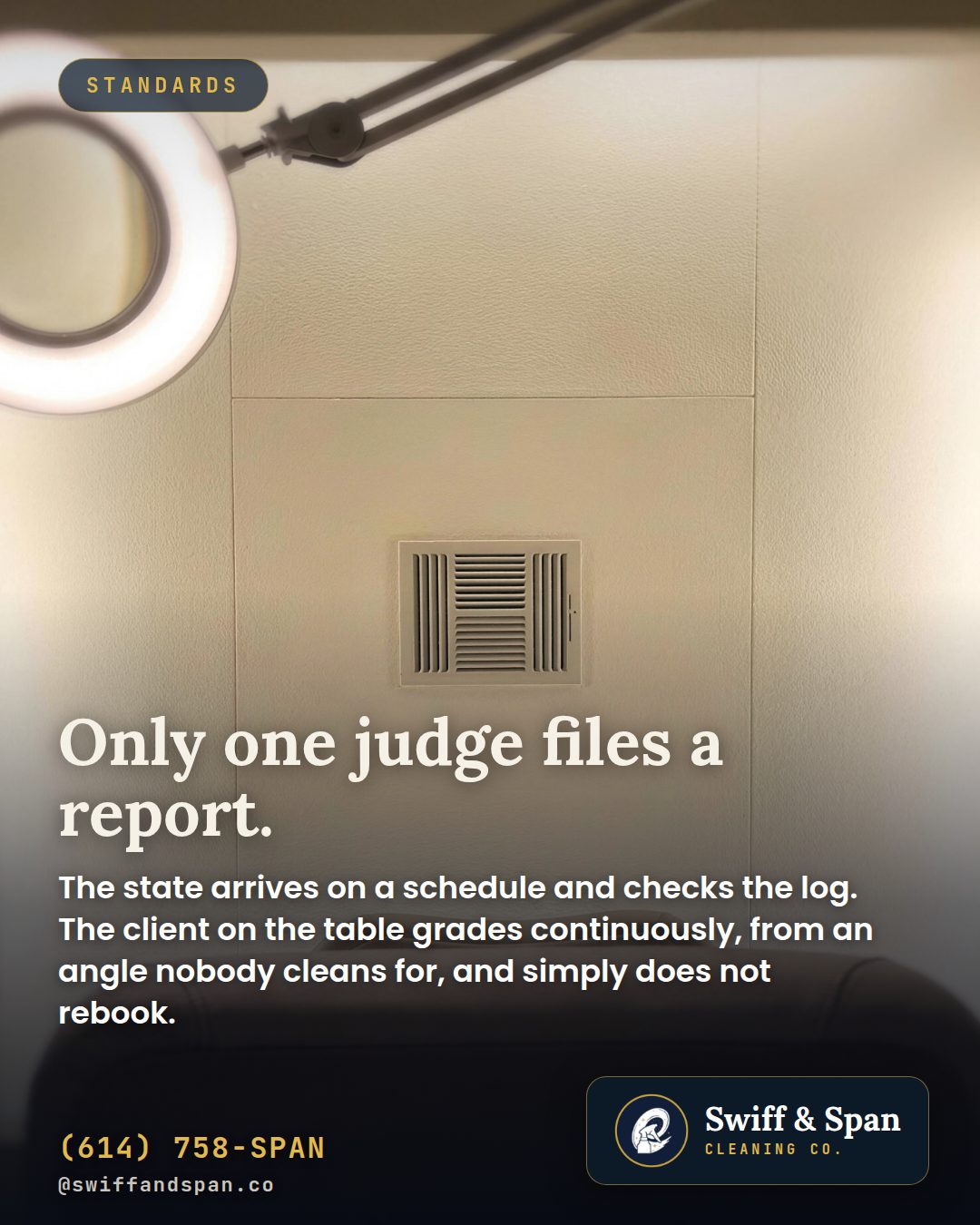
Aesthetic practices are graded twice, by two judges who never compare notes.
The first judge is the state. It arrives on a schedule, checks sharps handling, disinfection logs, licensure, autoclave records, and the things that appear on a citation. Pass and you keep operating.
The second judge is a woman on a treatment table with nothing to look at but your ceiling and the edge of your counter. She grades continuously, silently, and she never files a report. She just does not rebook.
Most of the cleaning conversation in this industry is aimed at the first judge. The revenue is decided by the second.
Does passing inspection mean a med spa is clean?
A compliance standard is binary and scheduled. It asks whether a protocol exists, whether it was followed, whether it was documented. It is satisfiable. You can be finished.
A perception standard is continuous and comparative. It asks whether this room feels like a place that handles needles near my face. It is never finished, because it resets with every client who walks in, and it is judged against every other room she has been in, including her own bathroom and the spa she visited in another city.
Here is the part that catches practices off guard. The two standards can point in opposite directions.
A treatment room can be fully compliant and still read as neglected: a water spot on the mirror, a smudge at hand height on the glass partition, dust on the top edge of the machine housing, a baseboard nobody has looked at in eleven months. None of these appear on any inspection. Every one of them is at eye level for someone lying down.
And the reverse is just as true. A room can look immaculate and be poorly cleaned. Fragrance is the usual culprit, which is why "smells clean" is a con. Shine is not a measure of anything. A high-gloss surface wiped with the wrong cloth and no dwell time looks better than a properly disinfected matte one.
What do clients notice in a treatment room?
Sightlines from the table, not from standing. Ceiling vents, the top surfaces of equipment housings, fingerprints on glass at hand height, floor corners and baseboards, and the underside of the armrest.
Spend ten minutes lying on your own treatment table before your next client day. The sightlines are completely different from standing, and the list is short and specific.
- The ceiling and the vent above the chair. Directly in the field of view for the entire appointment. Vent grilles collect visible dust and almost nothing in a standard scope touches them.
- The top surfaces of equipment. Machine housings, cart tops, the lip above a drawer pull. Cleaned at eye level when standing, invisible from there, obvious from below.
- Glass and mirror at hand height. Partitions, cabinet fronts, mirror edges. Fingerprints read as recency, and recency reads as "nobody has been in here since the last person."
- The baseboard and the floor corner. The most reliable tell in any room. It is where a rushed crew stops, and it is at eye level for anyone seated in the waiting area too.
- The underside of the armrest. She will touch it. She may be the only person who ever does.
None of these are hygiene failures in a clinical sense. All of them are trust failures, and trust is what the treatment is priced on.
Is daily cleaning enough for a treatment room?
Frequency is the answer practices reach for, and it is the wrong axis. Daily cleaning at the wrong height, with the wrong cloth, in the wrong sequence, produces a room that is cleaned daily and still fails both judges.
Three mechanisms do more than frequency:
- Sequence. Top-down, clean-to-dirty. Cleaning a counter before the shelf above it guarantees the counter gets recontaminated. Our cleaning process runs this order every visit for exactly that reason.
- Color-coded microfiber. A separate cloth color per zone, so a restroom cloth cannot reach a treatment surface. This is the single cheapest upgrade a practice can make, and it is invisible until you realize the alternative was one cloth and a bucket.
- Dwell time. EPA-registered disinfectants have a contact time on the label, usually somewhere between one and ten minutes. A surface sprayed and immediately dried has been wet, not disinfected. The chemistry cleaners skip covers what that actually requires.
Frequency without those three is motion. With them, a well-run room holds its standard between visits, which is the real goal.
Why does the same cleaner matter in a med spa?
Everything above is a list, and a list can be handed to anyone. The perceptual standard cannot, because it is not a list. It is a memory of one specific room.
The person who cleans your treatment room every week learns that the machine on the left has a housing lip that shows dust in the afternoon light, and that the second room's mirror streaks unless it is dried in one direction. Nobody writes that down. It accumulates in a person.
Rotate the crew and it resets to zero. That is the mechanism behind the 90-day quality fade: month one is the sales crew, month four is whoever the pool assigned, and your rooms are being relearned on your clients' appointments. The same small team returning every visit is what turns a checklist into judgment, which is the only thing that satisfies a judge who never files a report.
What can actually be measured about clean?
Perception is subjective. Cleaning effectiveness is not, and that is worth separating out.
An ATP swab reads organic residue on a surface. It gives a number in RLU, and it tells you whether a surface was actually cleaned or only wiped, which is the exact question the eye cannot settle on a glossy countertop. We hold cleans to below 25 RLU. What ATP testing measures explains the number and its limits: it reads residue, so it speaks to cleaning effectiveness rather than to disinfection or to any regulatory status.
For aesthetic practices, the useful pairing is a measured standard on the surfaces that carry clinical weight, plus photo documentation every visit on the surfaces that carry perceptual weight. One protects the license. The other protects the rebooking.
Verification runs on the cadence set in your contract, weekly, biweekly, or monthly depending on the room. For wellness and aesthetic spaces in Dublin and the Short North, it typically earns its place on treatment surfaces and the shared consultation room.
Why does high volume make this worse?
The practices that feel this most are the ones running at capacity. Room turnover compresses, the same crew has less time between clients, and the perceptual details are the first thing that gets traded away because they are the ones nobody documents. We wrote about why summer is the hardest cadence for a med spa for the same reason.
The fix is not heroics on a busy day. It is deciding in advance which surfaces are non-negotiable at every turnover and which belong to the nightly clean, then writing that down so it survives a full schedule.
What I would do first
Book yourself as your own client. Lie on the table. Look up, then left, then down at the baseboard. Write down the first five things you see.
That list is your real scope, and it will not match your current one.
If you want a second set of eyes, I will walk your space for 30 minutes at no cost, swab the treatment surfaces, and hand you the readings. The numbers are yours to keep, either way.
A share of every contract supports Columbus organizations serving Franklin County children facing homelessness and poverty. Clean is the product. It is not the point.
Frequently Asked Questions
How often should a med spa treatment room be cleaned?
Treatment surfaces are handled at every client turnover, and the full room including vents, equipment tops, glass, and baseboards runs on the nightly clean. Frequency matters less than sequence: top-down and clean-to-dirty, with disinfectants held to their labeled contact time.
What is a good ATP reading for a treatment surface?
We hold cleans to below 25 RLU. ATP measures organic residue, so it indicates how effectively a surface was cleaned. It is a cleaning-verification measure and does not by itself speak to disinfection or regulatory status.
Why does color-coded microfiber matter in an aesthetic practice?
A dedicated cloth color per zone keeps a restroom cloth from ever reaching a treatment surface. It is a low-cost change that removes an entire category of cross-contamination, and it is one of the first things worth asking any cleaning vendor about.