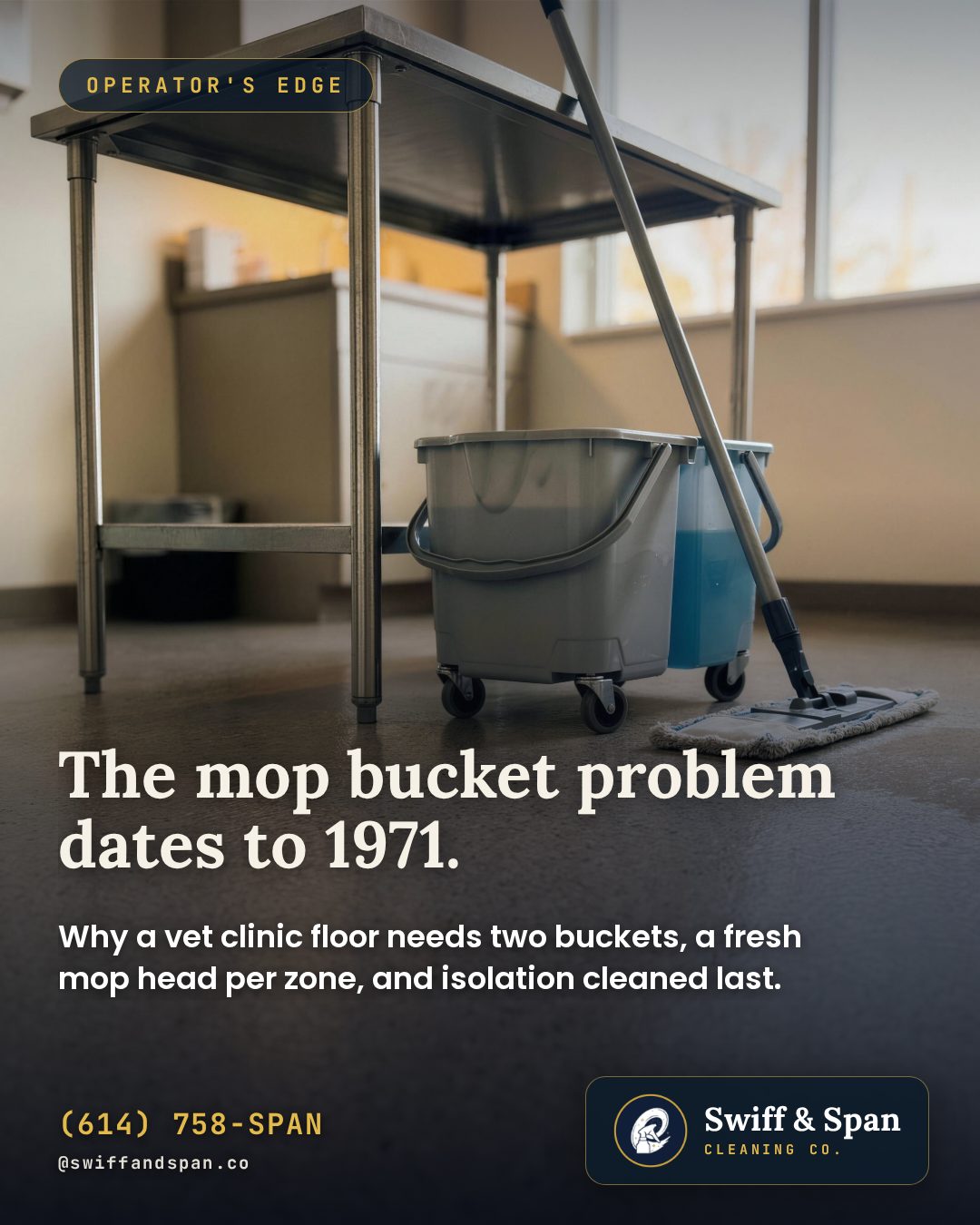
In April 1971, three microbiologists at Ottawa General Hospital published a paper with a title that reads like a confession: “Hospital Sanitation: the Massive Bacterial Contamination of the Wet Mop.”
They had already watched contamination spread through their hospital by way of the floor routine. So they went looking for the source, and they found it leaning against the wall in the janitor’s closet. Mops stored wet grew bacteria to very high levels. Soaking them in chemical disinfectant did not adequately fix it. Laundering and drying did. And counts built back up whenever mops were not changed daily or the disinfectant was left out of the wash water.
That paper is older than the barcode scanner at your front desk. The routine it warned about is still the default in a lot of veterinary clinics: one bucket, one mop, every room, top of the shift to bottom.
Here is the question this piece answers: why does a vet clinic floor need two buckets, and what else has to change for the second bucket to matter?
What is wrong with mopping out of one bucket?
Short answer: the mop carries the floor back into the solution, and then carries the solution to the next floor. Every dip after the first one is a little less clean than the one before it.
Picture the exam room at 6 p.m. A mop head goes into the bucket, out onto the floor, and picks up what a day of patients left behind. Then it goes back into the same bucket to be rinsed and recharged. Whatever came off the floor is now in the solution. The next pass lays a thin coat of that solution onto the next stretch of floor, and the next room, and the hallway.
By the fourth room, the bucket is not holding cleaning solution anymore. It is holding a soup of every room you have already done, with a disinfectant in it that is quietly losing the argument.
A 2022 report in the American Journal of Infection Control caught exactly this in a modern hospital. Researchers who happened to be culturing patient room surfaces for another study found large numbers of bacteria on handrails and equipment controls that had not been there before the room was cleaned. The trail led to a housekeeper who had not emptied and dried a bucket of quaternary ammonium disinfectant between uses and had carried the same bucket through several rooms. The solution still showed antimicrobial activity in the lab. It was contaminated anyway.
That is the uncomfortable part. A bucket can contain a perfectly good disinfectant and still be the thing that spreads the problem.
Why is a veterinary floor harder than a human one?
A dental operatory floor collects dust, tracked-in grit and whatever settles from the air. A vet exam room floor collects all of that, plus hair, dander, drool, urine, the occasional anal gland incident, and grit from paws that walked in off a wet parking lot. Patients sit on it, lie on it, and in some cases eat things off it.
Three things make it a special case:
- Hair arrives first and in volume. Wet-mop a floor covered in hair and you have made a hairy paste, and the paste goes into the bucket.
- The chemistry has to match the pathogen. Canine parvovirus has no lipid envelope, which leaves a quaternary ammonium disinfectant with very little to attack. We wrote about that in parvo does not care about your quat. A bucket of quat carried into an isolation room is the wrong tool even before it gets dirty.
- Hands are not carrying the load. Covert video across 38 clinics logged hand hygiene compliance at 14 percent, with a median handwash of two seconds, as covered in two seconds is the median handwash in a veterinary exam room. When hands are not reliable, the environment has to be.
The floor is also the biggest surface in the room, and the one people least expect to matter. We made the case that it behaves like a reservoir in hospital floors are a reservoir. In a clinic where patients are at floor level, the reservoir has visitors.
What does the two-bucket method actually do?
It separates the clean from the used, every single time the mop goes down.
One bucket holds fresh cleaning solution, mixed to the label dilution. The other bucket is for wringing and rinsing. The mop comes off the floor, goes into the rinse bucket, gets wrung out there, and only then goes into the clean solution to be recharged. The dirty water never touches the clean water. The solution you put on the last room is the same solution you put on the first.
That is the whole trick, and it is almost insultingly simple. It is also the step a rushed crew is most likely to skip, because one bucket is lighter and faster to fill. We covered the general version in color-coded microfiber and the two-bucket method.
Is two buckets enough on its own?
No. The 1971 paper and the 2022 report point at two other failures the second bucket does not fix by itself.
The mop head. The Ottawa team found that a mop stored wet becomes its own culture and is not adequately rescued by soaking it in disinfectant. Laundering and drying worked. So the mop head does not go back on the hook damp at the end of the night, and it does not travel from the isolation room to the lobby. Each zone gets a fresh microfiber head, and used heads go out to be laundered and dried.
The bucket itself. The 2022 case was a bucket that was never emptied and dried. Buckets get emptied, rinsed and left to dry between uses. A half-full bucket waiting in the closet overnight is a small pond, and ponds grow things.
Then there is the order of the evening.
What order should a vet clinic floor be cleaned in?
Clean to dirty, dry before wet, low risk before high risk. In practice, for a typical small animal clinic in Columbus:
- Dry removal first. Hair and grit come up before any liquid touches the floor. We use HEPA vacuums (ProTeam GoFit) so the fine dander and dust stay in the filter instead of going back into the air the next patient breathes.
- Lobby and offices. The lowest-risk floors go first, with fresh solution and fresh mop heads.
- Exam rooms. Fresh head per room. The rinse bucket gets changed when it looks like it needs it, and well before that.
- Treatment area. Its own head, and the disinfectant matched to the surface and the risk.
- Isolation, kennels and runs last. Separate heads that never leave that zone, with chemistry chosen against the clinic’s own protocol. Where a bleach product is called for, such as Clorox Healthcare Bleach Germicidal, it goes down at the dilution and contact time printed on its label, not the one that feels about right.
Every product we use is EPA-registered, matched to the surface, and held wet for its full label dwell time. Our standard lineup includes PDI Super Sani-Cloth, Diversey Oxivir Tb, Clorox Healthcare Bleach Germicidal and Spartan TB-Cide Quat, and which one goes where is a decision about the pathogen and the surface, not about what is closest to hand. Cleaning comes first and disinfecting comes second, because a disinfectant poured onto a film of hair and drool spends its effort on the film.
How do you know the floor routine is working?
Not by the smell. A floor that smells like lemons tells you a fragrance was used.
We swab high-touch surfaces with a Hygiena EnSURE Touch meter and UltraSnap swabs, and read the result in relative light units. Under 100 RLU is generally considered clean industry-wide. Our own standard is 25 RLU. ATP measures organic residue left on a surface, so it tells you whether the cleaning actually happened, which is the question a floor routine is supposed to answer. The background is in what is ATP testing.
Every visit also comes with a room-by-room checklist and photo documentation. If you ever want to know whether the isolation mop head stayed in isolation on a Thursday, there is a record.
Who does the mopping?
The same crew every visit. Our team is background-checked and brings a minimum of fifteen years of professional cleaning experience, which matters here more than almost anywhere. The two-bucket method is easy to explain and easy to abandon at 9 p.m. when the last room is the kennel run. Experience is what keeps the second bucket on the cart.
What to check in your own clinic this week
Walk into your janitor’s closet after the evening clean and look for three things:
- How many buckets are on the cart? One is the 1971 problem.
- Are the mop heads dry, or hanging damp? Damp is the culture the Ottawa team found.
- Does the isolation room have its own mop head? If it shares one with the lobby, the lobby is visiting isolation every night.
None of this needs a lab. It needs a look.
Veterinary clinics in New Albany, Dublin, the Short North, Columbus, Upper Arlington, Bexley, Hilliard and Worthington can book a complimentary 30 minute ATP walkthrough. Erik will walk your exam rooms and treatment area with you, swab the surfaces your team touches most, and leave you the readings. Call (614) 758-SPAN, or see our veterinary clinic cleaning page.
A portion of every contract supports Columbus youth programs.
Sources
- Westwood JCN, Mitchell MA, Legacé S. Hospital Sanitation: the Massive Bacterial Contamination of the Wet Mop. Applied Microbiology, April 1971.
- American Journal of Infection Control, 2022, in-use disinfectant bucket identified as a source of surface contamination (as reported by Infection Control Today and Cleaning & Maintenance Management).
Frequently Asked Questions
What is the two-bucket mopping method?
One bucket holds fresh cleaning solution and the other is used to rinse and wring the mop. The mop is always wrung out in the rinse bucket before it goes back into the clean solution, so dirty water never mixes with the solution going onto the next floor.
Why is one-bucket mopping a problem in a veterinary clinic?
Each dip returns what the mop picked up to the bucket, so the solution gets dirtier with every room. A 1971 hospital study traced spreading contamination to wet mops, and a 2022 hospital report traced contaminated surfaces to a disinfectant bucket carried through several rooms without being emptied and dried.
Does a quat disinfectant kill parvovirus on a clinic floor?
Canine parvovirus has no lipid envelope, which leaves quaternary ammonium disinfectants with little to attack. Parvo-risk areas need a product whose label supports that use, applied at the label dilution and contact time, after the floor has been cleaned.
How often should mop heads be changed in a vet clinic?
Use a fresh microfiber mop head for each zone, keep isolation and kennel heads in those areas, and launder and fully dry used heads. Research from 1971 found wet-stored mops grew bacteria to very high levels and were not adequately decontaminated by soaking in disinfectant.
Does Swiff & Span clean veterinary clinics in Columbus?
Yes. We clean veterinary clinics across New Albany, Dublin, the Short North, Columbus, Upper Arlington, Bexley, Hilliard and Worthington with a background-checked crew with a minimum of fifteen years of experience, the same team every visit, and a complimentary 30 minute ATP walkthrough. Call (614) 758-SPAN.
Every Columbus dental, medical, wellness, and commercial facility gets the same offer: a complimentary 30-minute ATP walkthrough. We swab your highest-touch surfaces, on the spot, and hand you the readings. No obligation, no pitch required to see the number. Book your complimentary ATP walkthrough or text (614) 758-SPAN.
Erik Kuusisto, Owner
Swiff & Span Cleaning Company