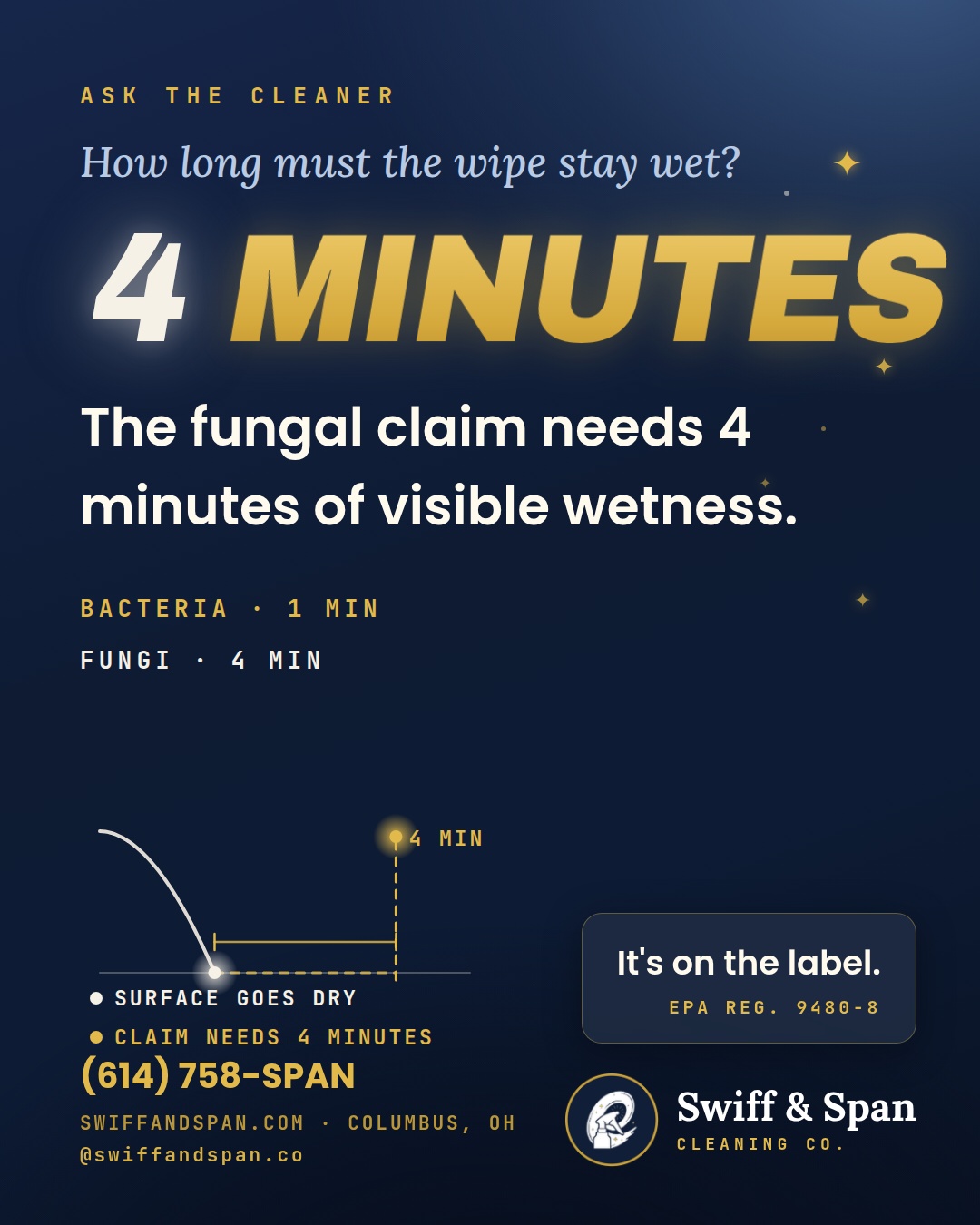
There is a line on the label of a hospital bleach wipe that names three organisms in a row: Trichophyton interdigitale, Candida albicans, and Aspergillus brasiliensis. A ringworm and athlete's foot fungus, a yeast, and a mold used as a laboratory standard. They are grouped together on that label because they share a number, and the number is 4.
PDI Sani-Cloth Bleach Wipes, EPA Reg. No. 9480-8, states it in the plainest language a federal document ever manages: "Allow surface to remain visibly wet for four (4) minutes."
That same wipe handles bacteria in 1 minute. Norovirus in 1 minute. Mycobacterium bovis BCG, the tuberculosis surrogate, in 2. The fungi take 4. Which is inconvenient, because if you run a heated room in Grandview, a reformer studio off High Street in the Short North, or a small-group training floor in Dublin, fungi are the category you are most likely to be moving around the room. Everyone is barefoot. The mats are stacked warm.
What does a disinfectant contact time require?
Here is the part almost every cleaning checklist gets backwards. A contact time is not a countdown you start after wiping and then ignore. It is a description of the surface's condition for that entire duration. The chemistry only works while it is in liquid contact with the organism. Dry disinfectant is not slow disinfectant. It is finished disinfectant.
PDI's own published guidance says this without hedging: treated surfaces must remain visibly wet for the full contact time, and when airflow, temperature, humidity, or surface porosity causes early drying, "additional wipes may be needed to keep the surface wet. The overall contact time itself does not change."
Read that last clause again. The requirement does not bend to your schedule. If the surface dries at minute 2 of a 4 minute claim, you have not achieved a 2 minute disinfection. You have achieved an unvalidated event.
Why do mats absorb disinfectant?
Because a mat is porous, so it pulls the liquid in rather than holding it on the surface where the chemistry needs to stay.
Now add the substrate problem, which is bigger than the drying problem and much less discussed.
Closed-cell TPE, PVC, natural rubber, cork, the microfiber top layer on a grip mat: these are not stainless steel. They absorb, they wick, and several of them are engineered specifically to pull moisture off skin, which is a polite way of saying they are built to defeat visible wetness.
The EPA addressed this directly in its December 2022 interim guidance on porous-surface efficacy claims: "Currently, most EPA-registered liquid-based antimicrobial products, including those on EPA's list of disinfectants effective against SARS-CoV-2 (List N) are registered for use on hard, non-porous surfaces (e.g., stainless steel, porcelain, glass)."
There is a narrow pathway for porous claims. It covers non-clothing fabrics, textiles, and upholstery laundered infrequently, in clinical and institutional non-residential settings, and it demands at least a 4.0-log reduction for bacteria and 3.0-log for viruses in 10 minutes or less. It exists. It is real. Very few products on very few shelves have gone through it.
So the accurate statement is not "you cannot disinfect porous surfaces." It is narrower and more useful: a product performs to the claim it was tested and registered for, and the vast majority of wipes in the vast majority of studio closets carry no porous claim at all. Using a hard-non-porous wipe on a foam mat is off label. Whatever happens on that mat, no federal registration stands behind it.
How fast does a wiped yoga mat dry?
Full candor, because the headline deserves it. Nobody has published a peer-reviewed figure for how quickly a wiped yoga mat goes dry. Eleven seconds is not a measurement. It is a placeholder for a measurement that does not exist.
That absence is the argument, not a weakness in it. You are running a 4 minute claim against an unmeasured variable, on a surface the product was never registered for, in a room that may be at 95 degrees with fans running. The honest position is that no one in your studio knows whether the contact time was met, because no one has ever checked.
And if you cannot say the contact time was met, you cannot say the surface was disinfected. You can say it was cleaned. Cleaning is real, valuable, and mechanically removes a great deal of what is there. It is simply a different claim, and the two get conflated constantly in this industry.
Can you disinfect a yoga mat?
In most cases, not with a standard disinfectant wipe, because those wipes are registered for hard non-porous surfaces and a mat is neither. To make a defensible disinfection claim on a mat you need a product whose EPA label actually covers that material, applied heavily enough to keep the surface visibly wet for the label's full contact time, which for pathogenic fungi such as the athlete's foot organism is 4 minutes. Otherwise the correct word for what happened is cleaning.
What has been found on gym equipment?
The literature is thinner than you would expect, and much of what circulates online is invented. There is no credible published CFU count for a yoga mat. There is no MRSA prevalence figure for mats. The "dirtier than a toilet seat" line is marketing folklore with no study behind it.
What does exist is worth knowing.
Bilung and colleagues, publishing in the Journal of Environmental and Public Health in 2018, swabbed 42 samples across gym surfaces including exercise mats, dumbbells, treadmills, dip stations, and back machines. 31 of the 42 samples, 73.81%, came back positive for Staphylococcus aureus.
A 2026 study in Pathogens took a more granular approach: 180 surface samples from 12 devices, sampled three times a day across five weekdays. Staphylococcus appeared in 54 of 180 samples, 30.0%. The 248 bacterial isolates spanned 61 species. Notably, S. aureus itself was uncommon at six isolates, with coagulase-negative S. saprophyticus more frequent at seventeen. Highest composite risk devices were the functional trainer and the leg extension, both at 42.3%. Fungi were explicitly excluded from that study, which is its own quiet commentary on how little we measure the thing the 4 minute claim was written for.
And a finding that should interest anyone reaching for the strongest product available: Fahimipour and colleagues, in mSystems in 2018, sampled 116 dust samples from 42 operating athletic facilities in Oregon, yoga, dance, and martial arts studios among them. Antibiotic-resistant bacterial isolates were cultured from all but one facility, with roughly 28% of colonies resistant to at least one tested antibiotic. Facilities with the highest triclosan levels averaged 1,307 nanograms per gram of dust against 410 in the others. More antimicrobial chemistry in the building did not mean a cleaner microbial picture. It correlated with a more resistant one.
What does a serious mat cleaning protocol do?
Five moves, none of them expensive, all of them boring in the best sense.
Match the chemistry to the substrate. Read the label for the surface, not just the organism list. If the mat material is not covered, you need a different product or a different process.
Control wet time on purpose. That means enough product to keep the surface visibly wet for the stated duration, a second application when the surface dries early, and a checklist that names the contact time in minutes rather than saying "wipe down."
Separate cleaning from disinfection in writing. Two lines on the checklist, two different claims. Staff should never have to guess which one they just performed.
Retire mats that can no longer be cleaned. Once the closed cell surface is cracked, gouged, or shedding, it is a porous sponge with a texture map. No protocol fixes that. Replacement is the protocol.
Verify instead of assuming. Swiff & Span uses ATP testing on studio surfaces and holds an internal standard of 25 RLU, which turns "it looks clean" into a number you can put in a log and compare week over week. Measurement is the only thing in this entire article that tells you whether any of the rest of it worked.
Studios in Clintonville, Italian Village, German Village, and New Albany are all running the same wipes against very different mat inventories and very different airflow. The chemistry does not adjust for any of that. Your protocol has to.
If you want to see what your own mats and equipment actually read, Swiff & Span offers a complimentary ATP walkthrough for Columbus studios: we swab, you watch the numbers come up.
Frequently Asked Questions
How long does a disinfectant wipe need to kill athlete's foot fungus?
On the PDI Sani-Cloth Bleach label, EPA Reg. No. 9480-8, fungi such as Trichophyton interdigitale require the surface to remain visibly wet for four minutes. The same wipe handles bacteria and norovirus in 1 minute and the tuberculosis surrogate in 2. Fungi are the slowest category on the label and the most relevant one in a barefoot studio.
Are standard disinfectant wipes registered for porous surfaces like mats?
Mostly no. The EPA's December 2022 interim guidance states that most EPA-registered liquid disinfectants, including those on List N, are registered for hard, non-porous surfaces such as stainless steel, porcelain, and glass. A narrow pathway for porous claims exists, but very few products have gone through it, so using a hard-surface wipe on a foam mat is off label.
Do stronger antimicrobial products make a studio cleaner?
Not according to the data. A 2018 study in mSystems sampled 42 operating athletic facilities in Oregon, including yoga, dance, and martial arts studios, and cultured antibiotic-resistant bacteria from all but one. Facilities with the highest triclosan levels in their dust did not show a cleaner microbial picture. More antimicrobial chemistry in the building correlated with a more resistant one.
Sources
- US EPA, PDI Sani-Cloth Bleach Germicidal Disposable Wipe, master label, EPA Reg. No. 9480-8
- US EPA, PDI Sani-Cloth Plus Germicidal Disposable Cloth, master label, EPA Reg. No. 9480-6
- PDI Healthcare, published FAQ on contact time and surface wetness
- US EPA, Interim Guidance for Products Including or Adding Efficacy Claims for Use on Porous Materials in Non-Residential Settings, December 2022
- Bilung et al., High Occurrence of Staphylococcus aureus Isolated from Fitness Equipment from Selected Gymnasiums, Journal of Environmental and Public Health, 2018, Article ID 4592830
- Martens, Schauer, Motevalli, Mair, Konig, Microbial Contamination of Gym Equipment, Pathogens, 2026; 15(7):707
- Fahimipour et al., Antimicrobial Chemicals Associate with Microbial Function and Antibiotic Resistance Indoors, mSystems, 2018; 3(6)