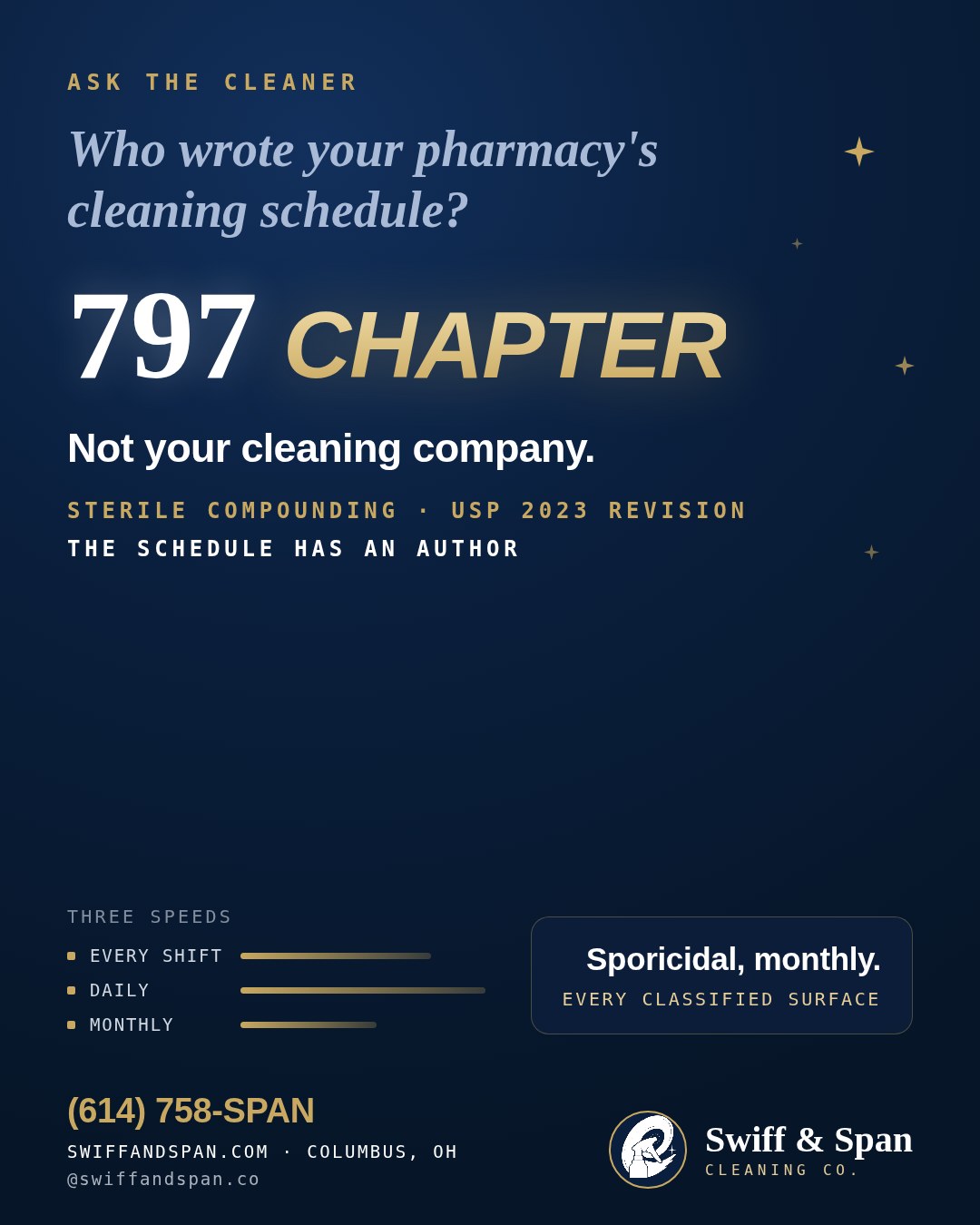
Ask the cleaner. That is the name of this series, and this week the question came from a pharmacist in Hilliard: who decides how often our compounding suite gets cleaned?
The answer is a document most cleaning companies have never opened. It is called USP Chapter <797>, it is written by the United States Pharmacopeia, and if your pharmacy compounds sterile preparations, it is the closest thing your cleaning schedule has to an author. The 2023 revision took effect on November 1, 2023, and it did something unusual for a standards document. It stopped talking in vibes and started talking in frequencies.
We like frequencies. Frequencies are numbers, and numbers are things you can hold a vendor to.
What does USP 797 actually say about cleaning?
Strip away the garbing diagrams and the beyond-use dating tables, and the cleaning portion of USP 797 comes down to a schedule with three speeds.
Every shift, or at minimum daily: the inside of the primary engineering control. That is the hood, the glove box, the laminar airflow workbench, whatever your suite uses as its cleanest cubic feet. Work surfaces inside it get sterile 70 percent isopropyl alcohol, and not the bottle from the supply closet. Sterile means sterile, filtered and sealed, because wiping a sterile zone with a non-sterile alcohol is a sentence that falls apart in the middle.
Daily: the horizontal world. Counters, carts, work surfaces and floors in the buffer room and ante room, cleaned with an EPA registered disinfectant that stays wet for its full labeled contact time. We have written before about why the wet part matters more than the spray part. A disinfectant that dries in forty seconds did not deliver its four minute kill claim, it delivered forty seconds.
Monthly: the vertical world. Walls, doors, ceilings and storage shelving. And here is the line the 2023 revision is known for among people who read these documents for a living: at least monthly, every surface in the classified space gets a sporicidal disinfectant. Not a stronger quat. A sporicidal agent, the class of chemistry built for bacterial spores like Bacillus and Clostridium, the organisms that shrug off standard disinfectants by wrapping themselves in a coat that ordinary chemistry cannot open.
That monthly sporicidal pass used to live mostly in USP 800, the hazardous drug chapter, where negative pressure rooms made it routine. The revision walked it into every sterile compounding space. Plenty of pharmacies found out from their state board inspector rather than from their cleaning vendor. That ordering is backwards, and it is the reason this article exists.
Why do so many pharmacy cleaning contracts miss it?
Here is the uncomfortable arithmetic. A pharmacy signs with a general commercial cleaning company. The crew is trained on offices. The contract says nightly service. Nobody on either side of that contract has read a word of Chapter 797, so the buffer room floor gets the same neutral cleaner as the break room, the walls get touched at move-out, and a sporicidal agent never enters the building.
The pharmacy is not cutting corners. The vendor is not lying. The schedule simply has no author. Chapter 797 was sitting right there, willing to be the author, and nobody invited it into the scope of work.
When we take on a pharmacy in Columbus, Dublin or New Albany, the chapter is the scope of work. Daily horizontals with a dwell-verified EPA registered disinfectant. Monthly verticals. Monthly sporicidal, documented, with the product name and EPA registration number on the log, because an inspector does not ask whether you cleaned, an inspector asks you to prove it.
How do you prove a compounding suite was actually disinfected?
A schedule tells you what was supposed to happen. It does not tell you what happened. That gap is where we put the meter.
We verify our pharmacy work the same way we verify a dental operatory: an ATP swab, on the spot, with the reading shown to you before we pack up. Adenosine triphosphate is the energy molecule in every living cell, and a luminometer counts it in relative light units in about fifteen seconds. A surface that was wiped looks identical to a surface that was disinfected. The number tells them apart. Photo documentation and the reading go in the same visit log, so when the board of pharmacy visits, your proof is not a stack of initials on a clipboard, it is data.
The same team walks your suite every visit. No rotating crews relearning your ante room from scratch every month, because the fastest way to break a classified space is to send someone into it who does not know which door is which. Every cleaner we send carries a minimum of fifteen years of professional cleaning experience, which is how we screen, not a substitute for the number on the meter.
Worth saying plainly: no cleaning contractor is certified to USP 797. It is a standard your pharmacy is held to, not a vendor credential. Our work is informed by the chapter and measured against it, which is a different sentence and a truer one.
What to ask your current vendor this week
Five questions, in the order most likely to end the meeting early.
- Which cleaning frequencies in our contract come from USP 797?
- What sporicidal agent do you apply, and how often?
- Is the alcohol used inside our hood sterile 70 percent IPA?
- What is the labeled contact time of your disinfectant, and how do you keep surfaces wet that long?
- Can you show me proof of any of this from your last visit?
If the answers arrive quickly, keep your vendor and shake their hand. If the answers are a pause followed by the word "industrial," call us.
Your next move
We are taking a limited number of new contracts under the Founder’s Deal: a three month commitment, the fourth month free, and your rate locked for as long as you stay. It starts with a complimentary walkthrough of your compounding suite, and we bring the ATP meter to the walkthrough, because the first number you see from us should be a measurement, not a price. Call (614) 758-SPAN or book your complimentary ATP walkthrough.
Frequently Asked Questions
What is USP 797 in plain language?
It is the United States Pharmacopeia's chapter on sterile compounding. It sets the conditions a pharmacy must maintain to compound sterile preparations safely, including specific cleaning and disinfecting frequencies. The current revision took effect November 1, 2023.
How often does USP 797 require pharmacy cleaning?
The interior of the primary engineering control is cleaned each shift or at minimum daily with sterile 70 percent isopropyl alcohol. Work surfaces, counters and floors in the buffer and ante rooms are cleaned daily. Walls, doors, ceilings and shelving are cleaned monthly.
What is the sporicidal requirement in the 2023 revision?
All surfaces in the classified compounding space must be disinfected with a sporicidal agent at least monthly. Sporicidal chemistry targets bacterial spores such as Bacillus and Clostridium that survive standard disinfectants.
Can a regular commercial cleaning company clean a compounding pharmacy?
Only if the scope of work is written from Chapter 797 and the crew is trained on classified spaces, correct agents and contact times. A standard office cleaning scope does not meet the chapter, however good the crew is at offices.
How do you prove a pharmacy was actually disinfected?
Documentation plus measurement. We log every agent, frequency and pass, and we verify surfaces with ATP testing on site, with readings shared the same visit.
Sources
- United States Pharmacopeia, Chapter <797> Pharmaceutical Compounding, Sterile Preparations, 2023 revision, effective November 1, 2023.
- Environmental Health & Engineering, "Solving the Unexpected Problem of the New USP 797 Sporicidal Disinfectant Requirement." eheinc.com.
- Foreman Pro Cleaning, "USP 797 Cleanroom Cleaning Standards for Pharmacy Compliance." foremanpro.com.