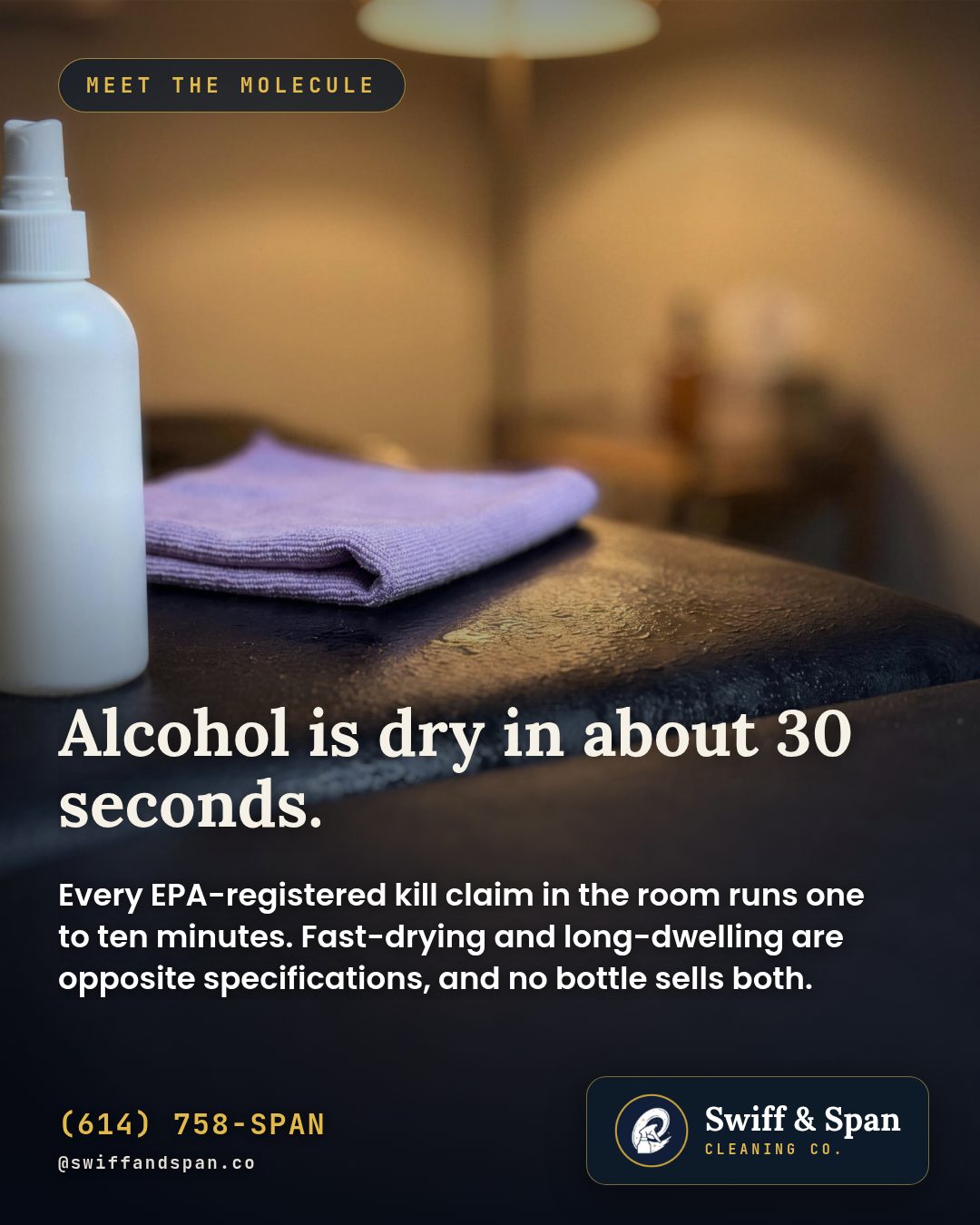
Rubbing alcohol is the only product in your treatment room whose main selling point is that it leaves.
Pour a little on a stainless tray and watch it. Half a minute, give or take the airflow, and there is nothing there. No film on the acrylic, no streak on the device window, no tacky patch where the next client puts a forearm. That disappearing act is exactly why the bottle is on the shelf.
It is also the entire problem.
Frequently Asked Questions
Does rubbing alcohol disinfect a treatment room surface?
Only within its own narrow window. Alcohol kills most vegetative bacteria and enveloped viruses while it is still liquid on the surface, but 70 percent isopropyl on a nonporous surface at room temperature is typically dry in about thirty seconds. EPA-registered surface disinfectants are labeled with contact times from roughly one to ten minutes, so alcohol is gone before most of those clocks have run. It also has no sporicidal action.
How long does isopropyl alcohol take to evaporate?
On a nonporous surface at room temperature, a thin film of 70 percent isopropyl alcohol is usually dry in about thirty seconds, and faster under airflow, a fan, or the heat of a device. Higher concentrations evaporate faster still, which is one of the reasons they disinfect less well.
Is 70 percent or 91 percent isopropyl alcohol better for disinfecting?
Seventy. The water content slows evaporation, which extends the time the alcohol is actually in contact with the surface, and it helps the alcohol penetrate the cell wall. Very high concentrations can coagulate protein on the outside of a cell into a barrier that shields what is inside. CDC disinfection guidance describes the effective band as roughly 60 to 90 percent.
What should a med spa use on a treatment table between clients?
A two-step sequence. Clean the surface first to remove body oil, product and serum residue, then apply an EPA-registered disinfectant that is compatible with the upholstery and keep the surface visibly wet for the full contact time on its label. Re-wet if it dries early. Choose the product against the surface material, since several common disinfectants damage treatment table vinyl.
Does alcohol still have a legitimate use in a treatment room?
Yes, wherever a manufacturer's instructions for use call for it: device screens and handpieces that name alcohol and exclude quats, skin antisepsis before a procedure, residue removal from stainless before the ultrasonic, and any surface where a disinfectant film would interfere with the next step. The error is using it as the between-client disinfectant for the table.
Every Columbus dental, medical, wellness, and commercial facility gets the same offer: a complimentary 30-minute ATP walkthrough. We swab your highest-touch surfaces, on the spot, and hand you the readings. No obligation, no pitch required to see the number. Book your complimentary ATP walkthrough or text (614) 758-SPAN.
Erik Kuusisto, Owner
Swiff & Span Cleaning Company