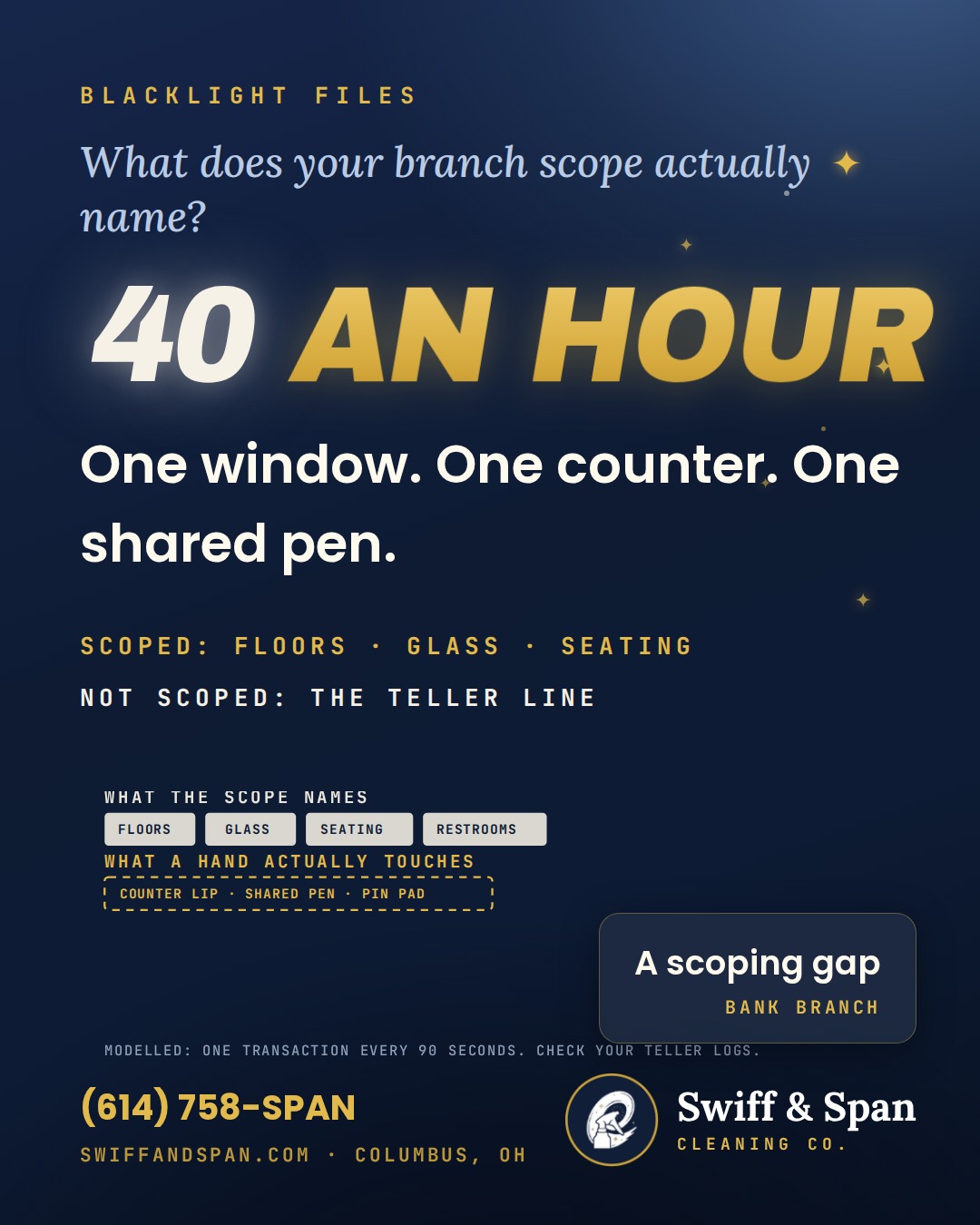
Pull up your branch’s cleaning contract and read the scope section out loud. Floors. Glass. Seating area. Restrooms. Somewhere in there, “counters wiped.” That last phrase is doing an enormous amount of work for four words, because it is very often the only line standing between your teller line and nothing at all.
That is worth sitting with, because the teller line is not a minor corner of the branch. It is the highest-contact square footage in the building, and in most scopes it is not named as its own item. It rides along under “counters” or gets folded into “customer area,” which is the same category as the magazine table in the lobby.
The scope tracks what a walkthrough notices, not what a hand touches
Here is the flip. A cleaning scope gets written the way a walkthrough happens: someone walks the branch and writes down what they see. Floors show wear. Glass shows streaks. The seating area shows crumbs and coffee rings. Restrooms get their own line because everyone agrees restrooms need one. All of that is visible, and a visible problem is easy to scope.
The teller line does not work that way. Nobody stands in a lobby and watches the counter lip get dirty. It looks clean between transactions because nobody is spilling anything on it. It just gets touched. A customer leans a forearm on it to sign a slip, hands a stack of bills across it, sets down a phone while they dig for an ID. None of that leaves a visible mark. All of it leaves a hand.
So the two things a branch cares about, what looks clean and what gets touched, point at almost opposite parts of the building. A scope built around the first one will faithfully clean the lobby forever and never once name the teller line as a line item, because nothing there ever looked dirty enough to earn one.
Where the traffic actually lands
Walk the teller line the way a customer does and a short list of surfaces takes almost all of the contact:
- The counter lip customers lean their forearm on while signing, waiting, or steadying a stack of cash or checks
- The shared courtesy pen clipped to the counter, used by every customer at that window who did not bring their own
- The deposit ledge where cash, checks, and deposit slips get set down and picked back up
- The PIN pad for debit transactions, touched by a different customer every few minutes
- The night deposit drawer, handled by whoever is closing out that day’s business deposits, often outside normal branch hours when nobody is watching the surface at all
Every one of those is a hand-contact surface at a volume the lobby furniture never sees. A lobby chair gets sat in for a few minutes by one person at a time, with long gaps in between. A teller window’s counter, pen, and PIN pad turn over constantly through a business day, one customer after another, all day.
What a typical scope names, against what gets touched
| Named in a typical branch scope | Actually gets touched this often |
|---|---|
| Lobby floor and entry mats | Foot traffic only, no hand contact |
| Glass doors and windows | Push plates and handles, not the glass itself |
| Seating area furniture | One customer at a time, long gaps between |
| Restrooms | High touch, but already its own scope line |
| “Counters wiped” (catch-all) | Counter lip, shared pen, deposit ledge, PIN pad, night deposit drawer, all folded into one phrase |
Read down that right column again. Four of the five highest-contact points in the branch are sitting inside a single catch-all phrase that most scopes treat as an afterthought to the lobby line above it.
Doing the arithmetic on a teller window
It helps to put a real number on how much traffic one window can see, and the honest way to do that is to build it from an assumption you can check against your own branch, not to hand you a figure and ask you to trust it.
Say a single teller window handles a routine transaction, roughly every ninety seconds, accounting for greeting the customer, processing the deposit or withdrawal, and handing back a receipt. Sixty minutes divided by ninety seconds works out to about 40 customers touching that one window’s counter, pen, and PIN pad in a single hour.
That is a modelled throughput number, not a count anyone took at a branch. Your real figure moves with the time of day, the day of the week, whether it is the first or fifteenth of the month, and how many windows you have staffed. A quiet Tuesday afternoon might run half that. A Friday before a holiday might run well past it. The math is simple enough that you can run it yourself against your own teller logs: take your busiest windows, ninety-second average or whatever your real average is, and see what the hourly number comes out to. The point is not the exact figure. It is that whatever number you land on, it is very likely larger than the number of people who sat in your lobby chairs that same hour, and the lobby chairs are the thing your scope actually names.
Why this matters more in a bank than most buildings
A dental operatory or a medical exam room already has a line item for high-touch surfaces, because the practice knows to ask for one. Branch cleaning contracts get written more like a general office contract, with a line for floors, a line for glass, a line for restrooms, and an assumption that “counters” covers the rest. That assumption is where the teller line falls through.
It is not that anyone is being careless. It is that the teller line does not present the way a dirty surface presents. Cash and paper move across it constantly, but cash and paper do not leave the same visible residue a coffee spill does. The counter looks the same at 9 a.m. and 4 p.m. even though a very different number of hands have been across it by the afternoon.
This is also where the difference between cleaning and cleaning verification earns its keep. A visual standard tells you whether a surface looks presentable. A cleaning verification step, an ATP swab read against a defined threshold, gives you a number for organic residue on a surface regardless of how it looks. It measures residue. It does not tell you anything about disinfection outcomes or compliance status on its own, and it is not a substitute for a written protocol. What it is good for is exactly this kind of blind spot: a surface that always looks fine and never gets checked because nothing ever prompted anyone to check it.
What to check in your own contract
You do not need a new vendor to fix this. You need your current scope language to say what it means. A few questions worth putting to whoever cleans your branch, or to yourself if you manage the account:
- Does the teller line counter, including the lip customers lean on, appear anywhere in the scope by name, or only inside a phrase like “counters wiped”?
- Is the shared courtesy pen ever removed, wiped, or replaced, or does it stay clipped to the counter indefinitely?
- Who is responsible for the PIN pad, and how often?
- Does anyone clean the night deposit drawer, given that it is handled at hours when the rest of the branch is empty?
- If verification is part of your contract at all, does it ever include a teller window, or only the areas that already have a visible standard?
None of those questions require a confrontation. They require reading your own scope the way you would read any other contract you are responsible for, line by line, and noticing which of your highest-traffic surfaces is riding along inside a phrase built for the lobby.
Branches across Dublin, Upper Arlington, Bexley, and Downtown Columbus all run this same scope pattern, because it is the industry default, not a mistake specific to any one building. A branch manager who checks the actual language in their contract, rather than the reputation of the vendor who wrote it, is usually the first person in the relationship to notice the gap.
Frequently Asked Questions
What is typically included in a standard bank branch cleaning scope?
Most scopes name floors, entry glass, the seating area, and restrooms as their own line items, since those are the surfaces a visual walkthrough notices first. The teller line usually has no dedicated line at all. It is folded into a general phrase like "counters wiped," which can mean anything from a daily wipe-down to an occasional pass, depending on how the vendor interprets it.
Why does the teller line need different treatment than the lobby?
A lobby chair gets touched by one person at a time with long gaps between uses. A teller window's counter, courtesy pen, and PIN pad turn over with a new customer every couple of minutes through the business day. High contact frequency, not visible dirt, is what should drive cleaning attention here, and a scope built around what looks dirty will consistently miss it.
How many customers actually touch a teller window in an hour?
There is no single real number, since it depends on your branch, staffing, and time of day. As a rough model, a transaction averaging about ninety seconds works out to roughly 40 customers touching that window's counter and PIN pad per hour. Run your own average transaction time against sixty minutes to get a figure you can check against your teller logs.
Does an ATP walkthrough prove a branch is disinfected or meeting regulatory standards?
No. An ATP swab measures organic residue on a surface and returns a reading against a cleaning target. It is a cleaning verification step, not a disinfection, sterilization, or regulatory test, and it does not certify anything on its own. Swiff & Span frames it as OSHA-Aware, HIPAA-Aware, and ADA-Aware protocol support, never as a guaranteed outcome.
What should a branch manager check first in their current contract?
Read the scope section the way you would any contract, line by line, and ask specifically whether the teller counter, the shared pen, the deposit ledge, the PIN pad, and the night deposit drawer are named anywhere by name. If they only appear inside a catch-all phrase like "counters wiped," that is worth a direct conversation with whoever cleans the branch now.
Every Columbus dental, medical, wellness, and commercial facility gets the same offer: a complimentary 30-minute ATP walkthrough. We swab your highest-touch surfaces, on the spot, and hand you the readings. No obligation, no pitch required to see the number. Book your complimentary ATP walkthrough or text (614) 758-SPAN.
Erik Kuusisto, Owner
Swiff & Span Cleaning Company