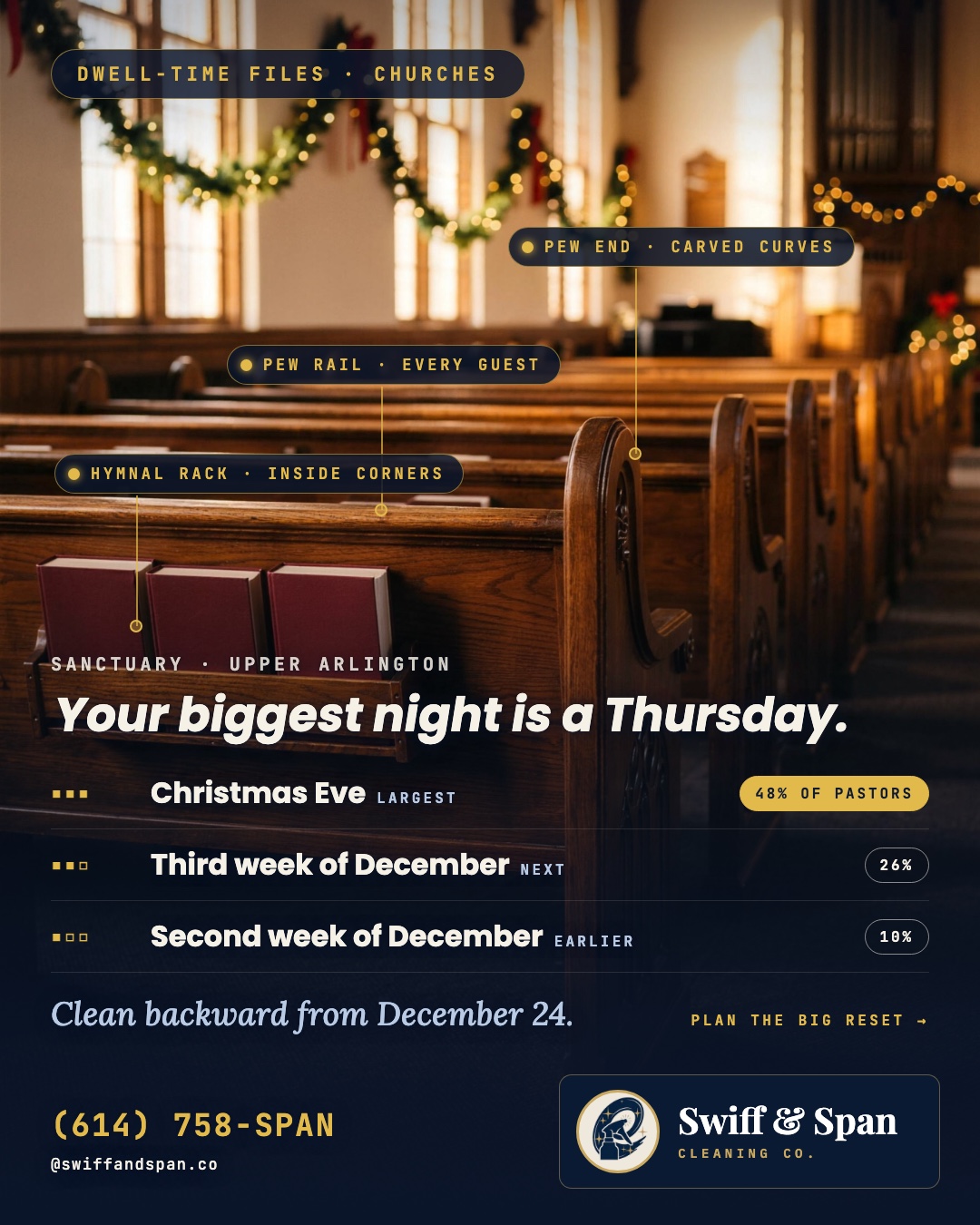
Your sanctuary will hold its biggest crowd of the year on a Thursday night this year.
Christmas Eve 2026 falls on a Thursday. For most churches, that one service outdraws every Sunday in December, and it lands four days after a full Sunday, in the middle of the week a regular cleaning schedule treats as quiet.
That is not a reason to worry. It is a reason to write the holiday cleaning plan now, while Advent is still a week away, and to build it backward from the night that matters most. This article covers what the attendance research says, which surfaces take the most hands, when electrostatic spraying earns its place on a pew, and a sample calendar a church administrator or facilities committee can hand to their cleaning company.
When is a church’s busiest day of the holiday season?
Christmas Eve, for about half of churches. In a Lifeway Research survey of 1,000 U.S. Protestant pastors, 48 percent said a Christmas Eve service is their church’s largest event of the holiday season. Attendance builds through December and tapers off into January.
The rest of the survey shows how sharp that build is. Only 6 percent of pastors named an event in the first week of December or earlier as their best attended, 10 percent named the second week, and 26 percent named the third week. Christmas Day (7 percent) and the first week of January (5 percent) trail far behind.
Read those numbers as a load curve for your building. Three quarters of churches see their biggest crowd either in the third week of December or on Christmas Eve itself. The cleaning plan should carry the same shape: steady in early December, heaviest in the week before December 24, and a recovery clean right after.
Why should a church plan holiday cleaning backward from December 24?
Because the big night breaks the weekly rhythm. Most church cleaning is scheduled around Sunday: reset on Saturday, recover on Monday. In 2026, Christmas Eve is a Thursday, four days after the Sunday of December 20, so a Sunday-only schedule leaves the year’s fullest room on a mid-week reset nobody planned.
Work back from that Thursday and the dates fall into place. The first Sunday of Advent is November 29. The Sundays that follow are December 6, 13 and 20. Many churches add a children’s program, a concert or a candlelight rehearsal in those weeks, and every one of them puts hands on the same pews, rails and doors.
A plan written backward also protects your people. The volunteers who set up greenery and the staff who run the nursery should not be the ones discovering at 3 PM on December 24 that the restrooms have not had a full clean since Monday.
Which church surfaces take the most hands during a holiday service?
The ones every guest shares on the way in, through the service and on the way out: entry door push bars, the pew back top rail, hymnal and card racks, pew end caps, stair and chancel rails, the welcome desk, restroom fixtures, and in the nursery, the tables, changing surfaces and toys.
A full holiday service is a long chain of touches. A guest pushes the entry door, takes a bulletin at the welcome desk, grips the pew rail to sit and to stand, reaches into the hymnal rack, passes the offering plate along the row, and repeats much of it in reverse on the way out. Visitors who come only at Christmas do not know where the restrooms are, so the hallway door hardware gets more traffic than on an ordinary Sunday.
Candlelight services add a job of their own: wax on the pew finish, the carpet and the end caps. Wax comes off more cleanly when it is lifted carefully the next morning than when it is scraped in a hurry an hour before the next service.
If your church has never written its high-touch list down, start with the one on our church cleaning page and add anything specific to your building.
Can you use an electrostatic sprayer on church pews?
Yes, with three conditions. Clean the pews first, use only a disinfectant whose EPA label includes electrostatic spray directions, and let the surface stay wet for the label’s full contact time. EPA does not recommend electrostatic spraying for any product whose label does not include directions for that method.
Pews are the kind of surface electrostatic application was made for. A sanctuary seating area is row after row of curved top rails, carved ends, hymnal racks with inside corners and the undersides a cloth rarely reaches. An electrostatic sprayer gives each droplet a charge, so the droplets spread evenly and wrap toward the back and underside of the shape instead of landing only where the nozzle points. We explain the physics, and the limits, in electrostatic spraying: what it actually does.
Each of the three conditions matters on its own:
- Clean first. A sprayer applies disinfectant; it does not remove soil. Product sprayed over hand oils and dust is partly used up on that film. Our article on why cleaning and disinfecting are two different steps covers the chemistry.
- Read the label for the method. Here is EPA’s own wording: “Unless the pesticide product label specifically includes disinfection directions for fogging, fumigation, wide-area or electrostatic spraying, or application via drones (i.e., unmanned aerial vehicles (UAV)), EPA does not recommend using these methods to apply disinfectants.” We only put a product in the sprayer when its label carries those directions.
- Hold the wet time. An even coat applied in seconds still needs its full label contact time, commonly one to ten minutes, to do what the label says. Our disinfectant contact time explainer shows why the minutes decide the outcome.
Two cautions for a sanctuary. Finished wood deserves a spot test on a hidden area before the first full pass, and the push bars and rails people grab most still get a hand-wiped pass with microfiber. Spray complements the cloth; it does not replace it.
What does a holiday cleaning calendar look like for a church?
It follows the attendance curve: a full baseline clean before Advent, a steady weekly reset through mid-December, the heaviest clean in the days before Christmas Eve, short resets between services that night, and a recovery clean afterward. Here is an example for 2026 that a church can adjust to its own services.
- Week of November 23 (before the first Sunday of Advent, November 29). Baseline clean of the whole building: sanctuary, nursery and children’s rooms, fellowship hall, restrooms and entries. Write down anything worn, sticky or damaged now, while there is time to fix it.
- Weeks of November 30, December 7 and December 14. The regular post-Sunday reset, plus a short pass after any mid-week concert, pageant or rehearsal. Restrooms and the nursery get their full checklist each time.
- Monday, December 21, to Wednesday, December 23. The big reset. Sanctuary seating cleaned and then given an electrostatic pass with a label-approved product, push bars and rails hand-wiped, restrooms deep cleaned and restocked, the nursery on its own checklist, floors last.
- Thursday, December 24, between services. A 20- to 30-minute turnaround: restrooms, entry hardware, the welcome desk, the nursery, and a quick look along the pews for spills and wax.
- Saturday, December 26, or Monday, December 28. Recovery clean: wax removal, carpet spot treatment, a full restroom clean, and a walk of the building with a written list of anything that needs repair before the new year.
Order matters on every one of those visits. We work top to bottom and clean to dirty, with color-coded microfiber so restroom cloths never touch a pew. The two-bucket method and color coding explains why.
Who at a church should own the holiday cleaning plan?
One named person, usually the church administrator, the business manager or the facilities committee chair. That person holds the service calendar, so they are the one who can tell the cleaning company about the extra concert, the funeral moved to a Tuesday, or the second Christmas Eve service added in October.
Most holiday cleaning problems are calendar problems. The crew cleans on its usual day, a choir rehearsal and a reception happen the next evening, and Sunday morning starts with a fellowship hall nobody reset. A one-page calendar shared with your cleaning company in November prevents most of it.
Churches in Upper Arlington and across Columbus often have a second building issue in December: weekday groups, preschools or community meals that share the same rooms. Put those on the calendar too. The pews may rest on a Tuesday; the fellowship hall rarely does.
What should a church ask its cleaning company before Advent?
Five questions, each with a specific answer you can check:
1. Have you seen our full December service calendar, including Christmas Eve on Thursday, December 24? You want dates on their schedule, not “we’ll be there Saturdays.” 2. Which product goes in your electrostatic sprayer, and does its EPA label include electrostatic directions? You want a product name and a yes. 3. What is that product’s contact time, and how do you keep the surface wet for it? You want a number of minutes. 4. What happens between our Christmas Eve services? You want a named person, a time window and a short list. 5. What do we get after each visit? A room-by-room checklist with photos tells the administrator and the board what was done before the doors opened.
If the answers are vague, the gap is in the plan, not the people. A cleaning crew can only follow the schedule and the scope it was given.
The short version for a busy church office
Nearly half of Protestant pastors say Christmas Eve is their biggest event of the season, and in 2026 it is a Thursday. Build the cleaning calendar backward from that night, put the heaviest clean in the three days before it, and plan a short reset between services. On the pews, electrostatic spraying is a good tool when the surface is cleaned first, the product’s label allows the method, and the wet time is respected.
If you want a second set of eyes on your building before Advent, Book your complimentary ATP walkthrough. We walk the sanctuary, nursery and restrooms with you, read your current cleaning scope against your December calendar, and leave you a short written list of what to change. It takes about 30 minutes, and you keep everything we find. Call (614) 758-SPAN or visit swiffandspan.com. If you are near the Upper Arlington area, we can usually be there the same week.
Frequently Asked Questions
What is the most attended church service of the holiday season?
Christmas Eve, for about half of churches. In a Lifeway Research survey of 1,000 U.S. Protestant pastors, 48 percent said a Christmas Eve service is their largest event of the holiday season. Another 26 percent named an event in the third week of December.
Can you use an electrostatic sprayer on church pews?
Yes, if the pews are cleaned first, the disinfectant's EPA label includes electrostatic spray directions, and the surface stays wet for the label's full contact time. EPA does not recommend electrostatic spraying for products whose labels do not include directions for that method.
When should a church schedule its deep clean before Christmas?
In the days right before Christmas Eve, after the last Sunday of Advent. In 2026 that is Monday, December 21, through Wednesday, December 23, with a short reset between Christmas Eve services and a recovery clean on December 26 or 28.
Which church surfaces should be cleaned most often during the holidays?
Entry door push bars, pew back rails, hymnal racks, pew end caps, stair and chancel rails, the welcome desk, restroom fixtures, and nursery tables, changing surfaces and toys. These are the surfaces nearly every guest touches during a full holiday service.
Does electrostatic spraying replace wiping pews by hand?
No. An electrostatic sprayer applies disinfectant evenly around curved surfaces, but it does not remove soil. Pews and rails still need cleaning first, and the push bars and rails people grab most should get a hand-wiped pass with microfiber.
Every Columbus dental, medical, wellness, and commercial facility gets the same offer: a complimentary 30-minute ATP walkthrough. We swab your highest-touch surfaces, on the spot, and hand you the readings. No obligation, no pitch required to see the number. Book your complimentary ATP walkthrough or text (614) 758-SPAN.
Erik Kuusisto, Owner
Swiff & Span Cleaning Company