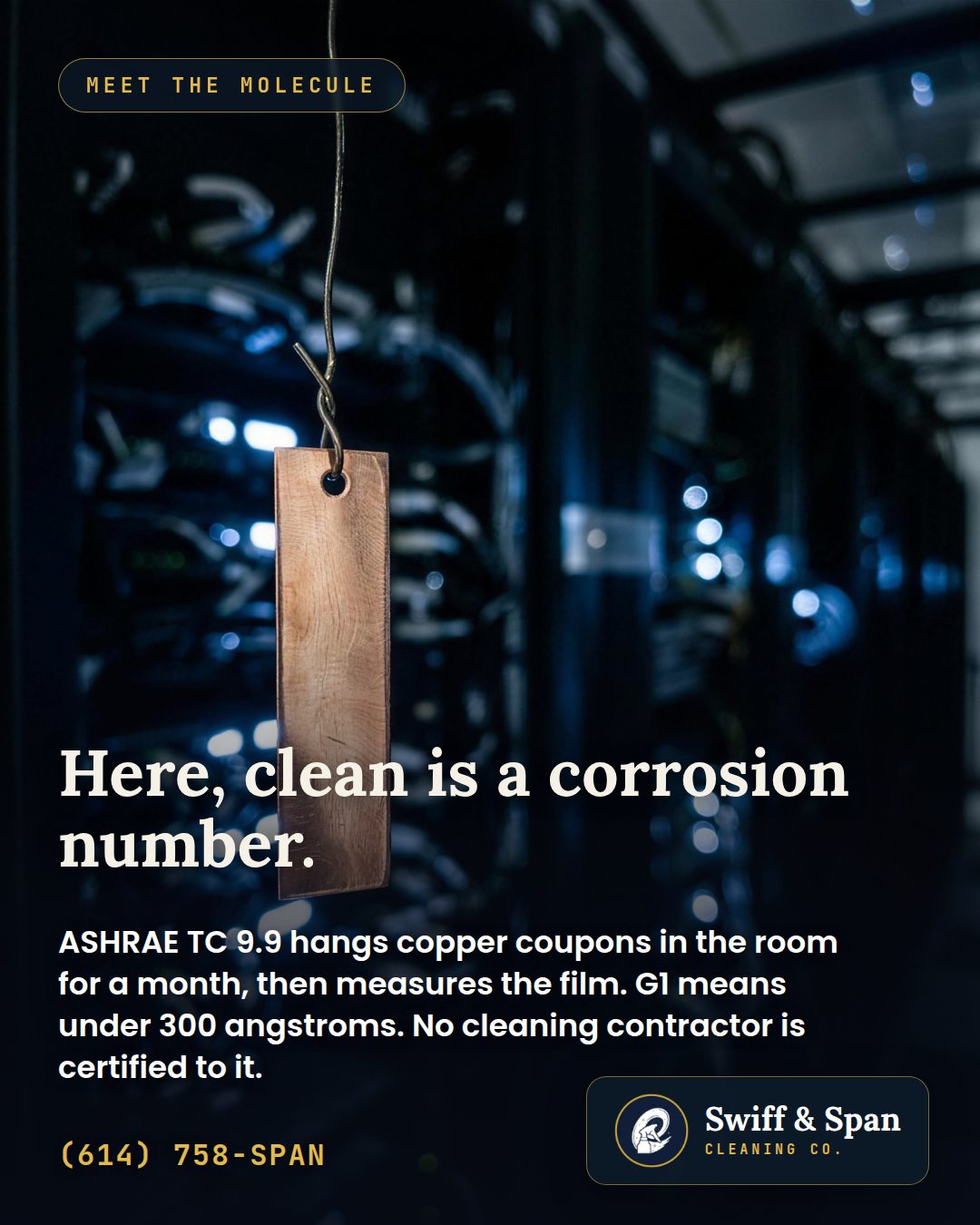
There is a small strip of polished copper hanging inside a data hall right now, doing nothing at all except corroding on a schedule. It is the most important object in the room.
It is called a coupon. Somebody weighed it, polished it, hung it in the airstream, and left it for thirty days. Then it gets pulled, sent to a lab, and stripped one atomic layer at a time so a technician can report exactly how thick the corrosion film became. That thickness, in angstroms, is the grade the room receives.
ASHRAE Technical Committee 9.9 put it in writing in the 2011 Gaseous and Particulate Contamination Guidelines for Data Centers. For a Severity Level G1 environment, the language is unsentimental: "the reactivity rate of copper coupons shall be less than 300 Å/month." Silver gets its own line, "the reactivity rate of silver coupons shall be less than 200 Å/month."
No square footage. No appearance clause. No mention of whether the floor shines.
What is ASHRAE Severity Level G1 in a data center?
G1 is ASHRAE's benign environment classification, the one a data hall is supposed to hold. A room qualifies when copper coupons hung in the airstream corrode at less than 300 angstroms per month, and silver coupons at less than 200 angstroms per month.
The elegance of the coupon is that it does not care about your opinion. It integrates thirty days of everything the room contained, gaseous sulphur, chlorides, whatever came through the louvres from a highway or a cooling tower, and reduces all of it to a single number. It is a report card written by chemistry, and it arrives after the exam.
How thick is 300 angstroms?
An angstrom is one ten-billionth of a metre. So 300 angstroms is 30 nanometres, a film roughly two thousand times thinner than a human hair. That is the pass or fail line for a room holding equipment worth more than the building it sits in.
Sit with that for a second. Nobody can see 30 nanometres. Nobody can smell it. It has no colour at that thickness, no texture, no smell of ozone or anything else that would tip off a person walking the aisle with a clipboard. A room can be six months into a failing corrosion trend and photograph beautifully the entire time.
That is the whole argument for why a data hall cannot be cleaned by eye. Most rooms give up a visual signal when they are losing. A waiting room looks tired. A treatment table shows its wear. A data hall gives you nothing, and then one day it gives you a lab result.
Why does ASHRAE write the dust limit as a humidity number?
Because settled dust is inert until it goes conductive. ASHRAE's particulate line reads: "The deliquescent relative humidity of the particulate contamination should be more than 60%." Not how much dust. Not how visible. At what humidity the dust turns into a liquid.
Deliquescence is the point at which a hygroscopic particle pulls enough water vapour out of the air to dissolve itself into solution. Below that humidity it is a powder sitting on a board, chemically bored. Above it, the same particle is a droplet of electrolyte bridging two things that were never meant to be bridged. Same dust. Same board. Different day.
Which makes this a seasonal, regional problem, and central Ohio is not exempt. A New Albany campus in February is ringed by road salt, and chloride salts have a low deliquescent point. Track enough of that across a raised floor in wet boots and you have imported a contaminant whose entire risk profile is a humidity setpoint away.
Where does data center dust actually come from?
Mostly from people and packaging, not from the air handlers. ISO 14644-1:2015 Class 8 caps a room at 29,300 particles per cubic metre at 5.0 microns, and particles that large do not drift in through a filter. They come off shoes, cardboard and ceiling tile.
That is the part worth internalising. The fine end of the particle distribution is the mechanical system's job. The coarse end is a behaviour problem: a pallet broken down inside the white space, a box cut open next to a rack, a tile lifted and set down without a mat, a contractor in the same boots he wore across the parking lot. Every one of those is a decision, not an equipment failure. We wrote about the ugliest version of this, the metal that grows in the dark under a raised floor, and the same principle holds: the room is fine until somebody disturbs it.
One clarification the industry muddies constantly. ISO 14644-1 Class 8 is a facility classification verified by third-party particle count. Swiff & Span is not certified to it, and no cleaning contractor anywhere is. It is a standard to be informed by and measured against, which is a different and more honest relationship than the one some vendors imply on their capability sheets.
What air filtration does ASHRAE recommend for a data center?
ASHRAE writes that room air "may be continuously filtered with MERV 8 filters," and that air entering the data center "may be filtered with MERV 11 or MERV 13 filters." Those numbers describe the building's air handling specification. They belong to the facility, not to any cleaning vendor.
What we find instructive is the grammar. ASHRAE did not write "high-quality filtration" or "premium air handling." It wrote MERV 8, MERV 11, MERV 13, because a number can be verified by a person who was not in the room when the decision was made.
Now go read the cleaning scope for the same facility. Odds are good it says something like "dust racks as needed" and "detail clean quarterly." Those are adjectives wearing a schedule's clothing. A cleaning specification for a data hall should read like the ASHRAE filtration line: named surface, named method, named frequency, named exclusion. We built a whole piece on the contract language that shifts risk back onto the facility, and the pattern is always the same. Vagueness is never accidental.
Is ATP testing useful in a data center?
No, and it costs us nothing to say so. ATP bioluminescence measures organic residue, the biological load that matters on an operatory tray or a break room counter. A data hall's contamination problem is inorganic: sulphur compounds, chloride salts, zinc, fibre.
ATP is the instrument our name is built on, and it is still the wrong instrument for this room. Swabbing a rack rail for RLU would produce a tidy number that answers a question the data hall never asked. The instruments that belong in the white space are the corrosion coupon, the particle count, and the filter differential pressure log.
A vendor who offers you an ATP number for your server room is telling you something useful, just not what they intended.
What actually causes data center outages?
People do. The Uptime Institute 2025 Outage Analysis reports that nearly 40% of organizations suffered a major outage caused by human error in the past three years, and that 85% of those trace to staff not following procedures, or to the procedures themselves being flawed.
Read the second number again. Eighty-five percent is not a story about careless people. It is a story about missing or bad documentation, which is a failure mode nobody insures against and every facility owns.
And whoever cleans the data hall is one of those people. The cleaning crew lifts tiles, rolls carts across a floor system, stages materials, and discharges vacuum air back into the room. They are inside the procedure boundary whether or not anyone bothered to write them into it. A cleaning provider who cannot hand you a written method for tile handling, cart routing, materials staging and vacuum discharge is not a low-risk vendor. They are an undocumented one, and the Uptime number says undocumented is exactly where the outages live.
Your next move
Ask your facility for the last corrosion coupon report and read two things off it: the copper number in angstroms per month, and the date it was pulled. If the answer is that nobody has hung a coupon, that is not a scandal. It is just a room grading itself on appearance.
Then ask whoever cleans the white space for their written procedure. Not their certifications. Their procedure, in a document, with named steps.
Our data center and server room scope is published as a document for Columbus, New Albany and Licking County facilities, informed by ISO 14644-1 Class 8 and IEST-RP-CC018.5 rather than by adjectives. If you want to read one and argue with it, call (614) 758-SPAN.
Frequently Asked Questions
What is the ASHRAE G1 corrosion limit for a data center?
ASHRAE Severity Level G1 is the benign environment classification for a data hall. A room qualifies when the reactivity rate of copper coupons is less than 300 angstroms per month and the reactivity rate of silver coupons is less than 200 angstroms per month.
Why does ASHRAE measure corrosion coupons instead of dust?
Because the damage in a data hall is done by gases, and gases leave no visual trace. A coupon integrates thirty days of exposure into one measurable film thickness. Dust you can photograph. Sulphur chemistry you cannot, so the metal keeps the record instead.
What does deliquescent relative humidity mean for data center dust?
Deliquescent relative humidity is the humidity at which a settled particle absorbs enough water to dissolve into a droplet. ASHRAE writes that the deliquescent relative humidity of the particulate contamination should be more than 60%. Below that point dust is inert. Above it, dust conducts.
Is Swiff and Span certified to ISO 14644-1 Class 8?
No, and neither is any other cleaning contractor. ISO 14644-1 Class 8 is a facility classification verified by third-party particle count, not a vendor credential. Cleaning procedures can be informed by it and measured against it. Swiff and Span is ATP-Verified, and OSHA and CDC conscious.
How much of data center outage risk comes from human error?
The Uptime Institute 2025 Outage Analysis reports that nearly 40% of organizations suffered a major outage caused by human error in the past three years. Of those, 85% trace to staff not following procedures, or to the procedures themselves being flawed.
Sources
- ASHRAE Technical Committee 9.9. 2011 Gaseous and Particulate Contamination Guidelines for Data Centers. American Society of Heating, Refrigerating and Air-Conditioning Engineers.
- ISO 14644-1:2015. Cleanrooms and associated controlled environments, Part 1: Classification of air cleanliness by particle concentration. International Organization for Standardization.
- Uptime Institute. Annual Outage Analysis 2025. Uptime Institute press release, 2025.
- IEST-RP-CC018.5. Cleanroom Housekeeping: Operating and Monitoring Procedures. Institute of Environmental Sciences and Technology.