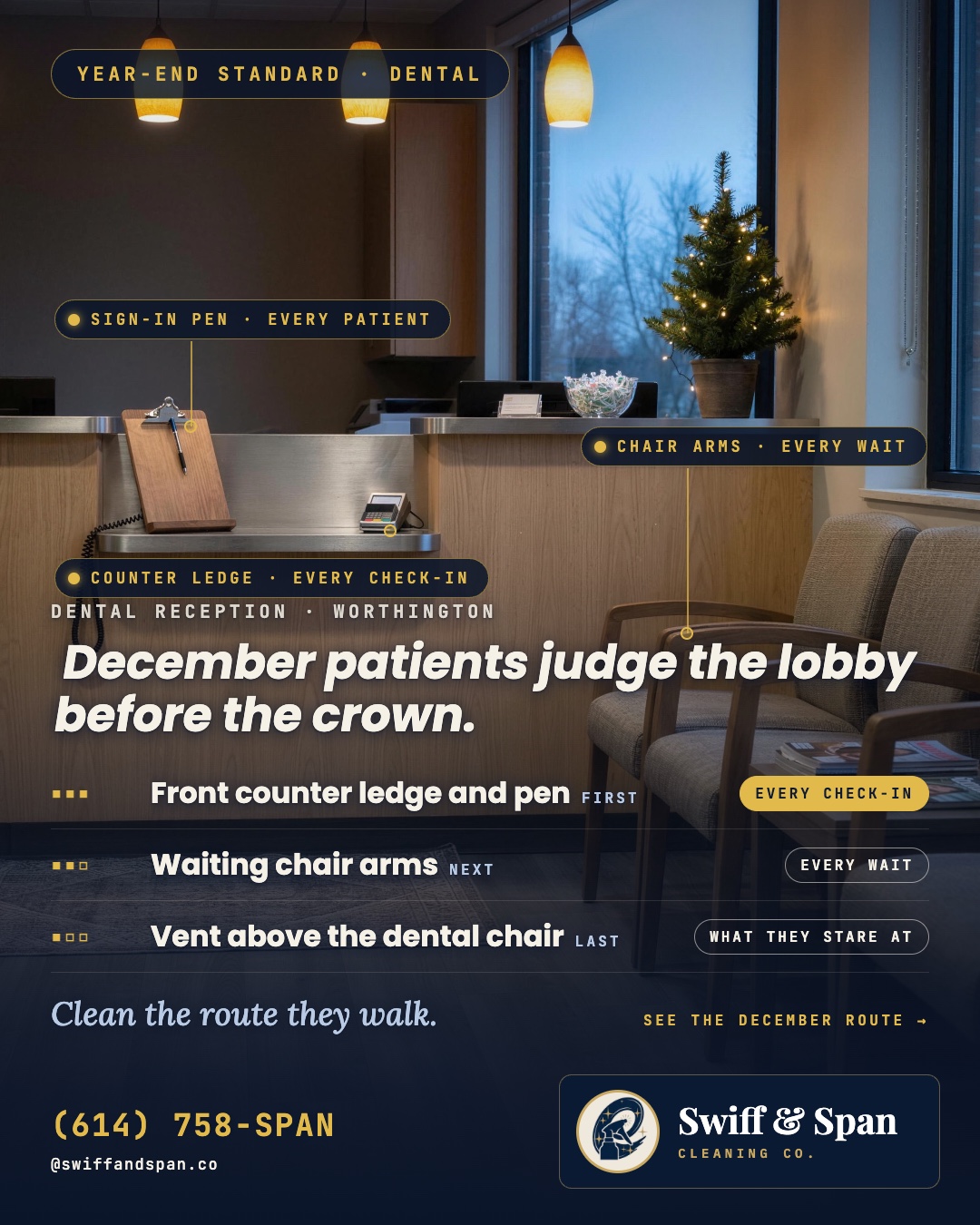
December is the month a dental office runs hardest. Patients who put off a crown all year suddenly want it done before their benefits reset. The schedule fills from the first chair to the last, the lobby is busier than it has been since August, and somewhere in the middle of it all the office closes for a holiday.
It is also the month a lot of patients are deciding whether to come back.
In a 2013 national survey of patient attitudes by 1-800-DENTIST, reported by DrBicuspid, 91% of respondents ranked cleanliness as a reason they would return to the same dentist for a follow-up appointment. Only two things rated higher: the quality of the dentist’s work and a clear explanation of which treatments were required and which were optional. A clean office beat a gentle dentist. It beat short waits. It beat friendly staff.
That is a strange thing to sit with if you manage a practice in Worthington, Clintonville or anywhere else around Columbus. The thing patients weigh above your chairside manner is the part of the office your team has the least time to think about in December. This article is about keeping it right through the year-end rush.
Do patients really notice how clean a dental office is?
Yes, and they rank it high. In the 1-800-DENTIST survey, 91% of respondents named cleanliness as a reason to return to the same dentist, ahead of a gentle dentist, short waits and friendly staff. Patients judge what they can see while they wait.
Patients cannot see your instrument processing or your operatory surface protocol. What they can see is the front door glass, the counter they lean on, the chair they wait in, the restroom and the ceiling above the dental chair when it tips back. Those are the surfaces they use to guess at everything they cannot see.
That is the logic of the survey result, and it is why we plan a dental office clean from the patient’s point of view first. The clinical team owns the operatory and everything that touches a patient’s mouth. The cleaning crew owns the building the patient walks through to get there. The first impression is ours.
Why is December the hardest month to keep a dental office clean?
Because more patients move through the same rooms while the team has less time. Practices schedule heavily before insurance benefits reset, longer procedures stack up, Columbus winter tracks salt and slush across the floors, and many offices close for part of the holidays.
The American Dental Association’s New Dentist blog looked at sales seasonality across a small set of general dental practices and found that high-ticket procedures like crowns and bridges cluster around December, from patients using expiring benefits, and again in January and February with new ones. In that data, December and January delivered the highest revenue of the year. The same post noted that most of the orthodontic offices it reviewed closed for at least a week in December.
Put those together and you get a predictable pattern:
1. More bodies, same lobby. Every extra appointment is another coat on a chair, another hand on the counter, another pen signature. 2. Salt season starts. The first freeze in central Ohio brings rock salt and grit through the door. It dulls floors and gets tracked straight to the operatories. 3. Flu and cold season overlaps. The waiting room is full in the same weeks respiratory illness is climbing. 4. The office goes dark. A week-long closure is the best chance all year for a deep clean, and the easiest week to forget to schedule one.
None of this is unusual. That is the point. A cleaning scope written for an average month does not fit December.
Which surfaces do dental patients judge first?
The ones on their path: the entry mat and door glass, the front counter ledge and pen, the waiting chair arms, the restroom, and the ceiling vents and light lenses they stare at from the dental chair. Clean that route in the order a patient walks it.
We call it the patient’s-eye route, and in most offices we walk it has six stops:
1. The entry. Door glass at hand height, the push bar, and the mat. In December the mat is the first thing that looks tired. 2. The front counter. Not the desk behind it where staff work, but the transaction ledge patients lean on, the card reader, and the sign-in pen. We wrote a whole piece on the dirtiest thing in a dental office being the pen. 3. The waiting chairs. Arms, front edges and the wooden caps where hands rest. The side table and whatever sits on it. 4. The restroom. Patients brush before appointments in a lot of practices. The sink, faucet handles, mirror and the walls beside the toilet all count. See why restroom walls matter in a dental or medical office. 5. The hallway to the operatory. Handrails, door edges and the floor line along the baseboard, where salt and dust collect. 6. The ceiling above the chair. This is the one almost nobody plans for. When the chair tips back, a patient looks straight up for the length of the visit. A dusty supply vent, a stained ceiling tile or a light lens with dead insects in it is the most visible surface in the room for that whole hour.
The front desk high-touch list goes deeper on stops one through three.
How should a dental office cleaning schedule change for the year-end rush?
Shift effort toward the patient’s-eye route on heavy days, add floor care for salt, and book a top-to-bottom deep clean for the closure week in writing now. The nightly clean stays the same in method; the order and emphasis change.
Here is how we adjust a December scope for a dental office:
- Heavier nights get a longer front route. On the evenings after the fullest schedules, the reception, waiting area and restroom get extra time before the crew moves back toward the operatory corridor.
- Salt gets its own line. Entry mats are vacuumed and the hard floor inside the door is damp mopped with a neutral cleaner to lift salt film, not just swept.
- Top to bottom, clean to dirty. High surfaces first so dust falls onto areas not yet cleaned, and the restroom last, with its own color of microfiber that never leaves that room.
- Carpet and rugs get a true HEPA vacuum. We use ProTeam GoFit backpack vacuums with HEPA filtration so fine dust is captured instead of blown back across a clean counter. Our dental floor cleaning article explains why that matters.
- The scope says who owns what. The clinical team covers operatory clinical contact surfaces and instruments. The cleaning crew covers housekeeping surfaces, floors, restrooms and the front of house. If that boundary is fuzzy, December is when it shows. Here is how we draw the dental scope boundary.
OSHA expects a written schedule for cleaning that accounts for the location, the type of surface, the type of contamination and the tasks performed. A busier month is a good reason to look at it again. We covered that in OSHA’s written cleaning schedule and its four factors.
What belongs in a dental office closure-week deep clean?
Everything the nightly clean reaches only at the edges: ceiling vents and light lenses, high dusting, baseboards, chair bases, waiting chair upholstery, behind and under furniture, entry mats, and a full restroom detail. Book it before the rush, not during it.
A closure week is the rare stretch when no patient is waiting on a room. That makes it the right time for the work that a nightly crew cannot do without moving furniture or climbing a ladder. Our closure-week list for a dental office usually covers:
1. Ceiling vents, return grilles and light lenses above every dental chair and in the reception area. 2. High dusting: tops of door frames, shelves, artwork and window ledges. 3. Baseboards and floor edges, especially the salt line just inside the entry. 4. Waiting chairs: upholstery cleaned per the fabric’s care code, arms and legs detailed. 5. Under and behind: the reception desk kick plate, the space behind waiting chairs, the bottom of the coat rack. 6. Restrooms: walls, partitions, the back of the toilet, the sink base and the dispensers. 7. Hard floors cleaned edge to edge, with carpets vacuumed with HEPA filtration.
Every room gets a checklist and a photo after it is finished, so the office manager can see each room without walking the building on a day off.
How do you know the cleaning held up through December?
Look and measure. Photo documentation shows each room was finished, and ATP testing measures organic residue left on surfaces after cleaning. Our cleaning target threshold is 25 RLU; 0-100 RLU is the acceptable pass band industry-wide.
ATP testing uses a swab and a handheld reader. We use a Hygiena EnSURE Touch with UltraSnap swabs on the surfaces patients actually touch: the counter ledge, the pen, the chair arms, the restroom faucet. The reading tells you how much organic residue is left, which is a measure of how well a surface was cleaned. It is not a test for any germ and it does not measure disinfection. It answers a narrower question that matters a great deal in December: did the cleaning actually remove the grime, or just move it around?
When a reading comes back high, the surface gets cleaned again and swabbed again, and the reason gets written down. That record is the difference between a crew saying the lobby was cleaned and an office manager knowing it.
Your next move before the rush
Walk your own office tonight the way a patient will on December 15. Come in the front door, lean on the counter, sit in a waiting chair, use the restroom, then lie back in a dental chair and look up. Write down anything you would not want a new patient to see.
Then compare that list to your current cleaning scope. If the ceiling above the chair, the counter ledge or the closure-week deep clean are not on it, they are not getting done.
If you want a second set of eyes, I will walk the office with you. Book your complimentary ATP walkthrough at (614) 758-SPAN. We swab the surfaces your patients touch, you see the readings on the spot, and they are yours to keep. Here is what happens during the walkthrough.
Frequently Asked Questions
Does office cleanliness affect whether dental patients return?
Yes. In a 2013 national survey by 1-800-DENTIST, 91% of respondents ranked cleanliness as a reason they would return to the same dentist for a follow-up appointment. Only the quality of the dentist's work and a clear explanation of required versus optional treatment ranked higher.
Why are dental offices busier in December?
Many patients schedule treatment before their dental insurance benefits reset. Data shared on the ADA New Dentist blog found high-ticket procedures like crowns and bridges cluster around December and again in January and February, with December and January delivering the highest revenue.
What should a dental office cleaning crew focus on during busy weeks?
The patient's-eye route: entry glass and mats, the front counter ledge and pen, waiting chair arms, the restroom, the hallway to the operatory, and the ceiling vents and light lenses above each dental chair. Clean high to low and the restroom last.
When should a dental office schedule a deep clean?
During a planned closure, such as a holiday week, when no patients are waiting on rooms. Book it in writing before the busy season and include ceiling vents, high dusting, baseboards, chair bases, upholstery, under furniture and a full restroom detail.
Does an ATP test show that a dental office was disinfected?
No. An ATP test measures organic residue on a surface, which shows how well it was cleaned. It does not detect germs and does not confirm disinfection. Our cleaning target threshold is 25 RLU; 0-100 RLU is the acceptable pass band industry-wide.
Every Columbus dental, medical, wellness, and commercial facility gets the same offer: a complimentary 30-minute ATP walkthrough. We swab your highest-touch surfaces, on the spot, and hand you the readings. No obligation, no pitch required to see the number. Book your complimentary ATP walkthrough or text (614) 758-SPAN.
Erik Kuusisto, Owner
Swiff & Span Cleaning Company