Most dental practices in Columbus have two cleaning teams. One is the clinical staff, who turn over operatories between patients and run the sterilization area. The other is the contracted cleaner, who comes in after hours. Both teams work hard. Almost nobody has written down where one job stops and the other starts.
That gap is where dental cleaning problems live. A surface both teams assume the other one handles gets handled by neither. A surface both teams handle gets wiped twice with two different products and a chemistry nobody planned. The fix is a written scope with a clear boundary, and it takes about an hour to build.
Who owns which surface in a dental office?
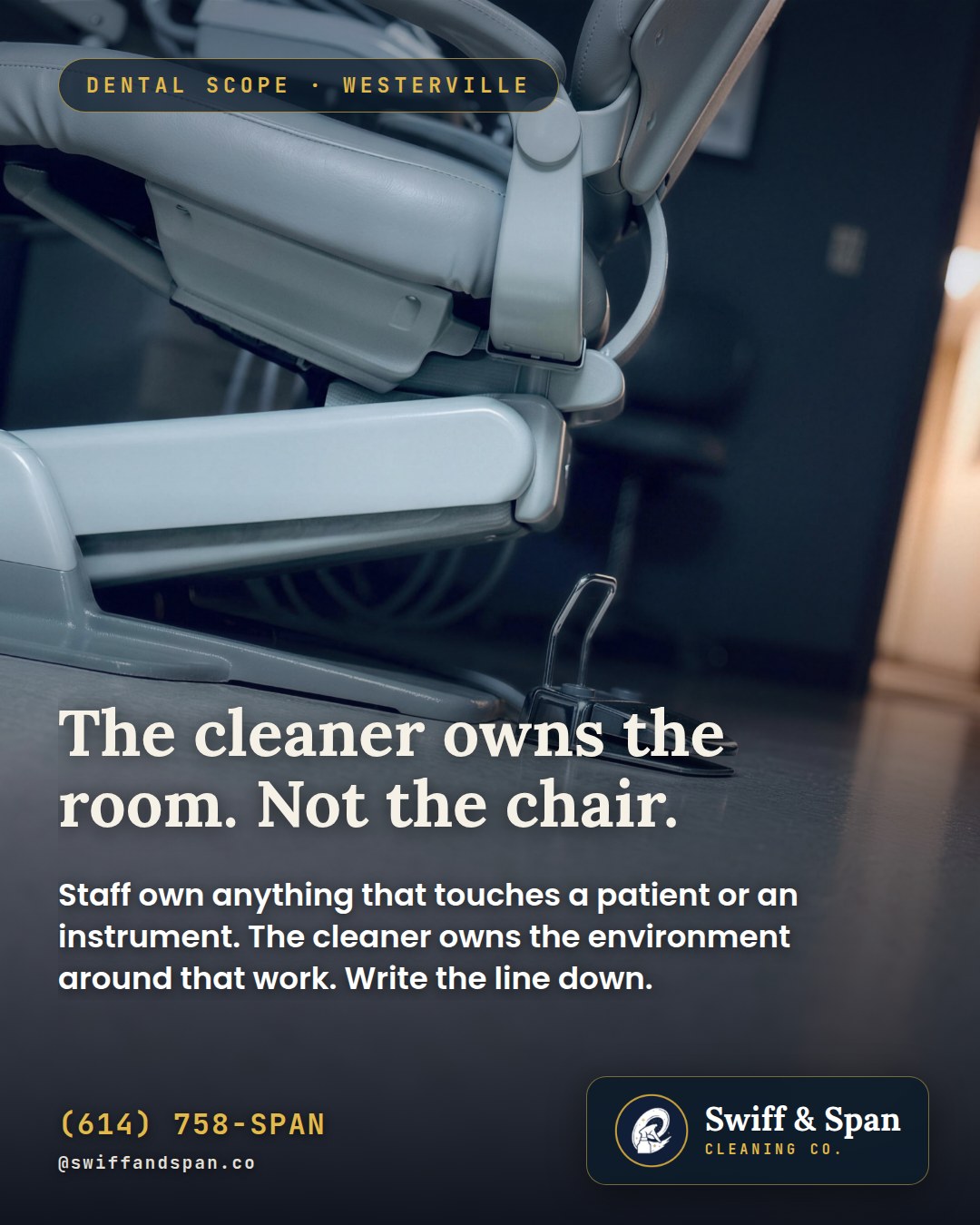
Your clinical team owns anything that touches a patient, anything that touches an instrument, and anything your infection-control protocol assigns to staff between patients. The cleaner owns the environment around that work.
That sentence sorts nearly every surface in the building. The rest of this article works through the exceptions, because the exceptions are where the arguments happen.
What belongs to the clinical team?
Instrument reprocessing, between-patient turnover, and dental unit plumbing. These are clinical acts with their own protocols, their own products, and their own documentation, and a contracted cleaner has no business inside any of them.
Instrument reprocessing is the clearest case. The sterilization area, the ultrasonic, the autoclave, the packaging, the storage of sterile packs: that is clinical work with its own protocol and its own documentation.
Between-patient turnover is the second case. The chair, the light handle, the bracket tray, the delivery unit, the counter within reach of the operator: those surfaces get cleaned and disinfected by staff between patients, on the practice’s product and the practice’s timing. A cleaner arriving at 7 PM is not part of that cycle and should not pretend to be.
Waterline maintenance, suction line cleaning, and anything involving dental unit plumbing sit with the practice and its equipment vendor. We have written separately about waterline biofilm, and the short version is that it is a clinical maintenance task, not a housekeeping one.
What belongs to the cleaner?
Everything the patient and staff move through that is not a clinical contact surface: reception, corridors, restrooms, staff areas, operatory housekeeping surfaces, and all floor care. In a typical Westerville general practice that breaks down four ways.
Reception and waiting. Door pulls, the check-in counter edge, the clipboard and pen station, chair arms, the children’s corner, the public restroom, and the floor. This is where a practice is judged before anyone sees an operatory.
Corridors and staff areas. Light switches, door hardware, the break room including the fridge handle and microwave keypad, the staff restroom, and the floors that connect every room.
Operatory housekeeping surfaces. This is the exception that needs the most care. The operatory floor, the baseboards, the cabinet fronts below the work zone, the sink exterior, the trash and sharps container exteriors, the window sills, and the vents. These are noncritical housekeeping surfaces. They sit in the same room as clinical contact surfaces and must be cleaned without disturbing them.
End-of-day floor care. Hard floors in operatories and corridors, cleaned in a sequence where the dirtiest area is handled last and the mop water is changed rather than carried from room to room.
Which three surfaces start the arguments?
The operatory counter, the patient chair base, and the sterilization area floor. Each one sits with a clinical surface on one side and a housekeeping surface on the other, and a scope that does not name them by hand will leave all three to chance.
The operatory counter. The half within the operator’s reach is clinical. The half against the wall with the supply bins is housekeeping. A good scope draws that line by naming the surface, not by assuming the cleaner will know. Our default is to clean the wall side and leave the work zone untouched unless the practice asks otherwise in writing.
The patient chair. Staff disinfect it between patients. The base, the foot control, and the floor underneath it collect debris all day and are almost never on anyone’s list. The cleaner should own the base and the floor. The upholstery stays with the practice’s protocol.
The sterilization area floor and exterior surfaces. The floor, the door, and the outside of the cabinets are housekeeping. Everything on the counter is clinical. A cleaner who wipes a counter in the sterilization area has just introduced an unknown product into a controlled process. The scope should say, in plain words, that the counter belongs to the clinical team.
What should “cleaned” mean in a written scope?
Named surfaces, a named sequence, and a named product class. A scope that says “operatories will be cleaned nightly” has told you nothing about what happens in the room, in what order, or with what chemistry.
Sequence matters in a dental office more than in most buildings. We work top-down and clean-to-dirty: reception and corridors before restrooms, operatory housekeeping surfaces before floors, and the last room of the night is never the first room the next morning’s patients see. Color-coded microfiber keeps a restroom cloth from ever touching an operatory cabinet. The two-bucket method keeps the mop water from carrying the corridor into the operatory.
Product class matters because your clinical team has already chosen a disinfectant for clinical contact surfaces. The cleaner’s product for housekeeping surfaces should be an EPA-registered disinfectant held at its full dwell time, and the practice should know what it is. A scope that names the product class removes the guesswork when an associate asks what was used on the floor.
How do you verify the boundary is holding?
Documentation plus measurement. Photo-timestamped records and a room-by-room checklist show what was done and when. An ATP reading shows whether the surface was actually cleaned, which is a different question and the only one a meter can answer.
A written scope is a promise. Verification is how you check it. The photo record and the checklist together give an office manager something to compare, and a place to point when something is missed.
ATP testing adds a third layer where it fits. An ATP meter reads organic residue on a surface in seconds. It is the same method used in cleaning audits, and it is useful precisely because it does not care how a surface looks. The industry danger threshold is 100 RLU or more. Below 25 RLU is the hospital-grade benchmark we hold to. On the dental work we have measured, post-clean surfaces read 8 to 14 RLU. Those readings verify cleaning. They say nothing about disinfection or regulatory status, and any cleaner who tells you otherwise has misread the meter.
Where ATP earns its place in a dental scope is on housekeeping surfaces that look fine and are not being touched: the chair base, the wall side of the operatory counter, the reception counter edge. A practice can swab those tonight with a rented meter and learn more than a year of visual inspection would tell it.
Does a written scope help with an inspection?
It helps you prepare, and that is all anyone should claim. A clean written scope, a documented sequence, and a verification method make an inspection a calmer experience, but the outcome belongs to the practice and the inspector.
That is compliance-prep cleaning: preparation, not a promise. What a cleaner can promise is that the environmental side of the building is cleaned to a stated standard, documented every visit, and measurable on request.
How do you find the gaps in your current scope?
Walk the building with a meter in hand. Our ATP walkthrough takes about 30 minutes. Erik walks the practice, swabs several housekeeping surfaces, reads them with you, and leaves you the numbers.
The readings are yours to keep either way. If your practice is in Westerville or anywhere in Greater Columbus, book your complimentary ATP walkthrough or call (614) 758-SPAN.
Frequently Asked Questions
Should the cleaner disinfect the operatory chair?
Only if the practice's protocol assigns it and the scope says so in writing. By default, staff handle the chair between patients and the cleaner handles the base and the floor beneath it.
Can a contracted cleaner enter the sterilization area?
For floors, door hardware, and cabinet exteriors, yes, with the sequence and boundary written into the scope. Counters and anything on them stay with the clinical team.
What should a dental cleaning scope list, at minimum?
Named surfaces by room, the cleaning sequence, the product class used on housekeeping surfaces, the documentation left after each visit, and what happens when a surface is missed.
Does ATP testing prove a surface is disinfected?
No. ATP measures organic residue and verifies that a surface was cleaned. Disinfection is a separate step with its own chemistry and dwell time.
How often should a dental office have housekeeping surfaces cleaned?
A common pattern is nightly service on patient days, with floor care and detail work on a set weekly rhythm. The right cadence depends on patient volume and the practice's own protocol.
Every Columbus dental, medical, wellness, and commercial facility gets the same offer: a complimentary 30-minute ATP walkthrough. We swab your highest-touch surfaces, on the spot, and hand you the readings. No obligation, no pitch required to see the number. Book your complimentary ATP walkthrough or text (614) 758-SPAN.
Erik Kuusisto, Owner
Swiff & Span Cleaning Company