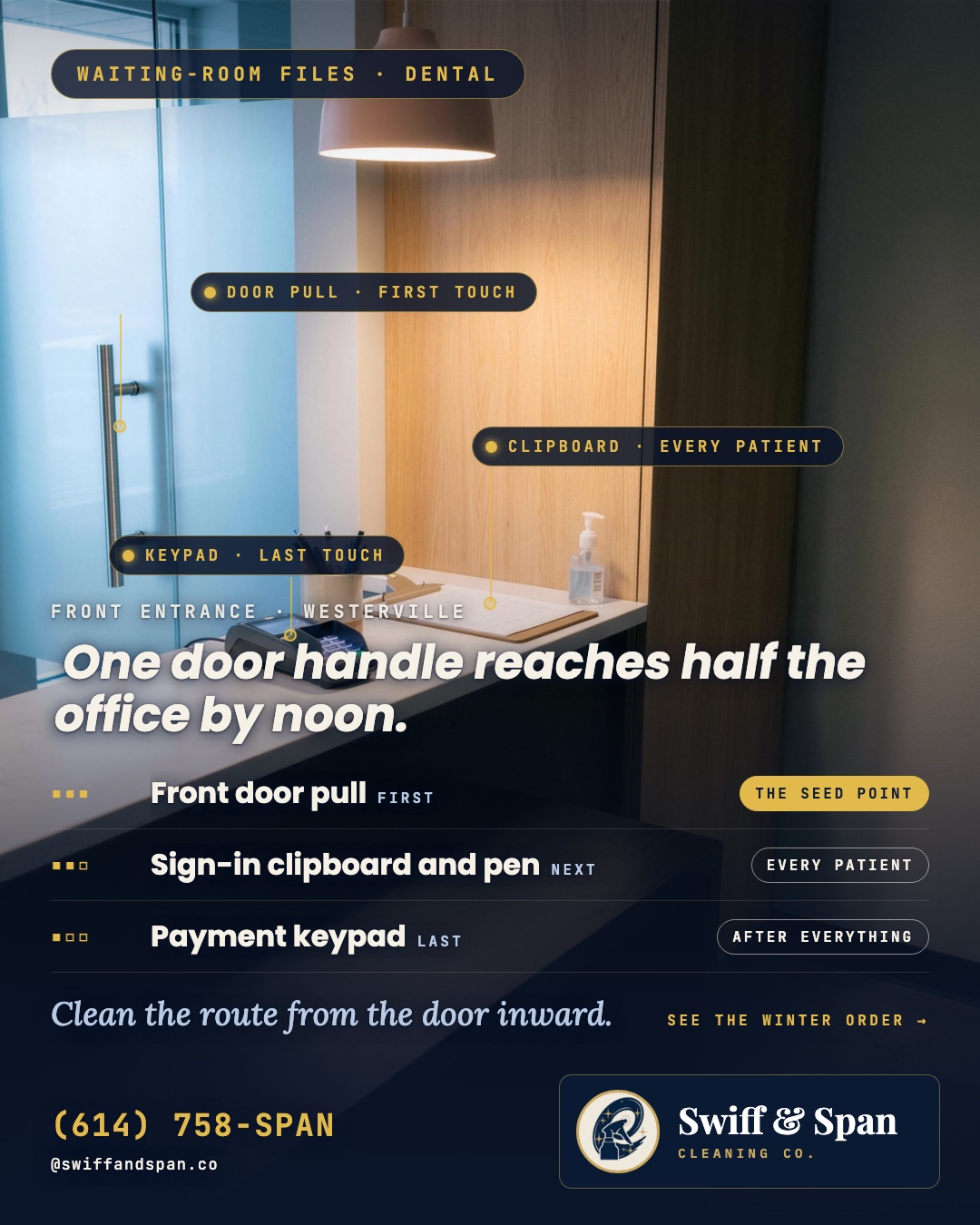
At 8 AM on the Monday after Thanksgiving, a dental office in Westerville opens its front door. The first patient of the day pulls the handle. By noon, if a tracer virus study is any guide, whatever was on that handle has had time to reach up to 60 percent of the surfaces people touch in the building.
That is not a scare line. It comes from a study presented in 2014 by Charles Gerba of the University of Arizona at the American Society for Microbiology’s ICAAC meeting. His team put a harmless tracer virus on one or two commonly touched surfaces, a doorknob or a tabletop, at the start of the day. They tested office buildings, a conference room and a health care facility. Within two to four hours, 40 to 60 percent of the sampled surfaces carried the tracer.
This article is about what that finding means for a dental practice in November and December, when flu and norovirus season are both climbing, and about the cleaning order that actually interrupts the spread.
How fast does a virus spread from one door handle in a dental office?
In the Gerba study, a tracer virus placed on a single doorknob or tabletop reached 40 to 60 percent of sampled surfaces within two to four hours. The tracer was a bacteriophage called MS-2, chosen because it behaves like human norovirus in size, shape and resistance to disinfectants.
The researchers did not swab a handful of things. They sampled 60 to 100 surfaces per site: light switches, countertops, push buttons, coffee pot handles, sink tap handles, door knobs, phones and computer equipment. Those are the same surfaces a dental office runs on. The front door pull, the check-in counter, the payment keypad, the restroom faucet, the break room coffee maker, the phone at the front desk.
The mechanism is simple. Hands move. A patient pulls the door, signs in, pays, uses the restroom, touches the faucet. A team member picks up the phone, walks to the back, opens the sterilization room door. Every hand that touches the seeded surface becomes a courier.
Why does flu season change the cleaning plan for a dental practice?
Flu season changes the plan because more people arrive carrying something. The CDC notes that flu activity usually climbs in fall and most often peaks between December and February. Most norovirus outbreaks in the United States happen from November to April.
A dental practice sits right in the middle of that traffic. Patients keep their six-month cleanings through the holidays. Families come in together during winter break. Some patients feel fine and are already contagious, which is exactly why a symptom questionnaire at check-in is not the whole answer.
The building does not know who is sick. The surfaces just collect whatever arrives. So the cleaning plan for November through March should assume that the front door handle is seeded every single morning and work outward from there.
Which dental office surfaces carry the most traffic in winter?
The surfaces that carry the most traffic are the ones nearly every person touches in the first two minutes of a visit. In a typical dental office in Worthington or Westerville, that route looks like this:
1. The front door pull, inside and outside. In winter, gloves come off in the vestibule, so bare hands meet the handle on the way out more than on the way in. 2. The check-in counter edge and sign-in tablet or clipboard. Patients lean on the counter and hand over cards. 3. The payment terminal keypad. It is touched at the end of the visit, after the patient has been everywhere else. 4. The waiting room chair arms. People push up from them. 5. The restroom door, faucet and flush handle. 6. The staff side: front desk phones, the shared keyboard and mouse, the light switch by the break room, the coffee maker handle.
Notice that only the last group belongs to the team. The first five belong to the public, and they all connect back to one place: the front door.
Does cleaning those surfaces actually reduce the spread?
Yes. The same study tested an intervention. Cleaning staff and employees were given disinfecting wipes made with quaternary ammonium compounds, EPA-registered as effective against viruses like norovirus and flu, and were told to use them properly at least once a day. The number of surfaces where virus was detected dropped by 80 percent or more, and the concentration of virus fell by 99 percent or more.
Two details in that result matter for a practice manager.
First, the products were EPA-registered for the job. Not a general-purpose spray, not a scented cleaner. A disinfectant whose label lists the organisms you care about.
Second, they were used properly. For a disinfectant, properly means the surface stays wet for the full contact time printed on the label. Wipe on, walk away, let it sit. A surface that is wiped and dried in five seconds has been cleaned, which is useful, but it has not been disinfected the way the label describes.
What does a flu-season cleaning order look like in a dental office?
A flu-season cleaning order works clean to dirty and follows the patient’s route, so one cloth never carries the front door into the restroom or the restroom into the operatory. Here is the order we use in dental offices across Columbus:
1. Clean first, then disinfect. Disinfectants are tested on surfaces that are already clean. Skin oil, hand lotion and road salt residue on a door pull get removed first with a cleaning pass, then the disinfectant goes on.
2. Match the product to the surface. We carry EPA-registered disinfectants chosen by surface and risk: Spartan TB-Cide Quat for hard public surfaces like door pulls and counters, Diversey Oxivir Tb where a faster accelerated hydrogen peroxide product fits, PDI Super Sani-Cloth wipes for electronics and small high-touch items, and Clorox Healthcare Bleach Germicidal when a bleach product is the right call. Each one is held at its full label contact time.
3. Color-code the microfiber. One cloth color for the reception and public route, a different color for restrooms, another for the clinical side’s non-clinical surfaces. A cloth never crosses zones. This is the single cheapest way to stop a cleaning crew from becoming the courier.
4. Start at the door and walk the route. Door pulls inside and out, push plates, the light switch by the entry, the counter edge, the sign-in station, the payment keypad, chair arms, then the restroom, then staff areas. Top to bottom inside each room, so dust and drips land on surfaces not yet cleaned.
5. Write it down. A room-by-room checklist with the time and initials, plus photo documentation of the entry and front desk. If someone asks what was done the night before the Monday rush, the answer is on paper.
What should a dental office do before reopening after a holiday?
Before reopening after Thanksgiving or the December holidays, a dental office should treat the last evening before the closure as the most important clean of the season. Whatever is left on the door pull and counter on Wednesday night is what greets the first patient on Monday morning.
Three practical moves:
- Schedule the full route clean for the last night before the closure, not a quick reception wipe. A four-day weekend gives surfaces no reason to get cleaner on their own.
- Ask for the reopening-morning list in advance. If your cleaning partner visits before you open, the door pull, counter and keypad are first on the list.
- Hand the team a short midday routine. The study’s intervention was “at least once daily.” The first patient seeds the door; a midday wipe of the door pull and keypad with an EPA-registered wipe, left wet for the label time, breaks the chain again before the afternoon schedule.
Our nightly scope covers the public route, restrooms, staff areas and the non-clinical surfaces of the clinical side. Clinical contact surfaces between patients belong to your clinical team and their infection control program; we cover where that line sits in our article on dental office cleaning scope.
How do you know the front entrance was actually cleaned?
You know the front entrance was cleaned when someone measured it, not when it looks shiny. A clean-looking steel pull handle tells you very little. Fingerprint smears are visible; the residue that matters usually is not.
This is where an ATP reading helps. An ATP meter, like the Hygiena EnSURE Touch we carry with UltraSnap swabs, measures organic residue left on a surface and reports it in relative light units. It does not identify viruses or any other germ. What it does is tell you whether a surface was actually cleaned or only passed by. During a walkthrough we swab the door pull, the counter edge and the payment keypad so you can see the numbers for yourself, measured against our cleaning target threshold and the acceptable pass band used across the industry. We explain both on our page about how we prove clean.
For a deeper look at the front counter specifically, read Dental Front Desk Cleaning: The Surface With Paper on It. For the item every patient touches at check-in, read the pen you hand patients. And for what happens on the operatory side after hours, read what a dental operatory terminal clean involves.
The short version for a practice manager
- One seeded surface reached 40 to 60 percent of sampled surfaces within two to four hours in a tracer virus study that included a health care facility.
- EPA-registered quat wipes used properly at least once a day cut the number of contaminated surfaces by 80 percent or more.
- In flu and norovirus season, assume the front door is seeded every morning. Clean first, disinfect at full label contact time, color-code the cloths, and walk the patient’s route from the door inward.
- The night before a holiday closure is the clean your Monday patients will meet.
If you run a dental practice in Westerville, Worthington or anywhere in greater Columbus and want to see what your front entrance reads before the holiday rush, we will bring the meter to you. Book your complimentary ATP walkthrough at swiffandspan.com or call (614) 758-SPAN.
Frequently Asked Questions
How fast can a virus spread from a doorknob in an office?
In a 2014 University of Arizona study presented by Charles Gerba, a tracer virus placed on one doorknob or tabletop was found on 40 to 60 percent of sampled surfaces within two to four hours. The sites included office buildings, a conference room and a health care facility.
Does disinfecting high-touch surfaces once a day make a difference?
In the same study, giving cleaning staff and employees EPA-registered quaternary ammonium disinfecting wipes and instructing them to use them properly at least once daily reduced the number of contaminated surfaces by 80 percent or more and the virus concentration by 99 percent or more.
Which surfaces should a dental office clean first in flu season?
Start with the front door pull inside and out, then the check-in counter edge, the sign-in station, the payment keypad and the waiting room chair arms. Then the restroom door, faucet and flush handle, then staff phones, keyboards, light switches and the break room.
What does label contact time mean for a disinfectant?
Contact time, also called dwell time, is how long the surface must stay visibly wet with the disinfectant to achieve the kill claims on the EPA-registered label. If the surface dries sooner, the label claim has not been met, so the product has to be reapplied.
Can an ATP test tell me if flu virus is on my front desk?
No. An ATP test measures organic residue on a surface, which tells you whether the surface was actually cleaned. It does not detect or identify viruses. It is a fast way to check cleaning quality on the surfaces patients touch.
Every Columbus dental, medical, wellness, and commercial facility gets the same offer: a complimentary 30-minute ATP walkthrough. We swab your highest-touch surfaces, on the spot, and hand you the readings. No obligation, no pitch required to see the number. Book your complimentary ATP walkthrough or text (614) 758-SPAN.
Erik Kuusisto, Owner
Swiff & Span Cleaning Company