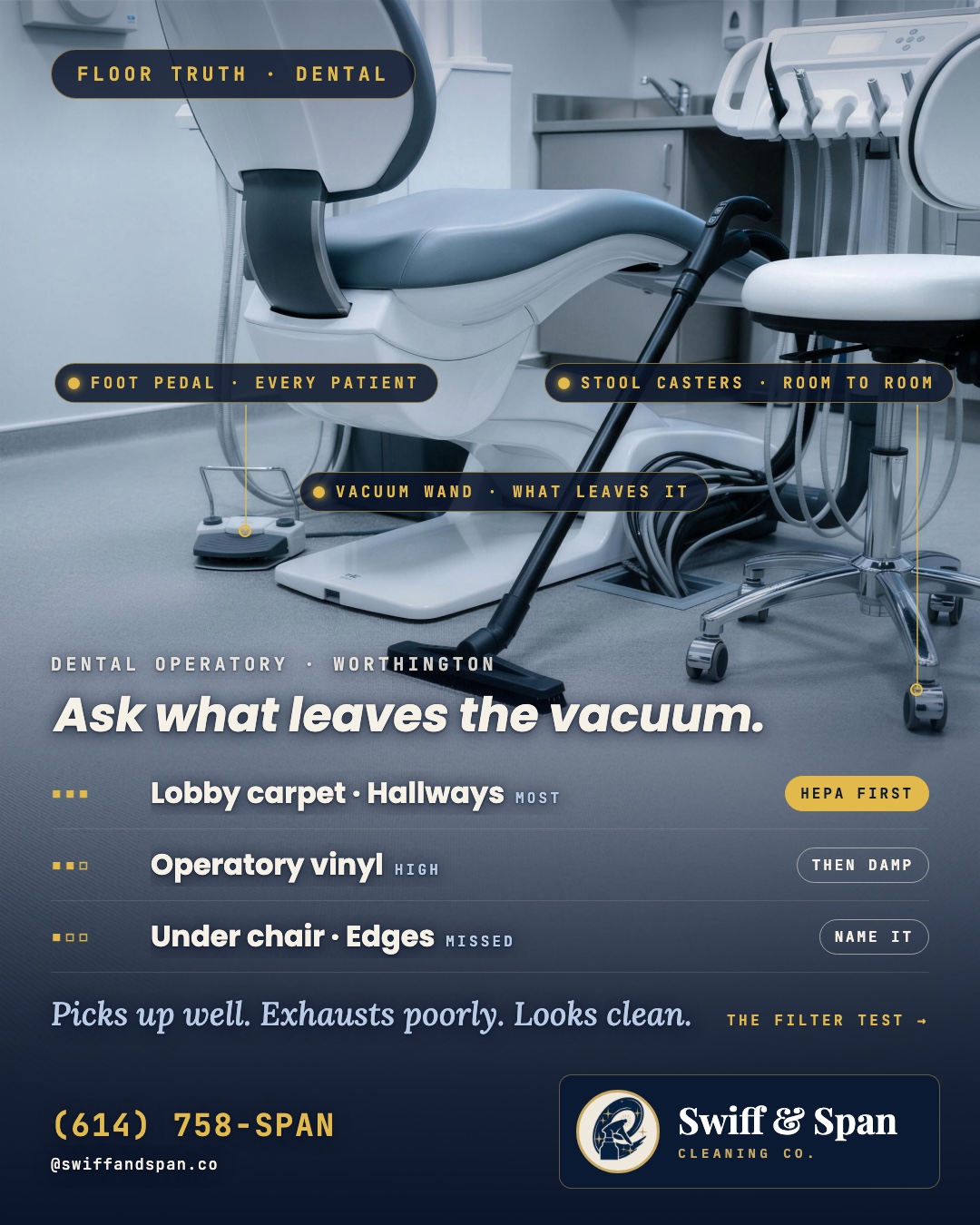
Most dental offices judge a vacuum by what it picks up. The better question is what it lets back out. A vacuum pulls air through the floor, through a bag or a bin, and out an exhaust port near ankle height. Whatever the filter cannot hold leaves with that air, and it lands where every patient walks the next morning.
The number that sorts vacuums into two groups is small: 0.3 microns. That is the particle size used to define a HEPA filter, and it is the reason we run HEPA vacuums in every dental office we clean. Here is what the number means, what it does not mean, and how to check your own cleaner’s equipment in about five minutes.
What does HEPA actually mean on a vacuum?
HEPA is a filter standard, not a marketing word. The U.S. EPA describes a HEPA filter as one that can, in theory, remove at least 99.97 percent of airborne particles 0.3 microns in size. That size is the hardest for a filter to catch, so it is the test point.
The practical meaning for a vacuum is narrow and useful. A HEPA vacuum is built so that the air leaving the machine has passed through that grade of filter first. It is about the vacuum’s own exhaust. It does not make a vacuum an air cleaner for the room, and nobody should sell it to you that way. What it does is stop the machine from blowing the finest floor dust back out at ankle level.
Why does the floor matter so much in a dental office?
A dental floor collects what the room produces all day: tracked-in grit, fibers, skin flakes, dried spatter from the work above it. Floors sit at the end of the cleaning sequence for that reason. They take everything the higher surfaces shed, so a vacuum that blows fines back out undoes the last step.
We wrote about the other half of this, the spatter and aerosol that settles on operatory surfaces after a procedure. Settling is the point. What drifts down off the light, the tray and the chair ends up on the floor. A vacuum that stirs the finest part of it back into motion gives it a second trip.
Floors are also handled more than people think. Bags, purses, a child’s coat, the strap of a backpack, a dropped glove. Our piece on why hospital floors behave like a reservoir covers how quickly floor soil reaches hands. A dental office is a smaller building with the same physics.
Does CDC say anything about carpet in a dental office?
Yes. CDC’s dental infection control guidance recommends avoiding carpeting and cloth-upholstered furnishings in dental operatories, laboratories and instrument processing areas. Carpet holds soil and is hard to clean after a spill. Many Columbus practices still have it in the lobby, hallways and offices.
That split is common in practices we walk, from Worthington to Downtown Columbus: hard sheet flooring in the operatories, carpet out front where patients wait and staff work. It is a sensible design. It also means the vacuum matters most in exactly the rooms patients see first and sit in longest. Carpet is where a non-HEPA vacuum does the most damage, because carpet is where the fine dust lives.
How can you tell whether your cleaner uses a HEPA vacuum?
Look at the machine. A true HEPA vacuum names its filter and its filtration on the unit or in the manual, and the filter is a separate, replaceable part. If the crew cannot show you the filter or tell you when it was last changed, assume it is not doing HEPA work.
Five questions that take about five minutes on a walkthrough:
- What vacuum do you run in this office? A make and model, not “a commercial one.” Ours is the ProTeam GoFit, a HEPA backpack vacuum.
- Where is the HEPA filter, and when was it changed? A filter that has never been changed is a decoration.
- Is the same vacuum used in the operatories and the lobby? One machine can serve both if its filter and attachments are handled correctly. The crew should know the answer without guessing.
- What comes before the vacuum? Floors are last. High surfaces, then touch points, then floors, top to bottom and clean to dirty.
- What does the hard floor get after vacuuming? Vacuuming lifts loose soil. Hard floors still need a damp clean with the right product and a fresh solution, which is where the two-bucket method and color-coded microfiber earn their place.
What does a written dental floor scope include?
A floor line that says “vacuum and mop” is not a scope. A written scope names each floor type, the tool for each one, the order of work, and how the result is documented. That turns “the floors looked fine” into something you can check.
Here is how we write the floor section for a dental office:
- Carpeted areas (lobby, offices, hallways): HEPA vacuuming with a ProTeam GoFit, edges and under-chair zones included, on the schedule the office sets.
- Hard floors in operatories and instrument processing areas: HEPA vacuum or dry microfiber first to lift grit, then a damp clean with a dedicated color of microfiber, using the two-bucket method so dirty water never goes back on the floor.
- Order of work: floors last in every room, so nothing falls on a floor that was just finished.
- Disinfection where the floor calls for it: an EPA-registered disinfectant matched to the surface, held wet for the full dwell time on its label. Spartan TB-Cide Quat is one we keep for hard floors that need it.
- Proof: photo documentation and a room-by-room checklist, so the office manager can see the floor section was done without walking it at night.
Can ATP testing check a floor?
Not in a useful way. ATP testing measures organic residue on a defined patch of a touched surface, so we point it at the places hands go: the chair controls, the light handle, the front desk. Floors are judged by sight, by touch with a white cloth, and by the written checklist.
When we do swab, we report against a stated line. Our cleaning target threshold is 25 RLU; 0-100 RLU is the acceptable pass band industry-wide. ATP tells you about residue left behind on the surfaces you choose. It does not measure dust. That is exactly why the vacuum deserves its own question.
The short version for a busy practice
If you remember one thing, remember the exhaust. A vacuum that picks up well and exhausts poorly moves fine dust from the floor to the air and back to the floor, and the room looks clean the whole time.
Ask your cleaner to show you the filter. If the answer is a shrug, the floor is getting half a clean.
If you would like us to look at your floors, your equipment questions and your current scope together, Book your complimentary ATP walkthrough. It takes about 30 minutes, we walk the rooms with you, and you keep what we find. Call (614) 758-SPAN or visit swiffandspan.com.
Frequently Asked Questions
What does HEPA mean on a commercial vacuum?
HEPA is a filter standard. The U.S. EPA describes a HEPA filter as one that can, in theory, remove at least 99.97 percent of airborne particles 0.3 microns in size. On a vacuum, it means the machine's exhaust air passes through that grade of filter before it leaves.
Does a HEPA vacuum clean the air in a dental office?
No. A HEPA vacuum filters its own exhaust so it does not blow fine floor dust back out while it runs. It is not an air cleaner for the room, and it should never be sold as one.
Should a dental office have carpet?
CDC's dental infection control guidance recommends avoiding carpeting and cloth-upholstered furnishings in dental operatories, laboratories and instrument processing areas. Many practices keep carpet in lobbies and offices, which makes the vacuum used in those rooms more important.
How do I check whether my cleaning company uses a HEPA vacuum?
Ask for the make and model, ask to see the HEPA filter, and ask when it was last changed. A crew running a true HEPA vacuum can answer all three on the spot.
Can ATP testing measure how clean a floor is?
Not usefully. ATP testing measures organic residue on defined touch surfaces such as chair controls and light handles. Floors are checked by sight, a white cloth and a written room-by-room checklist.
Every Columbus dental, medical, wellness, and commercial facility gets the same offer: a complimentary 30-minute ATP walkthrough. We swab your highest-touch surfaces, on the spot, and hand you the readings. No obligation, no pitch required to see the number. Book your complimentary ATP walkthrough or text (614) 758-SPAN.
Erik Kuusisto, Owner
Swiff & Span Cleaning Company