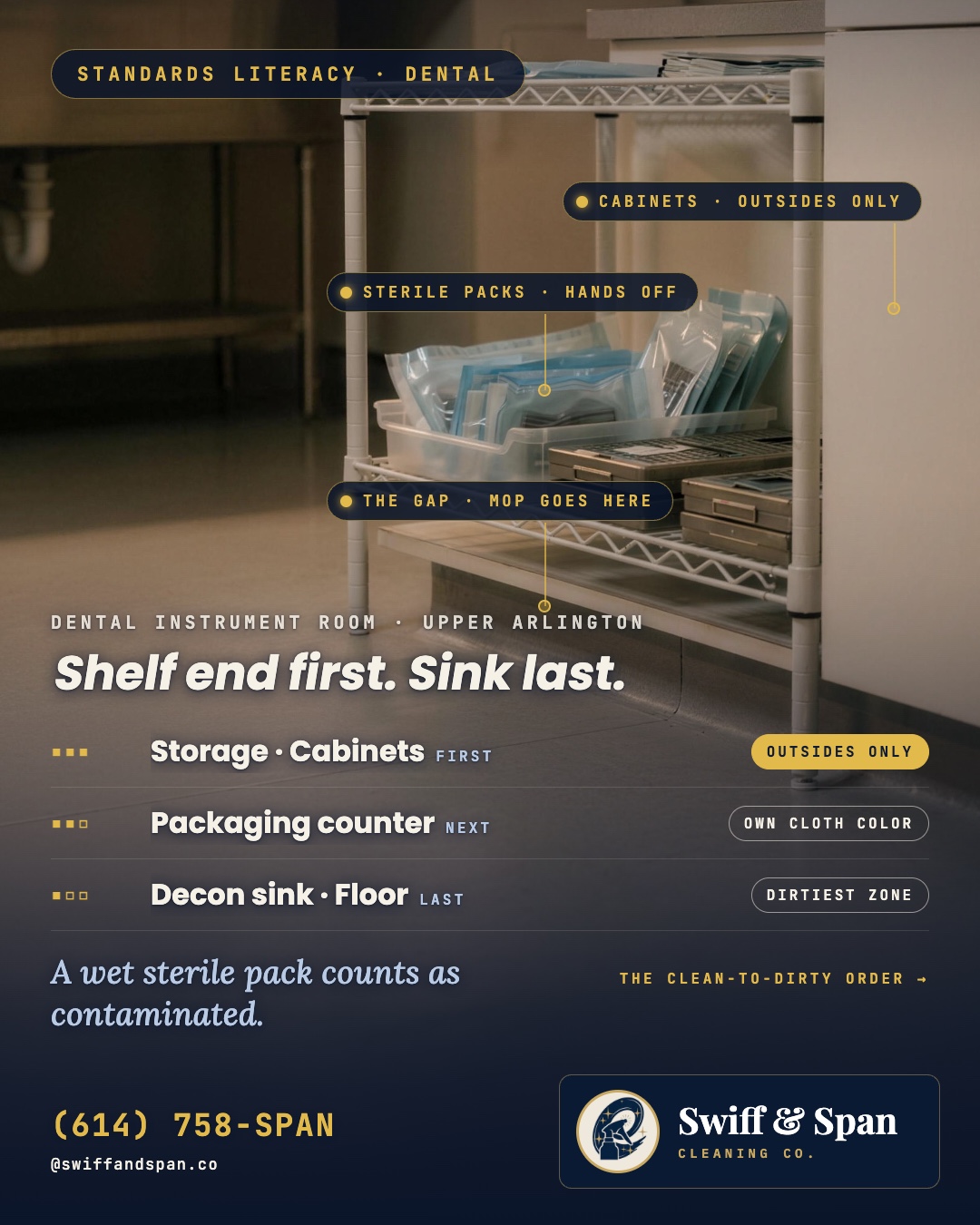
The cleanest shelf in a dental office sits about 8 inches above the floor a night crew mops.
That gap is not an accident. It comes from federal infection control guidance, and it exists for two reasons: so air can move around sterile packs, and so the floor underneath them can actually be cleaned. Most cleaning scopes never mention it. Most cleaning crews have never been told why it is there.
This article is about the room every dental practice depends on and almost nobody outside the clinical team understands: the instrument processing room, often called the sterilization area. Here is what the guidance says about it, what a cleaning crew should and should not touch in it, and the order that keeps a mop bucket from undoing a morning’s worth of autoclave cycles.
What is the 8-inch rule for sterile storage?
The CDC’s Guideline for Disinfection and Sterilization in Healthcare Facilities says sterile supplies should be stored 8 to 10 inches off the floor, 5 inches from the ceiling (18 inches from a sprinkler head) and 2 inches from outside walls. The stated reasons are air circulation, ease of cleaning and local fire codes.
“Ease of cleaning” is the part that matters to us. A bottom shelf that sits on the floor, or a box of pouches pushed underneath it, turns the cleanest storage in the building into a place the mop cannot reach. Dust and grit collect against the packaging. Mop water wicks toward it.
That guideline was written for healthcare facilities broadly, not for dentistry alone. The physics are the same in a four-chair practice off Lane Avenue as in a hospital’s central processing department: the floor under the bottom shelf has to be cleanable without anyone touching what sits on the shelf.
Why does a cleaning crew care where sterile packs sit?
Because a wet or dropped pack is a problem the dental team has to fix in the morning. The same CDC guideline says sterile items that become wet are considered contaminated, and any package that falls to the floor has to be inspected for damage before it can be used.
Think about what that means at 8 PM. A crew member swings a wet mop under a wire shelf. The strings flick water onto the bottom row of peel pouches. Nobody notices, because the pouches dry by morning. Or a cart bumps the shelf and a cassette slides off. It goes back on the shelf, and nobody mentions it.
Either way, the assistant who opens that pack the next morning has no idea anything happened. The guidance treats moisture as a way for organisms from the air and surfaces to reach what was inside, which is exactly why the 8-inch gap and a careful mop matter more in this room than in any other.
So the rules we write for an instrument room are physical and specific:
- Damp mop, never flooded. A wrung mop head under and around storage shelving, with no splash toward the packs.
- No bucket in the storage zone. The bucket stays at the far end of the room and the mop comes to the shelves, not the other way around.
- Hands off the packs. The crew never moves, opens, restacks or straightens a sterile pack or cassette. If something is on the floor, it gets left where it is and reported to the practice manager with a photo.
How is a dental instrument processing room supposed to be laid out?
The CDC’s 2003 Guidelines for Infection Control in Dental Health-Care Settings divide the processing area into four sections: receiving, cleaning and decontamination; preparation and packaging; sterilization; and storage. Walls or partitions are ideal, but at a minimum the areas should be separated by space.
The same guideline says instruments should not be stored in an area where contaminated instruments are held or cleaned, and that sterile items and clean dental supplies should be kept in covered or closed cabinets if possible.
In other words, the room has a dirty end and a clean end, and the workflow moves one way: used instruments come in at the decontamination sink, get cleaned, packaged, run through the autoclave, then go to storage. Nothing travels backward.
A cleaning crew that understands that layout can work with it. A crew that does not will treat the room like a break room with a sink, and that is how a cloth from the decontamination counter ends up wiping the cabinet where clean packs live.
What order should a cleaning crew clean the instrument room in?
Clean end first, dirty end last: storage, then the sterilization area, then the packaging counter, then the decontamination sink, then the floor from the storage end back toward the door. It is the same top-to-bottom, clean-to-dirty sequence we use in every room, applied to a room that already flows one way.
Here is the order we follow:
- Storage zone. Outside surfaces only: cabinet fronts, handles, the outsides of closed bins, shelf uprights and the wall around them. Nothing inside a closed cabinet and nothing on an open shelf.
- Sterilization area. The counter around the autoclave, the wall behind it and the floor in front of it. The autoclave itself, its chamber, trays and indicators belong to the dental team.
- Packaging counter. Cleared surfaces only. If the team left supplies out, we clean around them and note it.
- Decontamination sink and counter. The sink basin, faucet, backsplash and counter edge, cleaned last with their own cloth.
- Floor. Damp mop from the storage end toward the exit, so the crew is never walking back over a finished floor with a dirty mop.
Two details keep that order honest. First, the room gets its own color of microfiber, and the decontamination sink gets a separate cloth that never goes back to the storage end. Our article on the color-coded microfiber and two-bucket method explains the system. Second, the solution is fresh. The CDC dental guideline says to prepare fresh cleaning or disinfecting solutions daily, as instructed by the manufacturer, so yesterday’s bucket never comes back into this room.
Where a disinfectant is used on housekeeping surfaces like the sink and counter edges, we use an EPA-registered product, typically Diversey Oxivir Tb, and leave it wet for the full label time. If contact time is new territory, here is what dwell time actually means.
What does a cleaning contractor touch, and what stays with the dental team?
A contractor cleans housekeeping surfaces: floors, walls, sinks, counters that have been cleared, cabinet exteriors, door handles and light switches. The CDC dental guideline describes housekeeping surfaces as floors, walls and sinks, cleaned routinely with detergent and water or an EPA-registered hospital disinfectant or detergent.
Everything that touches a patient, or will, stays with the dental team: instruments, cassettes, sterile packs, the autoclave and its monitoring, ultrasonic cleaners, instrument washers and the packaging itself. That line is not modesty. It is how the work stays accountable. If a contractor wipes the inside of a cabinet that holds sterile packs, nobody can say afterward which packs were touched.
We wrote a whole piece on drawing that line in writing: the dental office cleaning scope boundary. The instrument room is where it matters most, because the two teams share the same few square feet of counter.
Which floors and finishes make the instrument room easier to clean?
Hard, one-piece, washable ones. The CDC’s 2003 dental guideline recommends avoiding carpeting and cloth-upholstered furnishings in dental operatories, laboratories and instrument processing areas. Sheet vinyl with a coved base, closed cabinets and shelving that stands clear of the floor all make the room easier to clean well.
A few things we flag on walkthroughs in Upper Arlington and across Columbus:
- Boxes of pouches stored on the floor under a counter or beside the shelf, which blocks the mop and puts packaging right at splash height.
- A bottom shelf set too low, sometimes only an inch or two off the floor, which turns the space under it into a dust trap.
- Cloth chairs or a fabric stool in the processing area, which cannot be cleaned the same way a hard surface can.
- Open shelving for sterile packs where closed cabinets would fit, which leaves packaging exposed to dust and to whatever the room’s airflow carries.
None of those are cleaning failures on their own. They are room decisions that make good cleaning harder. A practice manager who knows about them can fix most of them in an afternoon.
What should a dental cleaning scope say about the instrument room?
It should name the room, the order, the off-limits items and the record. “Clean sterilization area” says none of that. A useful scope tells the crew where to start, where to finish, what never to touch and how the practice will know the room was done.
Here is the instrument room section we write into a dental scope:
- Sequence: storage, sterilization area, packaging counter, decontamination sink, then floor, clean end to dirty end.
- Hands off: instruments, cassettes, sterile packs, autoclave chambers and trays, ultrasonic cleaners, packaging materials and the contents of any closed cabinet.
- Floor: damp mop only, bucket kept out of the storage zone, the gap under the bottom shelf cleaned on every scheduled visit.
- Cloths: a dedicated microfiber color for the room, with a separate cloth for the decontamination sink.
- Solution: mixed fresh each night, EPA-registered product named in the scope, held wet for the label contact time on sinks and counters.
- Report: anything found on the floor, wet or out of place is left as found and reported with a photo and a room-by-room checklist entry for the practice manager.
If your practice already has a written cleaning schedule for OSHA, this section slots right into it. Our article on OSHA’s written cleaning schedule and its four factors covers the document it belongs in.
The short version for a busy practice
Sterile packs belong 8 to 10 inches off the floor so the floor under them can be cleaned. The crew should clean the instrument room from the storage end to the sink end, damp mop the gap without splashing a pack and never touch a pack, cassette or autoclave.
If you want a second set of eyes on how your instrument room gets cleaned at night, Book your complimentary ATP walkthrough. We walk the room with you, read the scope line by line and point out anything that makes the floor or the storage zone harder to clean. It takes about 30 minutes and you keep everything we find. Call (614) 758-SPAN or visit swiffandspan.com.
Frequently Asked Questions
How far off the floor should sterile dental packs be stored?
8 to 10 inches. The CDC's Guideline for Disinfection and Sterilization in Healthcare Facilities says sterile supplies should sit 8 to 10 inches off the floor, 5 inches from the ceiling and 2 inches from outside walls, for air circulation, ease of cleaning and fire codes.
Should a cleaning company clean inside a dental sterilization area?
Yes, but only the housekeeping surfaces: floors, walls, sinks, cleared counters and cabinet exteriors. Instruments, cassettes, sterile packs, the autoclave and ultrasonic cleaners stay with the dental team, and the crew never opens a closed cabinet that holds sterile items.
What order should a dental instrument room be cleaned in?
Clean end to dirty end: storage, the sterilization area, the packaging counter, the decontamination sink, then the floor from the storage end toward the door. The room gets its own microfiber color, and the decontamination sink gets a separate cloth.
What happens if a sterile pack gets wet during cleaning?
CDC guidance says sterile items that become wet are considered contaminated, and any package that falls to the floor must be inspected for damage. A cleaning crew should damp mop near storage, keep the bucket away from the shelves and report any wet or dropped pack instead of putting it back.
Can a dental instrument processing room have carpet?
The CDC's 2003 dental guideline recommends avoiding carpeting and cloth-upholstered furnishings in dental operatories, laboratories and instrument processing areas. One-piece hard flooring such as sheet vinyl with a coved base is easier to clean and holds up to daily damp mopping.
Every Columbus dental, medical, wellness, and commercial facility gets the same offer: a complimentary 30-minute ATP walkthrough. We swab your highest-touch surfaces, on the spot, and hand you the readings. No obligation, no pitch required to see the number. Book your complimentary ATP walkthrough or text (614) 758-SPAN.
Erik Kuusisto, Owner
Swiff & Span Cleaning Company