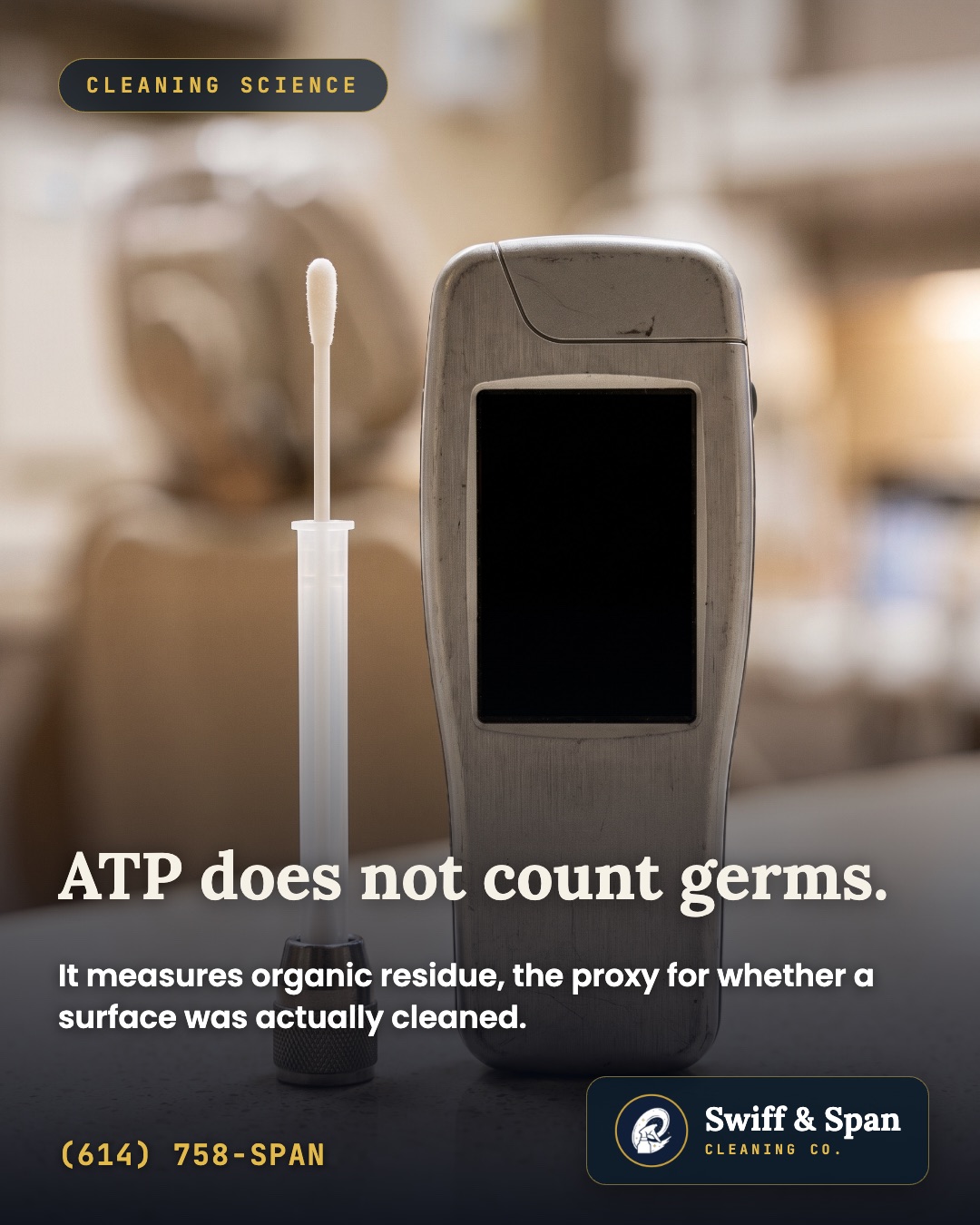
No. And the practices that get the most out of ATP testing are the ones that understand that sentence before they ever hold the swab.
This question comes up in almost every walkthrough I do. A practice manager watches me swab a delivery unit arm, watches the meter return a number about ten seconds later, and asks the obvious thing. Is that how many germs are on there?
It is not. What that number measures is adenosine triphosphate, which is the energy-carrying molecule present in anything that was recently alive or was produced by something living. Saliva. Blood. Skin cells. Tissue debris. Food residue. Biofilm. The swab collects whatever is sitting on the surface, a reagent in the swab tube reacts with any ATP present, that reaction produces light, and the meter reports how much light it saw as Relative Light Units.
More residue, more light, higher number. That is the entire mechanism.
Frequently Asked Questions
Does ATP testing measure germs or bacteria?
No. ATP testing measures adenosine triphosphate, an energy molecule found in organic residue such as saliva, blood, skin cells and food debris. A high reading means residue is present. It does not count microorganisms and it is not a microbiology test.
What is a good ATP reading for a dental office?
Under 100 RLU is generally considered the clean line across the industry. Swiff & Span holds its own clinical standard at 25 RLU, because operatory surfaces sit inside the aerosol field of a procedure and are contacted repeatedly by gloved hands.
How long does an ATP test take?
About ten seconds from swab to number. The result appears on the handheld meter while you are still standing in the room, which is what makes it usable as a working check rather than an audit finding.
Can a surface pass an ATP test and still be contaminated?
Yes. A low reading proves the surface was cleaned to a measurable standard. It does not prove sterility or the absence of pathogens. ATP is a cleaning verification tool, which is why it sits alongside EPA-registered disinfectants held at full label dwell time rather than replacing them.
Why does ATP testing matter if it does not measure pathogens?
Because organic residue interferes with disinfection. Disinfectants are validated on surfaces that have been cleaned first. Verifying that the residue is gone confirms the disinfectant had a fair chance to work.
Every Columbus dental, medical, wellness, and commercial facility gets the same offer: a complimentary 30-minute ATP walkthrough. We swab your highest-touch surfaces, on the spot, and hand you the readings. No obligation, no pitch required to see the number. Book your complimentary ATP walkthrough or text (614) 758-SPAN.
Erik Kuusisto, Owner
Swiff & Span Cleaning Company