Ask any gym owner in Grandview what the first Monday in January looks like and you get the same picture: brand-new shoes, brand-new water bottles, and a strength floor full of people keeping a promise they made a few days earlier.
The numbers back up what every owner already feels. IHRSA data reported by U.S. News found that more than 12 percent of gym members join in January, against an average of 8.3 percent a month across the rest of the year. And the crowd is not shrinking: the Health & Fitness Association reports that U.S. commercial fitness facilities averaged more than 184,000 visits per location in 2025, up 4.2% from 2024.
Here is the strange part. A new member spends a few seconds at the front desk and an hour on the equipment. And the equipment that gets touched hardest is the equipment that is hardest to clean, because it was designed to be hard to let go of.
This article walks the nine grips a January member squeezes before they break a sweat, why texture beats effort on every one of them, and how to set up your cleaning scope before the resolution crowd shows up.
Why does gym cleaning get harder in January?
Because the hands multiply and the hours do not. More than 12 percent of members join in January, against an 8.3 percent monthly average, so the same racks, pins and handles see more palms per hour, with the same overnight window to reset them.
A cleaning schedule is usually written in October, when a studio is quiet and the walk-through is easy. It lists rooms: strength floor, cardio, locker rooms, front desk. It rarely lists grips. In a normal month that gap hides. In January, when every bench is taken by 6 AM and the 5:30 PM class runs at capacity, the gap shows up on the one surface your members actually feel: the handle in their hand.
The fix is not a longer checklist. It is a different one, written around what a hand closes on.
What are the 9 grips a January member touches first?
Walk your floor the way a new member does and count what their hands close on. On a typical strength floor, the list comes to nine grips, and every one of them is textured, small or both.
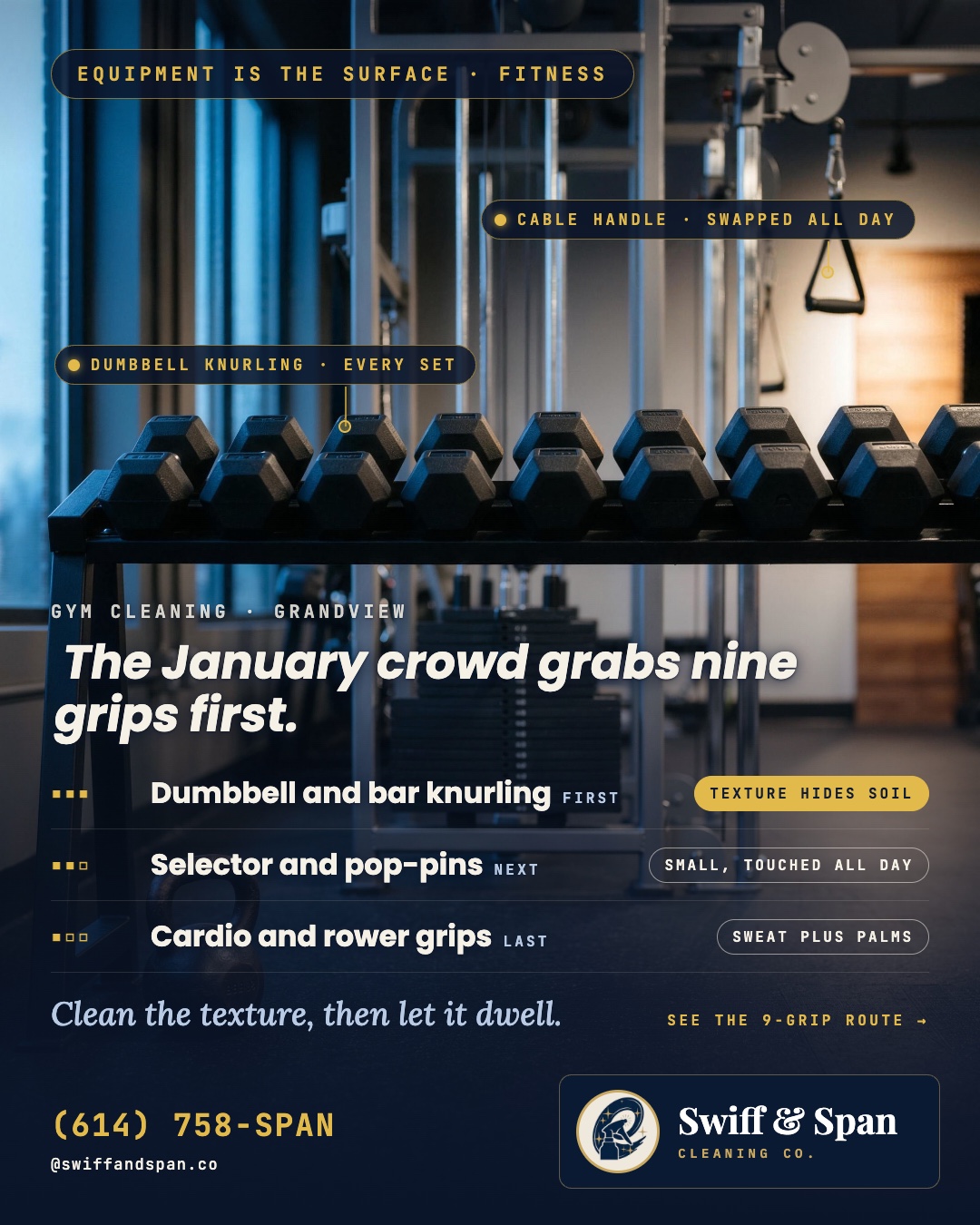
1. Dumbbell handles. Knurled steel, picked up and racked dozens of times an hour. 2. Barbell knurling and collars. The crosshatch texture that gives grip also gives residue a place to sit. 3. Weight plate grip holes and rims. Loaded and unloaded by fingertips, rarely wiped inside the cutout. 4. Kettlebell handles. Thick, curved and gripped with both hands. 5. Cable attachments. D-handles, rope ends and straight bars, swapped between users all day. 6. Weight-stack selector pins. Small, pulled and pushed on every set, almost never on a checklist. 7. Bench pop-pins and adjustment knobs. Touched every time someone changes an incline. 8. Cardio handrails and heart-rate grips. Held by sweaty palms for thirty minutes at a time. 9. Rower handles. Pulled hundreds of times a session, then hung back on the rail.
Notice what is missing: the floor, the mirrors, the front desk. Those matter, and we clean them. But a new member judges your gym by what they hold, and none of the nine is a flat surface a quick wipe can cover.
Why can’t a quick wipe clean knurled steel?
Because knurling is texture, and texture holds residue in its valleys. A cloth glides over the peaks of a crosshatch grip and skips the grooves between them. Effort does not fix that; method does.
The same is true of the inside edge of a plate cutout, the hinge of a D-handle and the shallow ring around a selector pin. A flat surface forgives a fast wipe. A three-dimensional one does not. This is why a wipe station by the rack, useful as it is, is a courtesy for the next member and not a cleaning plan for the building. We wrote about that difference in whether anyone disinfects gym equipment between users.
How should a gym clean textured equipment overnight?
In order: remove soil from the texture first, then apply an EPA-registered disinfectant with coverage that wraps the shape, then leave it wet for the full contact time printed on the label. Skipping any of the three breaks the chain.
Here is how we set that up on a strength floor.
Clean before you disinfect. Disinfectant labels call for a precleaned surface. On knurled steel that means a damp, color-coded microfiber cloth worked with the texture, not across it, so the grooves get the same attention as the peaks. Strength-floor cloths are one color and never travel to the locker room. Our color-coded microfiber and two-bucket method explains why that matters.
Use electrostatic application where shape defeats a cloth. An electrostatic sprayer charges disinfectant droplets so they wrap around curved and complex surfaces: the underside of a kettlebell handle, the back of a rack hook, the inside of a plate cutout. It is a coverage tool, not a substitute for cleaning first. Our explainer on what electrostatic spraying actually does covers where it earns its place and where it does not.
Hold the full label dwell time. Every EPA-registered disinfectant lists a contact time: how long the surface must stay visibly wet. We match the product to the surface and hold that time, whether it is Diversey Oxivir Tb on hard equipment or another product from our approved list. Wiping it dry early is the most common reason a surface was sprayed but never disinfected. More on that in disinfectant contact time explained.
Work top to bottom, clean to dirty. Cable towers and racks first, benches and plates next, floors last, with the HEPA vacuum (we run ProTeam GoFit) and mop following the equipment instead of chasing it.
Should a gym change its cleaning scope for January?
Yes, if the scope lists rooms instead of grips. Add the nine grips by name, confirm overnight frequency for January through March, and schedule a deep clean of the strength floor in late December, before the first resolution Monday.
A practical January scope has four lines an owner can check in five minutes:
- The grip list, by name. Not “wipe equipment.” Dumbbell handles, barbell knurling, plate cutouts, kettlebell handles, cable attachments, selector pins, pop-pins, cardio grips, rower handles.
- The frequency, by season. If your contract is written for October volume, ask whether January through March gets the same nights or more.
- The method, in writing. Clean first, disinfect second, full label dwell, electrostatic where the shape calls for it.
- The proof. Room-by-room checklists and photo documentation after each clean, so you know the rack was done before the 5 AM crowd arrives.
If you run a boutique studio rather than a big-box floor, the list shrinks but the logic holds. Swap barbells for reformer handles and straps, and the same rule applies: whatever the hand closes on comes first. Our piece on the six fitness studio touchpoints nightly cleaning misses goes deeper on studio surfaces.
When should a gym schedule its deep clean before January?
In the last two weeks of December, ideally during a holiday closure or a short-hours day. That gives the strength floor, cardio deck and locker rooms a full reset before the first Monday in January, when the floor never empties long enough to do it.
A good pre-January deep clean for a gym in Grandview, Hilliard or Upper Arlington covers the equipment in detail (every grip on the list, rack frames, upholstery seams), high dusting above the cardio deck, the locker room and shower areas in full, and the rubber floor under the racks, where chalk and dust collect out of sight. Book it in writing now, because every cleaning team in Columbus is busy that week.
How do you know the grips were actually cleaned?
Ask for evidence instead of reassurance: a checklist that names each grip, photos from the night, and, if you want a number, an ATP reading taken during a walkthrough. ATP measures organic residue, which tells you how well a surface was cleaned.
ATP testing does not detect germs and does not confirm disinfection. It answers a narrower question: is there organic residue left on this handle? Our cleaning target threshold is 25 RLU; 0-100 RLU is the acceptable pass band industry-wide. A walkthrough reading on a dumbbell handle and a selector pin tells you more about your current scope than any brochure.
The takeaway for gym owners
January does not test your cleaning crew. It tests your cleaning list. If the list says “equipment,” it is written for a quiet month. Rewrite it around the nine grips before the resolution crowd arrives, and the gym your new members feel in their hands will match the one you sold them.
If you run a gym or studio in Grandview, Clintonville, Hilliard or anywhere around Columbus, I will walk your strength floor with you, swab a few grips and show you what they read. Book your complimentary ATP walkthrough at (614) 758-SPAN, and see what the walkthrough covers before we meet.
Frequently Asked Questions
When do most people join a gym?
January. IHRSA data reported by U.S. News found that more than 12 percent of gym members join in January, compared with an average of 8.3 percent per month for the full year.
What gym equipment is touched the most?
The grips: dumbbell handles, barbell knurling, weight plate cutouts, kettlebell handles, cable attachments, weight-stack selector pins, bench pop-pins, cardio handrails and rower handles. All are textured or small, which makes them harder to clean than flat surfaces.
Is electrostatic spraying enough to clean gym equipment?
No. Electrostatic spraying improves disinfectant coverage on curved and complex surfaces, but equipment still needs to be cleaned first, and the disinfectant must stay wet for the full contact time on its EPA-registered label.
When should a gym schedule a deep clean before January?
In the last two weeks of December, ideally during a holiday closure or short-hours day, so the strength floor, cardio area and locker rooms are fully reset before the first Monday in January.
Does an ATP test show that gym equipment was disinfected?
No. An ATP test measures organic residue on a surface, which shows how well it was cleaned. It does not detect germs and does not confirm disinfection. Our cleaning target threshold is 25 RLU; 0-100 RLU is the acceptable pass band industry-wide.
Every Columbus dental, medical, wellness, and commercial facility gets the same offer: a complimentary 30-minute ATP walkthrough. We swab your highest-touch surfaces, on the spot, and hand you the readings. No obligation, no pitch required to see the number. Book your complimentary ATP walkthrough or text (614) 758-SPAN.
Erik Kuusisto, Owner
Swiff & Span Cleaning Company