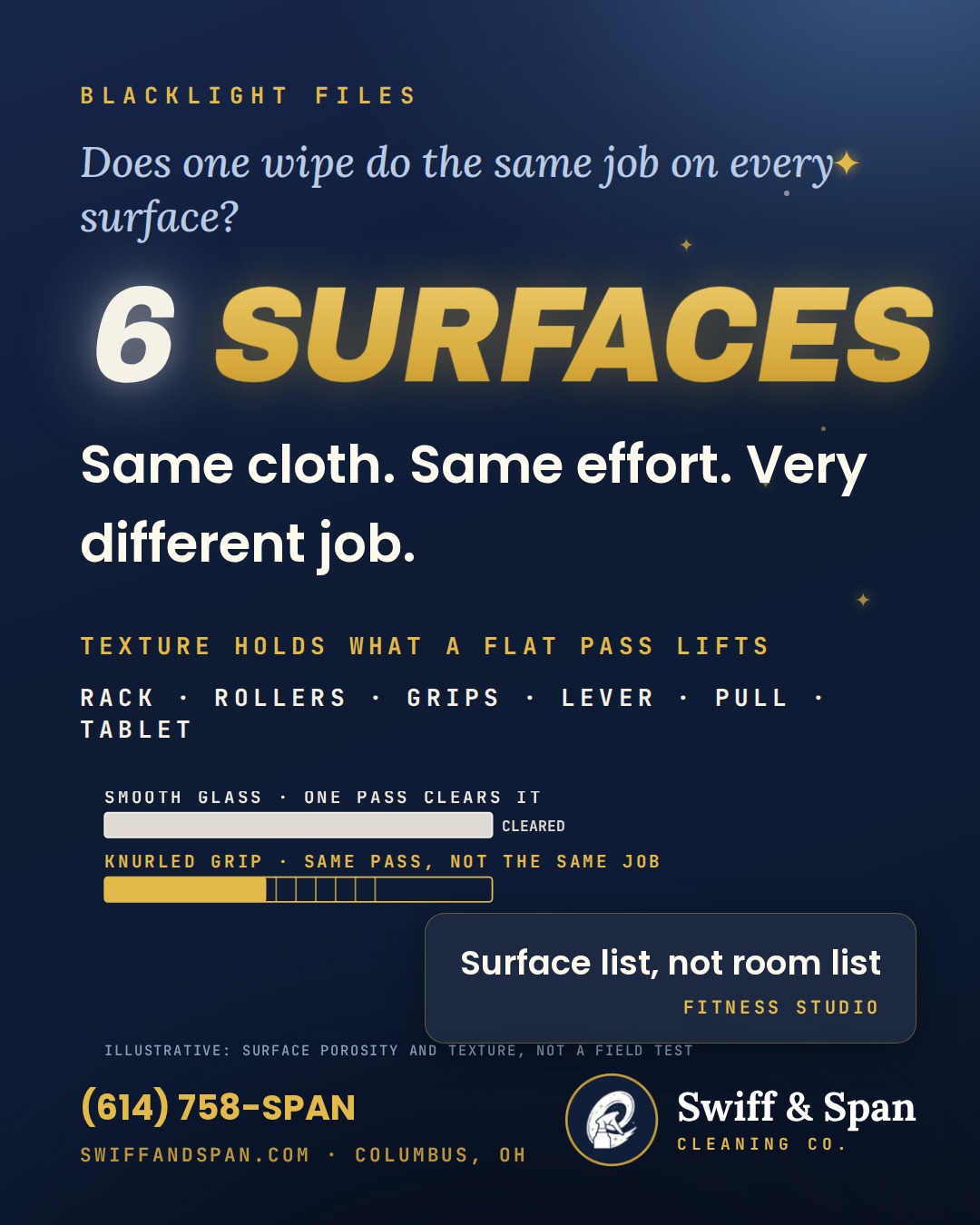
You already wipe down the studio every night. The mats get sprayed, the machines get a pass, the front desk gets straightened. That is not the gap. The gap is that a single wipe does not do the same job on every surface, and most nightly checklists are written as if it does.
That is the whole idea behind this piece: 6 shared touchpoints in a typical fitness or yoga studio that a standard nightly clean tends to under-serve, not because staff skip them, but because the surface itself resists the same motion that clears a countertop in one pass.
The wipe-down isn’t the problem. The surface is.
Picture the front desk check-in tablet next to the cable machine ten feet away. Both get wiped nightly with the same cloth, the same product, roughly the same amount of contact time. The tablet’s glass comes back looking, and testing, close to clean. The cable handle’s knurled grip does not, even though nobody spent less time on it.
The reason is not effort. It is geometry. A tablet screen or a painted metal lever is smooth and nonporous: residue sits on top of the surface, and a wipe with enough contact time picks up nearly all of it in one motion. A knurled cable handle, a foam roller, or the webbing on a mat rack is textured: the same residue settles into grooves, pores, and stitching that a cloth’s fibers cannot fully reach in a single pass. Cleaning science on surface roughness has shown this for decades in food service and healthcare settings: microscopic texture creates hiding places for organic material that flat, sealed surfaces simply do not have. A fitness studio is full of both surface types sitting side by side, cleaned on the same schedule with the same expectation.
Why this matters more in a gym than an office
An office breakroom has shared surfaces too, but a fitness studio multiplies the contact. Bare hands and bare feet touch equipment directly, sweat adds moisture that helps residue bind to a textured surface, and the same six or eight pieces of equipment get gripped by dozens of different people in a single day. Public health guidance written specifically for fitness facilities has flagged shared equipment grips and handles as touchpoints that need attention beyond a general surface wipe, precisely because of that volume and contact pattern. None of this means a nightly clean is being done wrong. It means the checklist has not yet accounted for the fact that six of your most-touched surfaces are not built the same way.
The six touchpoints a nightly protocol tends to under-serve
These are not exotic spots. They are surfaces almost every studio already has on the nightly list, they just do not all clean the same way.
| Touchpoint | Surface type | Why a standard wipe under-serves it |
|---|---|---|
| Yoga mat rack | Woven webbing or nylon strapping | Fibers trap residue between threads; a wipe cleans the surface of the strap, not the weave |
| Foam rollers | Closed-cell foam with a textured or ridged shell | Ridges and seams hold residue a flat cloth pass slides over |
| Cable machine handles and grips | Knurled metal or textured rubber | Knurling exists to improve grip, which means it also improves residue retention |
| Water fountain lever | Smooth painted or plated metal | Nonporous, so it actually releases residue easily. It is missed for a different reason: it is low, small, and easy to skip visually |
| Locker room door pull | Painted metal or coated composite | Also nonporous and easy to clean, but high-frequency touch with wet hands means it reloads between cleaning passes |
| Front desk check-in pad or tablet | Glass or hard plastic screen | Nonporous and cleanable in one wipe, but screen protectors and edge seams create a thin lip that traps residue the flat wipe skips |
Two of the six, the fountain lever and the door pull, are smooth and nonporous. They are missed for a logistics reason, low visibility, high reload rate, not a texture reason. The other four, the mat rack, the rollers, the cable grips, and the tablet’s edge seam, are missed because texture holds onto residue that a flat wiping motion is built to remove from flat surfaces.
Illustrative: two studios, same checklist, same effort
Here is a hypothetical, not a claim about any facility Swiff & Span has visited. Picture two studios in Columbus, one in Short North and one in Dublin, both closing at 9 p.m. and both running an identical nightly checklist: wipe every touchpoint, same product, same contact time. A UV inspection light run across both studios afterward would very likely show the same pattern in each: the check-in tablet and the locker room door pull reading clean, and the cable grips and mat rack strapping showing residue the light picks up but the eye does not. Same staff discipline. Same product. Different result, because the surfaces are not interchangeable.
That is the value of a UV inspection pass or an ATP swab as a verification step rather than a judgment of effort. An ATP reading measures organic residue left on a surface and returns a number, an RLU reading, that tells you what is actually still there after the clean rather than what the surface looks like. It does not tell you anything about germs, disinfection, or compliance. It tells you whether the cleaning step actually pulled residue off that specific surface, which is exactly the question a textured grip or a woven strap raises and a glass tablet does not.
What actually closes the gap
None of this calls for more time on the checklist. It calls for a different tool or a different motion on four specific spots.
- Textured grips and knurled handles respond to a brush pass or a microfiber cloth folded to a point, worked into the grooves, before the wipe rather than instead of it.
- Foam rollers and mat rack webbing benefit from a spray-and-dwell step, letting the product sit in the texture for a few seconds rather than being wiped on and off in one motion.
- Low, easy-to-skip surfaces like the fountain lever need to be added to the checklist by name, not folded into “wipe down the water station.”
- Screen edges and seams on a check-in tablet need a folded cloth corner, not a flat pass, to clear the lip where a case or protector meets the glass.
None of these are complicated fixes. They are the difference between a checklist that names “clean the cable machines” and one that specifies the grip separately from the frame, because the frame is painted metal and the grip is knurled steel, and they do not respond to the same motion.
Where this fits into a studio’s real week
A studio in Bexley or Upper Arlington running back-to-back classes does not have room in the evening for an elaborate new protocol. The fix here is not more time, it is aiming the existing time at the surfaces that need a different motion. A cleaning team that has walked a facility with a UV inspection light and an ATP meter, rather than just a checklist, tends to catch this kind of gap because they are looking at what is actually left on the surface, not just whether the cloth passed over it. That is the same logic behind an ATP walkthrough: a below-25 RLU cleaning target and photo documentation are useful because they measure the surface itself, not the effort that went into it.
A studio that already runs a tight nightly routine, whether it is a boutique yoga space Downtown or a full gym floor in Westerville or New Albany, is not the problem here. The protocol just has not yet been written to treat a knurled handle differently from a glass tablet, and that is a five-minute adjustment once someone points at the six surfaces that need it.
Frequently Asked Questions
Why would the same cleaning product work differently on two surfaces right next to each other?
It comes down to surface texture, not product strength. A smooth, nonporous surface like glass or painted metal releases residue in a single wipe because there is nowhere for it to hide. A textured surface, like a knurled grip or woven strap, has grooves and fibers that hold residue below the reach of a flat wiping motion, even with the same product and the same contact time.
Does ATP testing tell us whether equipment is disinfected?
No. An ATP swab measures organic residue on a surface and returns an RLU reading. It shows whether a cleaning step removed residue, not whether pathogens were killed or a space meets a disinfection or compliance standard. Disinfection is a separate step with its own product and dwell time; ATP verifies the cleaning result, not the disinfection outcome.
Which gym surfaces usually need a different cleaning motion than the rest of the equipment?
Textured, high-grip surfaces, cable machine handles, foam rollers, and mat rack webbing, generally need a brush pass or a dwell step before wiping, since a flat cloth motion tends to clear the surface without reaching into the texture. Smooth surfaces like fountain levers and tablet screens usually just need to be named individually so they are not skipped.
Is a nightly wipe-down not enough for a fitness studio?
A nightly wipe-down is the right foundation. The issue this piece points at is not frequency, it is that six common touchpoints do not all respond to the same wiping motion. Adjusting the motion on a handful of textured surfaces, without adding time to the routine, closes most of the gap.
How does Swiff & Span check whether a studio's cleaning is actually reaching these surfaces?
An ATP walkthrough covers multiple surfaces in the facility with real RLU readings taken on site, so a studio owner can see, in numbers, which surfaces are already hitting the below-25 RLU cleaning target and which need a different approach. Questions about the process can go to (614) 758-SPAN.
Every Columbus dental, medical, wellness, and commercial facility gets the same offer: a complimentary 30-minute ATP walkthrough. We swab your highest-touch surfaces, on the spot, and hand you the readings. No obligation, no pitch required to see the number. Book your complimentary ATP walkthrough or text (614) 758-SPAN.
Erik Kuusisto, Owner
Swiff & Span Cleaning Company