Watch a busy med spa between appointments and you will see the same choreography. The client stands, gathers a phone and a jacket, gets walked to the front. Someone steps into the room with a wipe, hits the bed, the armrest, the tray, the handles. Fresh linen down. Door open. Next client in.
Most treatment room turnovers I have timed run about five minutes. Nobody chose five minutes. It is what fits between the appointment that ran long and the client already sitting in the lobby.
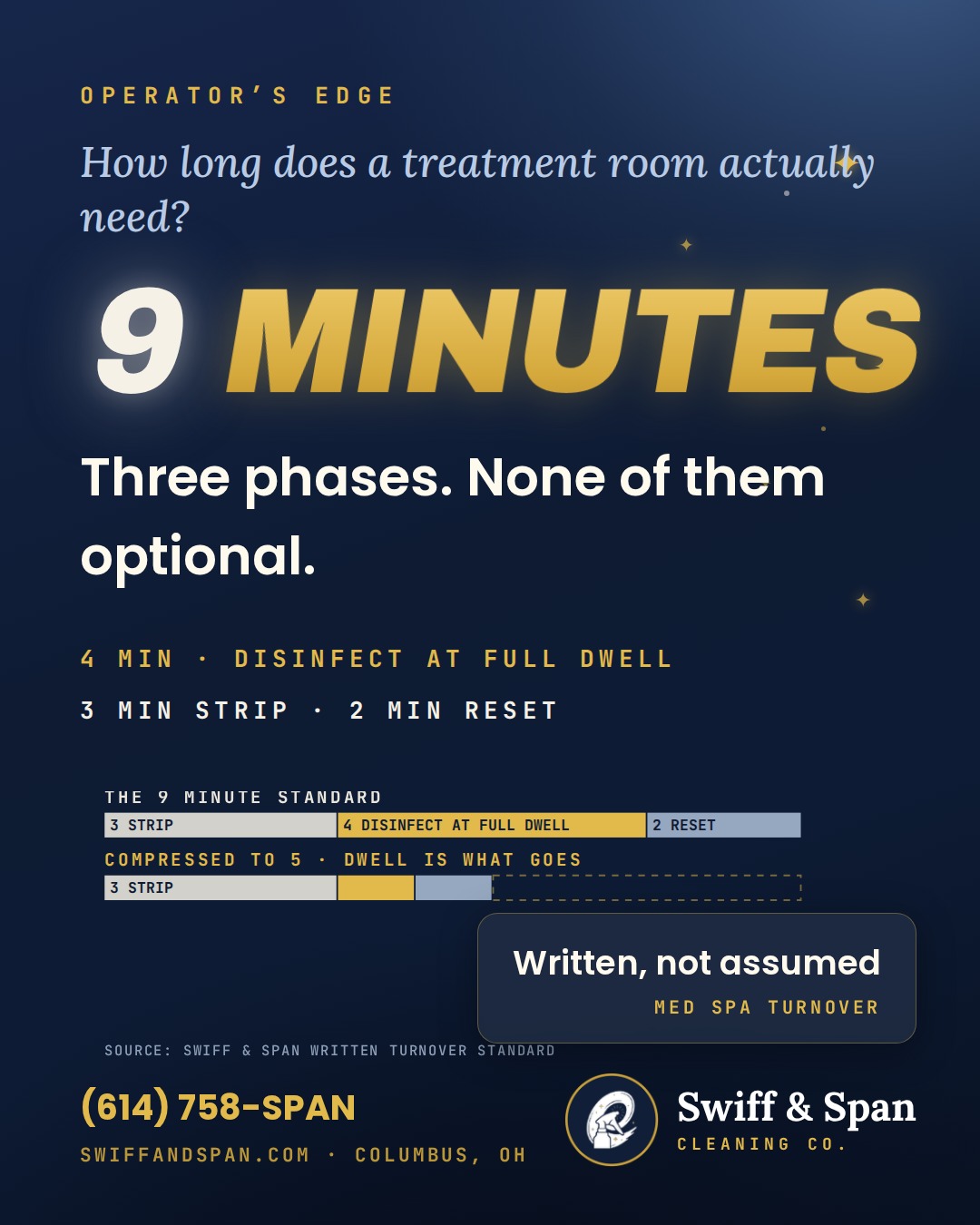
We wrote ours down at nine.
Why nine and not five
Nine minutes is not a number I picked because it sounds rigorous. It is the sum of three phases that each have a job, and none of the three can borrow time from the others without changing what the room actually is when the next client lies down.
Three minutes to strip and reset. Four minutes to disinfect at full dwell time. Two minutes for the presentation reset. Nine.
The part that matters is not the total. It is that the four minutes in the middle are protected by a written standard instead of by whoever happens to be holding the wipe.
The step that disappears when a turnover gets compressed
Here is the thing nobody scopes for in an aesthetics room.
When a turnover gets squeezed, the step that silently disappears is always dwell time. It is never the linen. It is never the visible wipe-down of the bed. It is never the trash. Those three survive every compression, because a client walking into the room can see whether they happened.
Dwell time is the only step in the sequence that a client cannot see happen. A surface wiped with an EPA-registered disinfectant and left to sit for the manufacturer’s full contact time looks exactly the same as a surface wiped and dried off with a paper towel eight seconds later. Same sheen. Same smell. Same room.
So under schedule pressure, the invisible step is the one that gets traded. Not out of laziness. Out of arithmetic. Something has to give, and the human brain gives up the thing with no visible consequence.
That is the flip worth sitting with: the quality of your turnover is decided entirely by the one step your client will never notice. Which is exactly why it needs to be written down rather than remembered.
The three phases, in full
This is our internal protocol for aesthetics and med spa treatment rooms. It is written, it is trained, and the team works it in the same order every time.
| Phase | Minutes | What happens | Why it is timed |
|---|---|---|---|
| 1. Strip and reset | 3 | Linens and disposables off and bagged. Trash and sharps handled to OSHA bloodborne pathogen standards. Used product, applicators, and spatulas cleared. Room cleared to bare surfaces. | You cannot disinfect a surface you have not exposed. Clutter is the most common reason a turnover looks done and is not. |
| 2. Disinfect at full dwell time | 4 | Clean-first sequencing, top down, clean to dirty. Color-coded microfiber so a restroom cloth never reaches a treatment surface. High-touch points and noncritical surfaces wetted and left visibly wet for the label’s stated contact time. | This is the step that vanishes under pressure. Timing it is the only thing that keeps it. |
| 3. Presentation reset | 2 | Fresh linen squared. Stool and armrest positioned. Product tray restocked and faced. Mirror, floor edge, and door handle checked. Lighting and temperature returned to standard. | The room is a clinical space and a hospitality space at the same time. The client reads the second one first. |
Phase one: strip and reset, 3 minutes
The first three minutes are about exposure, not shine. Everything soft and everything single-use comes off the room. Sharps and regulated waste are handled the way OSHA bloodborne pathogen training says to handle them, not the way a busy afternoon suggests.
What we are buying with these three minutes is a bare surface. A tray with three product bottles still standing on it is three surfaces that did not get disinfected, and the wipe that went around them looks identical to the wipe that went under them.
Phase two: disinfect at full dwell time, 4 minutes
Four minutes is the phase that defines the standard.
Disinfectant labels do not agree with each other. Contact times vary by product, by formulation, and by the organism the label is written against, and the only correct source for the number is the label on the bottle in your own cart. The rule we hold is not a specific number of seconds. The rule is that the surface stays visibly wet for the full time that product’s label states, and that the tech is not moving to phase three while that clock runs.
That is why the disinfect phase sits in the middle rather than at the end. A tech with two minutes of presentation work left has something useful to do while contact time runs. A tech with nothing left to do will dry the surface early, every time, and feel productive doing it.
In practice the sequence inside those four minutes is clean first, then disinfect. Organic soil on a surface is a physical barrier. You clean to remove the soil, then you disinfect what is underneath it. Reversing those two is one of the most common errors in a fast room turn, and it is the kind of error that leaves a surface looking finished.
Color-coded microfiber runs through the whole phase. A cloth that has been in a restroom does not come back into a treatment room. That is a cart discipline, not a chemistry question, and it is the part of a protocol that quietly falls apart when a team is improvising.
Phase three: presentation reset, 2 minutes
Two minutes, and this is the phase med spa owners care about most, because it is the phase the client grades.
Linen squared, not draped. The stool where the provider will actually want it. Product faced on the tray. The floor edge checked, since the strip of floor along the base cabinet is where every med spa room shows its age first. Lighting and temperature back to where the room is supposed to start.
A room that has been disinfected correctly and then left with a crooked sheet and a smeared mirror reads as unclean, and the reading is the one that ends up in the review. Phase three is not vanity. It is the part of the protocol that makes phases one and two legible to a person who was not in the room.
Why it has to be written
A standard that lives in someone’s head is a preference. A standard on paper is a thing you can train, audit, and hand to a new tech on a Tuesday in Dublin without hoping they absorbed it by watching.
Written also means measurable. If the room is supposed to take nine minutes and it is taking five, that is not a mystery to investigate. It is four missing minutes, and you already know which phase they came out of.
We build these turnovers to be OSHA-Aware and HIPAA-Aware in how waste, documentation, and client information are handled in the room. Those are our framing words on purpose. Being aware of the standard and building to it is a description of our process. It is not a regulatory verdict on your facility, and no cleaning company can issue you one.
Where the ATP meter fits, and where it does not
We use ATP swab testing as cleaning verification. An ATP swab measures organic residue left on a surface and returns an RLU reading, which tells you how well a surface was actually cleaned rather than how it looks under treatment room lighting. Our own cleaning target threshold is 25 RLU.
What ATP does is give the invisible part of the job a number. A treatment bed that looks perfect can carry residue, and the meter says so in a way an eye cannot.
What ATP does not do is speak to dwell time. Contact time is a process control, held by the protocol and the clock, not by a meter. That is the honest division of labor between the two: the swab verifies the cleaning, the written standard protects the disinfection step. You want both, and you want them doing separate jobs.
Fitting nine minutes into a schedule that is already full
The objection is always the same, and it is fair. Nine minutes times eight rooms times a full day is real time.
Three things make it fit in the med spas we have built protocols for, from Short North studios to suites out in New Albany.
- Nine minutes of a written sequence is faster than five minutes of improvising, because nobody is deciding what to do next. Decision time is the hidden cost of an unwritten turnover.
- Phase two runs a clock, not a person. Presentation work happens while contact time runs, which is why the standard is nine minutes and not twelve.
- Deep work leaves the turnover. Floor edges, cabinet faces, vents, and baseboards belong to the scheduled clean, not to the gap between two clients. A turnover that carries deep work is a turnover that will get cut.
If your rooms currently turn in five minutes, the useful exercise is not adopting our number. It is timing your own turnover, phase by phase, and finding out how many seconds the disinfectant actually stays wet. Most operators are surprised, and nobody on the team is at fault. It was never written down.
Questions about how this would map onto your room count and your appointment grid, call (614) 758-SPAN.
Frequently Asked Questions
Why is a med spa treatment room turnover nine minutes instead of five?
Nine minutes is the sum of three timed phases: three minutes to strip and reset the room, four minutes to clean and disinfect at the disinfectant's full label contact time, and two minutes for the presentation reset. Five minute turnovers are not chosen, they are what is left after a schedule runs long. Writing the sequence down protects the disinfection phase, which is the step that gets shortened first.
What is dwell time and why does it get skipped?
Dwell time, also called contact time, is the period a disinfectant must stay visibly wet on a surface to work as its label intends. It gets skipped because it is the only step in a room turnover a client cannot see. A surface wiped and dried immediately looks identical to one held for full contact time, so under schedule pressure it is the step with no visible consequence and it disappears first.
How long should a disinfectant stay wet on a treatment surface?
There is no universal number. Contact times vary by product and formulation, and the correct time is the one printed on the label of the disinfectant in your own cart. The working rule is that the surface stays visibly wet for that stated time, and that the person cleaning does not wipe it dry or move to the next surface early.
Does ATP testing prove a treatment room is disinfected?
No. ATP swab testing measures organic residue on a surface and returns an RLU reading, which verifies how well that surface was cleaned. It does not measure disinfection, pathogen kill, sterilization, or regulatory compliance. Dwell time is protected by a written protocol and a clock, not by a meter. The two tools do different jobs, and a good turnover standard uses both.
Can a cleaning company make my med spa compliant?
No cleaning company can issue a compliance outcome, and any that promises one is selling something it cannot deliver. What a cleaning partner can do is build OSHA-Aware and HIPAA-Aware protocols, train to bloodborne pathogen standards, document each visit, and verify cleaning with ATP readings. Compliance itself is determined by regulators and inspectors, not by a vendor.
Every Columbus dental, medical, wellness, and commercial facility gets the same offer: a complimentary 30-minute ATP walkthrough. We swab your highest-touch surfaces, on the spot, and hand you the readings. No obligation, no pitch required to see the number. Book your complimentary ATP walkthrough or text (614) 758-SPAN.
Erik Kuusisto, Owner
Swiff & Span Cleaning Company