The centrifuge was on the kitchen counter. Next to it sat a heating block and a rack of unlabeled tubes of blood. In the refrigerator, more unlabeled blood tubes shared the shelves with Botox, lidocaine and somebody’s food.
That is what inspectors found in the fall of 2018 when they walked into a spa in New Mexico that had been offering platelet-rich plasma microneedling facials, the treatment most people know as the vampire facial. The CDC published the full investigation in its Morbidity and Mortality Weekly Report in April 2024, and it reads like a list of every boundary a clinic is supposed to keep and this one did not.
Here is the part that should stop every med spa owner in the Short North, Dublin and Upper Arlington for a second: the spa did wipe things down. After each client, the report says, procedure equipment was surface cleaned with a disinfecting spray and disinfecting wipes. Somebody was cleaning. The cleaning just had no map.
This article is about that map. What cleaning zones are in a med spa, which ones your cleaning company owns and which ones it must never touch, and how to write all of it into a scope you can actually check.
What did CDC inspectors find inside the New Mexico spa?
They found clinical work happening in a kitchen. A centrifuge, a heating dry bath and unlabeled blood tubes sat on a kitchen counter; more blood tubes and injectables were in the kitchen refrigerator with food; unwrapped syringes were in drawers, on counters and in regular trash; and there was no autoclave on site.
The report adds two more details that matter for anyone who runs a treatment room. Disposable tips for an electric device were cleaned by soaking in alcohol and then reused. And the spa kept no real client records, so investigators had to rebuild the client list by hand from consent forms, handwritten appointment notes and phone contacts.
That rebuilt list identified 59 clients at risk for exposure: 20 who had the microneedling facial and 39 who had other injections. Over the following years, five people were linked to the spa through HIV sequencing, and 198 former clients and their partners were tested. It was the first documented case of HIV transmission tied to cosmetic injection services, and the spa had been operating without the proper licenses. The report is careful to say the exact source of contamination was never determined.
So, plainly: this was an unlicensed operation with unsafe injection practices, and a cleaning company could not have fixed that. But the floor plan of the failure is worth studying, because it is a picture of what happens when the clean side, the dirty side and the break room all become the same counter.
Why didn’t wiping equipment after every client help?
Because a wipe answers a different question. A surface disinfectant cleans and disinfects a surface you touch. It does not make a reused single-use tip safe, and it does not turn a kitchen counter into a clinical work surface. Wiping the wrong things in the wrong room is still the wrong system.
This is the trap a lot of small clinics fall into, and it is not limited to bad actors. A visible habit, like wiping the cart after every client, feels like control. It looks like control to a client watching from the chair. But the risk in the New Mexico report lived in decisions a wipe never touches: what gets reused, what gets stored next to what, where blood is handled, and where lunch is eaten.
The useful lesson for a licensed Columbus med spa is not “wipe more.” It is “draw the lines first, then clean inside them.”
What are cleaning zones in a med spa?
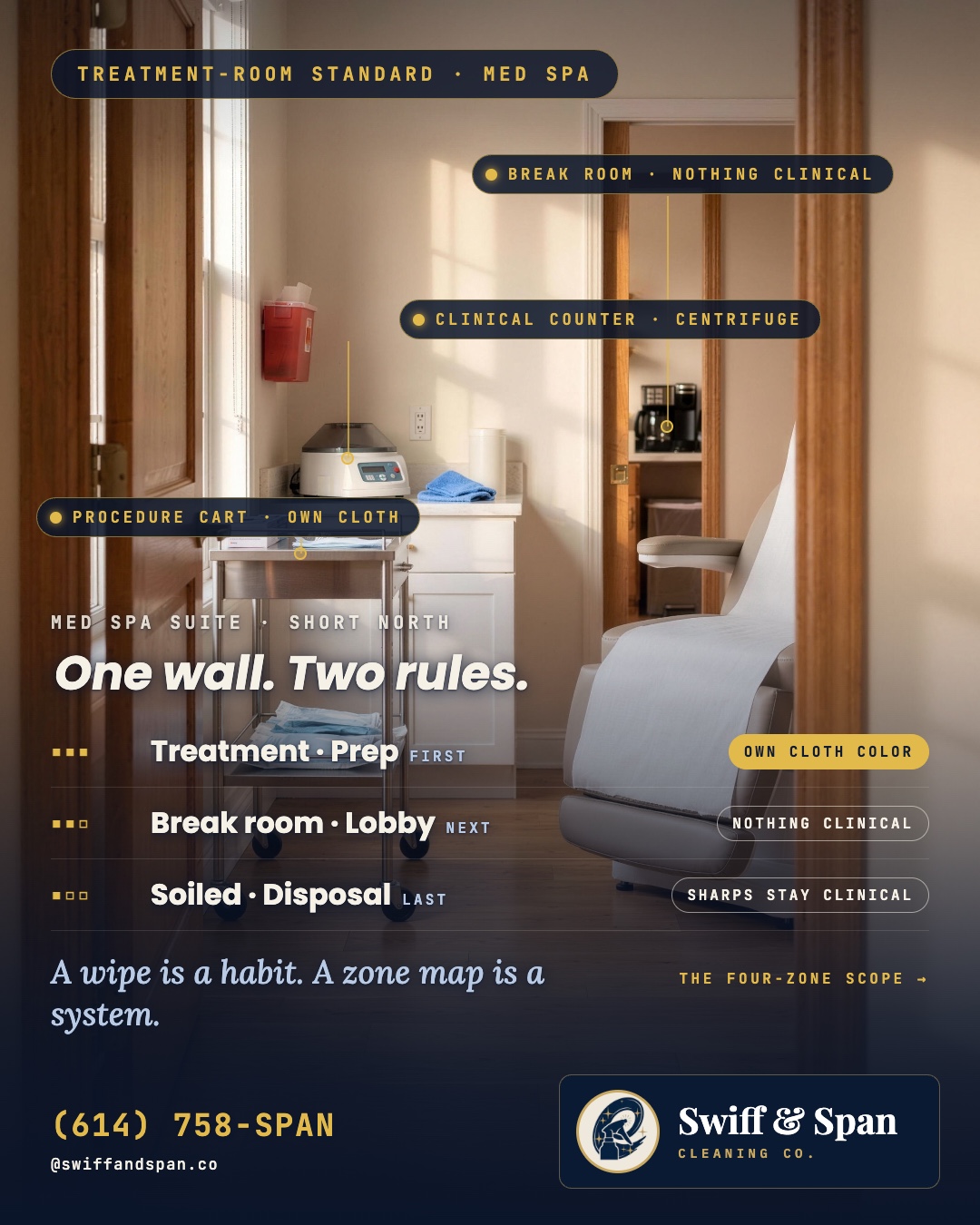
Cleaning zones are the areas of a clinic sorted by what happens there, each with its own tools, products and order of cleaning. Most med spas have four: the treatment rooms, the clean prep and supply area, the soiled and disposal area, and the staff and client spaces like the break room, restrooms and lobby.
Here is how I sort them when I walk a clinic for the first time:
- Treatment rooms. The chair or bed, the procedure cart, light arms, device handles, counters and the floor. These get an EPA-registered disinfectant held wet for its full label contact time on every high-touch surface, in a fixed top-to-bottom order.
- Clean prep and supply. Where sealed supplies are stored and where clinical staff prepare for procedures. The cleaning crew cleans the counters, shelves and floor here, before anything dirtier, and never opens or moves sealed clinical supplies.
- Soiled and disposal. Sharps containers, regulated waste, used linens. The crew cleans around these surfaces and the floor beneath them, last, with its own color of cloth. Sharps containers and regulated waste stay with the clinical team.
- Staff and client spaces. Break room, kitchenette, restrooms, lobby, retail wall. Normal commercial cleaning with its own tools, and one hard rule: nothing clinical ever lives here.
That last rule is not a style preference. OSHA’s Bloodborne Pathogens Standard, 29 CFR 1910.1030, says food and drink shall not be kept in refrigerators, freezers, shelves, cabinets, or on countertops or benchtops where blood or other potentially infectious materials are present. The New Mexico fridge broke that sentence about as completely as a fridge can.
Who owns each zone, the cleaning company or the clinical team?
The clinical team owns anything that touches a client’s blood or skin barrier: needles, single-use devices, instrument reprocessing, specimens and regulated waste. The cleaning company owns the environment around it: floors, walls, counters, fixtures, chairs, carts and high-touch surfaces, cleaned in a set order with named products.
Writing that split down protects both sides. A scope that just says “clean treatment rooms” leaves room for a well-meaning cleaner to move a tray, wipe a device handpiece the wrong way, or empty a bin that was never theirs. A scope that names the split does not.
When we take on a med spa, the scope says it in plain words. Our crew does not handle sharps, does not open sealed supplies, does not touch specimens, and does not clean device tips or handpieces unless the clinic’s own protocol names the product and the step. Everything else in the room, from the light switch to the baseboard, is ours, on a room-by-room checklist the practice owner can read.
How does color-coded microfiber keep zones from mixing?
Each zone gets its own cloth color, so a cloth that touched a restroom or a disposal area can never travel back to a treatment cart or a prep counter. The color is the rule made visible: anyone on the crew, or anyone at the front desk, can see at a glance that the right cloth is in the right room.
Color-coded microfiber is one of the simplest controls in commercial cleaning, and one of the most skipped. A single bucket of mixed cloths is how a residue from one room ends up on the surfaces of another without anyone noticing. Pair the colors with the two-bucket method, so the clean solution and the dirty rinse never share water, and the boundary holds at the level of the cloth itself.
Sequence does the rest. Inside every zone the crew works clean to dirty and top to bottom: high surfaces before low, prep before treatment, treatment before restrooms, the disposal area last, the floor last of all. The order is written on the checklist, so it does not depend on who is working that night.
What should a Short North med spa’s cleaning scope say?
It should name the four zones, the products used in each, the order they are cleaned in, and the line between environmental cleaning and clinical work. If your current scope says “clean and sanitize treatment rooms” and stops, it is describing a hope, not a system.
Here is a short version you can hold your current contract against:
- A zone map. Treatment, prep and supply, soiled and disposal, staff and client spaces, each listed by room.
- Named products. For example, PDI Super Sani-Cloth or Diversey Oxivir Tb on treatment surfaces, matched to what the clinic uses and held for the full contact time on the label.
- A cloth color for each zone, and the two-bucket method for floors.
- A written sequence: clean to dirty, top to bottom, floors last.
- A hands-off list: sharps, regulated waste, sealed supplies, specimens, devices and anything clinical.
- A report line: what the crew does when it sees something out of place, like food in a fridge that holds clinical supplies. The answer should be “tell the practice manager in writing that night,” not “move it.”
- Proof: a signed room-by-room checklist and photos of the finished rooms.
None of this replaces the clinic’s own infection prevention plan, its licensing or its medical director. It is the cleaning half of the building, written down so it can be checked. Med spas in the Short North, Dublin, New Albany and Upper Arlington run in tight spaces, often a single suite where the break room shares a wall with a treatment room. That shared wall is exactly where the scope has to be clearest.
If you want to see how a full room reset fits between clients, our breakdown of the five surfaces a treatment room reset misses walks through it surface by surface. And if you have ever wondered why contact time decides whether a wipe did its job, start with clean versus disinfect, and why dwell time decides it.
See your own zones on paper first
Every med spa in Columbus can see its own zones on paper before it signs anything. I will walk your suite with you, map the four zones, and show you where your current scope draws its lines and where it does not. Book your complimentary ATP walkthrough or call (614) 758-SPAN.
Sources: Stadelman-Behar AM, et al. Investigation of Presumptive HIV Transmission Associated with Receipt of Platelet-Rich Plasma Microneedling Facials at a Spa Among Former Spa Clients, New Mexico, 2018 to 2023. MMWR Morb Mortal Wkly Rep 2024;73:372 to 376. OSHA 29 CFR 1910.1030, Bloodborne Pathogens. See also how we prove clean.
Frequently Asked Questions
What did the CDC find in the vampire facial investigation?
Inspectors found a centrifuge and unlabeled blood tubes on a kitchen counter, blood tubes and injectables in a kitchen refrigerator with food, unwrapped syringes in drawers and regular trash, no autoclave, and disposable device tips cleaned in alcohol and reused. The spa was unlicensed and kept no proper client records.
How many clients were affected by the New Mexico spa investigation?
Investigators identified 59 clients at risk for exposure, 20 who received the microneedling facial and 39 who received other injections. Five people were linked to the spa through HIV sequencing, and 198 former clients and their partners were tested between 2018 and 2023.
Can a med spa keep food in the same refrigerator as clinical supplies?
No, not where blood or other potentially infectious materials are present. OSHA's Bloodborne Pathogens Standard says food and drink shall not be kept in refrigerators, freezers, shelves, cabinets, or on countertops or benchtops where blood or other potentially infectious materials are present.
What should a med spa cleaning company not touch?
Sharps containers, regulated waste, sealed sterile supplies, specimens, device tips and handpieces, and any clinical equipment the clinic's protocol reserves for its own staff. The cleaning company owns the environment around that work: floors, walls, counters, fixtures, chairs, carts and high-touch surfaces.
What are the cleaning zones in a med spa?
Most med spas have four: treatment rooms, the clean prep and supply area, the soiled and disposal area, and staff and client spaces such as the break room, restrooms and lobby. Each zone gets its own cloth color, products and place in a clean-to-dirty cleaning order.
Every Columbus dental, medical, wellness, and commercial facility gets the same offer: a complimentary 30-minute ATP walkthrough. We swab your highest-touch surfaces, on the spot, and hand you the readings. No obligation, no pitch required to see the number. Book your complimentary ATP walkthrough or text (614) 758-SPAN.
Erik Kuusisto, Owner
Swiff & Span Cleaning Company