Walk into most offices in Dublin or the Short North at 7 PM and you will see what the cleaning crew was told to do. The desktops are wiped. The trash is out. The carpet has vacuum lines. The chair you are about to sit in and the phone you are about to pick up look exactly the way they looked at 5 PM, because the scope never named them.
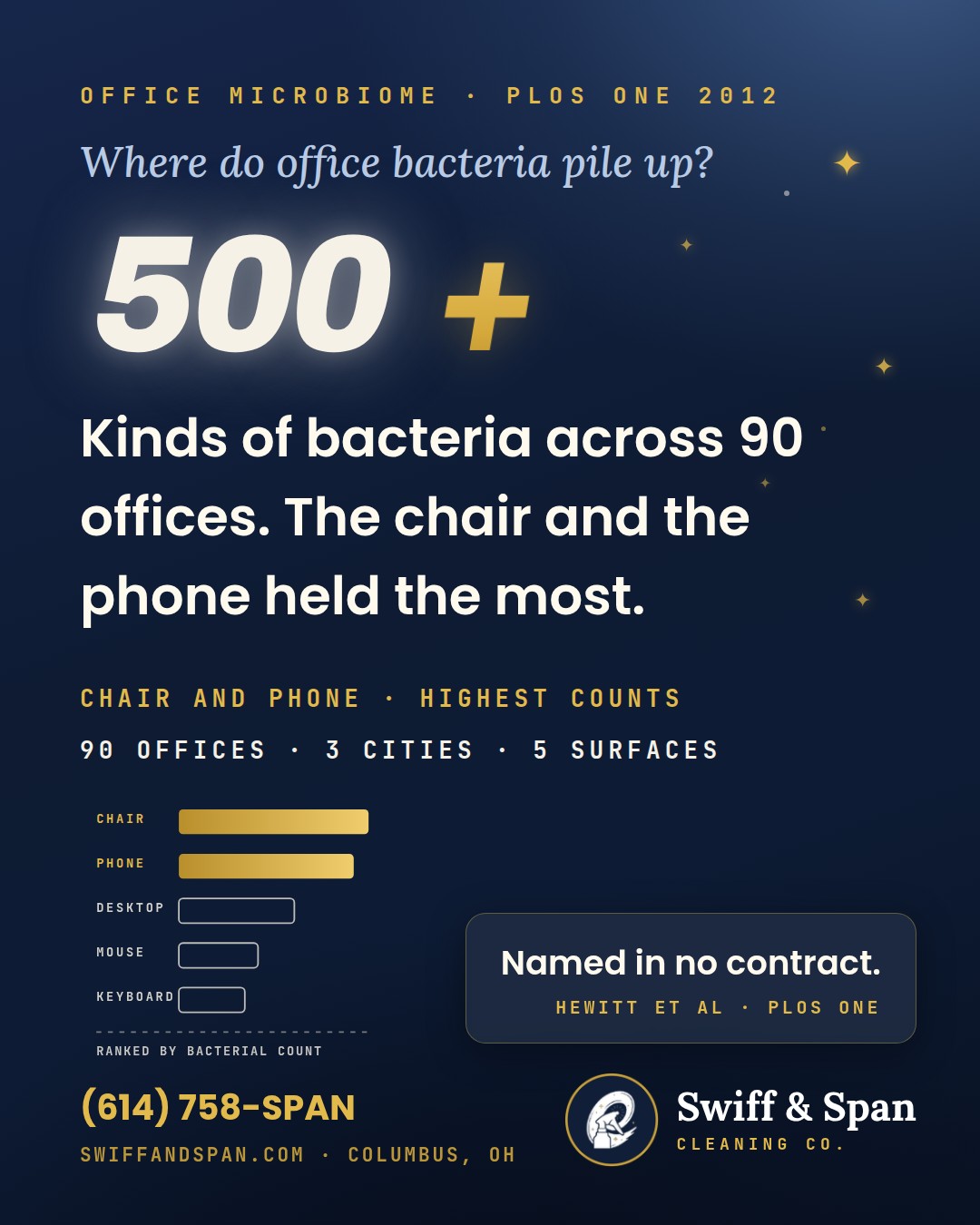
In a study published in 2012, a team from San Diego State University and the University of Arizona decided to find out what actually lives in an office. Krissi Hewitt, Charles Gerba, Sheri Maxwell and Scott Kelley sampled 90 offices across New York, San Francisco and Tucson, five surfaces in each: the chair, the desk phone, the desktop, the computer mouse and the keyboard. They counted bacteria the old way, on culture plates, for all 450 swabs. Then they identified the kinds the new way, by sequencing a bacterial marker gene (16S rRNA) from 54 chair and phone swabs. The paper ran in PLoS ONE.
Sequencing turned up more than 500 bacterial genera from 20 divisions, pooled across those swabs. That is the variety. The amount is a separate measure, and on the culture plates the answer was plain: of the five surfaces, the chair and the phone carried the most bacteria.
What did 450 office swabs find?
The abundance ranking is the part that should interest anyone who signs a cleaning contract. All five surfaces carried bacteria, but chairs and phones sat at the top. Keyboards and mice came in lower, and the desktop, the one surface nearly every scope we read names, came in lowest of all.
The bacteria themselves came mostly from people. The dominant genera were the ones that live on skin and in the nose, mouth and gut, which is what you would expect on a surface that hands, faces and trousers touch all day. Three findings worth repeating in the break room. Offices used by men were consistently more contaminated than offices used by women, and the authors pointed to hand washing, tooth brushing and body size. San Francisco offices tended to carry less than New York or Tucson. And the Tucson bacterial mix stood apart from the two coastal cities, which the authors suggest may trace to desert soils. None of it reads as an outbreak. It reads as a census of who has been in the room.
That is the point worth taking. A surface does not need to be dangerous to be dirty, and a cleaning scope does not need to be negligent to be aimed at the wrong thing. It only needs to have been written by someone who never asked where the load sits.
Why do office cleaning scopes skip the chair and the phone?
Look at the two surfaces from the crew’s side of the cart. A desktop is flat, hard and empty at night. One pass with a cloth and it is done, and it looks done. A chair is fabric or mesh, curved, with arms that take the weight of two forearms for eight hours and a seat edge that takes the back of two legs. A phone is a handset that touches a cheek and catches breath on every call, sitting on a keypad with a dozen recessed buttons. Neither one gets faster with practice, and neither one looks dirty when it is.
So the scope skips them, and the skipping is invisible. We wrote about the same pattern with shared keyboards in hot-desk offices and again with the break room faucet handle. Attention follows the checklist, the checklist follows what looks dirty, and the surfaces people actually touch with their bodies fall through the gap.
There is a second cost. When a chair arm does get wiped, it is often with whatever cloth is already in the cleaner’s hand, and that cloth may have been in the restroom twenty minutes earlier. A chair that is never named in the scope is never assigned a cloth, and a surface without its own cloth is not being cleaned so much as visited.
What this means for a Columbus office
Most commercial office cleaning agreements we read in Columbus price the job per square foot and describe it in a paragraph: empty trash, wipe desks, vacuum, clean restrooms, dust surfaces as needed. Chairs appear nowhere. Phones appear nowhere. The two surfaces the science ranks first are covered by the words “as needed,” which in practice means when someone complains, and nobody complains about a chair.
Check your scope in 60 seconds. Open the contract and search for three words: chair, phone, cloth. Each one that never turns up is a gap. Closing the gaps is not expensive. It is four lines.
- Name the chair. Arms and the front edge of the seat, on every occupied workstation, weekly at minimum and nightly in shared or hot-desk areas. Mesh and fabric get a product rated for soft surfaces; hard arms get the same EPA-registered disinfectant as the rest of the room.
- Name the phone. Handset, both ends, and the keypad, nightly. Wiped, kept wet for the labeled contact time, wiped again.
- Assign the cloth. Color-coded microfiber, with a color that never enters a restroom. If the crew cannot tell you which color touches the phones, they are probably using one cloth for the building.
- Name the check. How does anyone know it happened? A supervisor’s initials say the crew was there. A reading says the surface changed.
How we check it
On a complimentary ATP walkthrough of an office, the handset on the busiest desk and the arm of the most-used chair are two of the first surfaces we swab. ATP testing measures organic residue. The swab picks up adenosine triphosphate, the energy molecule in every living cell, and the meter reports a relative light unit (RLU) reading in about fifteen seconds. Lower is cleaner, and we clean to a 25 RLU target. The reading tells you whether the cleaning step removed what skin and breath left behind, and cleaning is the step that has to succeed before any disinfectant can do its job.
A handset that reads high the morning after service still carries residue, whatever the sign-off sheet says. That is not an accusation against the crew. It is a description of the scope they were handed. The number is yours whether you hire us or not, and the four lines above are yours to send to whoever cleans your building tonight.
The one-sentence version for your office manager
A peer-reviewed study of 90 offices found the highest bacterial counts on the chair and the phone, and our cleaning scope does not name either one. Send that, and ask which cloth touches the phones.
Frequently asked questions
Which office surfaces carry the most bacteria?
In the 2012 PLoS ONE study of 90 offices, chairs and desk phones carried the highest bacterial counts of the five surfaces sampled. The keyboard and mouse came in lower, and the desktop came in lowest. The two surfaces with the highest counts are the two most office cleaning scopes we read never name.
Are the bacteria on office chairs and phones dangerous?
Mostly not, according to the authors. They judged most of the human-associated bacteria to be likely commensals, the everyday microbes of skin, nose, mouth and gut, and the other main group appeared to come from the environment, such as soil. It is a map of who has been in the room, not an outbreak. The lesson is that wiping the desktop misses where the load actually sits.
What should an office cleaning scope say about chairs and phones?
Name them. Chair arms and the front edge of the seat, the phone handset and keypad, on a stated cadence, with an EPA-registered disinfectant kept wet for its labeled contact time and a dedicated microfiber cloth. If the scope only says wipe desks, the desk is the only thing that gets wiped.
Can ATP testing show whether a phone handset was cleaned?
Yes, as a cleaning check. ATP measures organic residue in relative light units, so a handset that reads high after the nightly service still carries what hands and mouths left on it. The reading tells you whether the cleaning step worked on that surface.
Every Columbus medical, dental, wellness, and commercial facility gets the same offer: a complimentary 30-minute ATP walkthrough. We swab your highest-touch surfaces, the meter measures organic residue on the spot, and you keep the readings. No obligation, no pitch required to see the number. Book your complimentary ATP walkthrough or text (614) 758-SPAN.
Erik Kuusisto, Owner
Swiff & Span Cleaning Company
Sources
- Hewitt KM, Gerba CP, Maxwell SL, Kelley ST. Office Space Bacterial Abundance and Diversity in Three Metropolitan Areas. PLoS ONE. 2012;7(5):e37849. PMID 22666400.