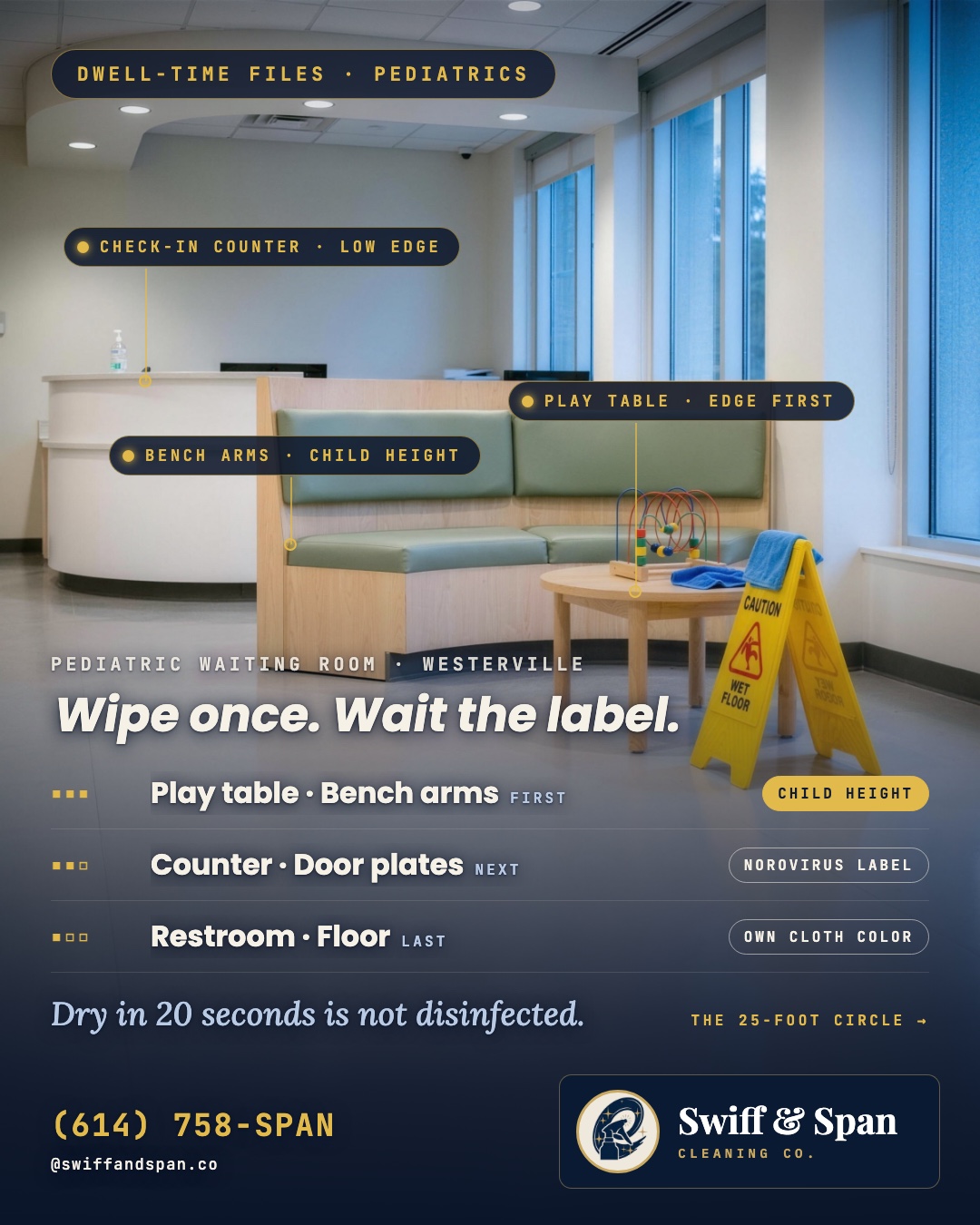
A child gets sick next to the bead maze at 3:40 on a Tuesday afternoon. By 3:50 the spot is wiped, the floor is dry and the next family is checking in.
The virus may still be there in two weeks.
That is the uncomfortable math of norovirus season in a pediatric office. It is the season we are walking into right now, and it lasts until spring. The virus survives on ordinary surfaces far longer than most people expect, it shrugs off hand sanitizer, and a quick wipe with the wrong product does very little to it. None of that is a reason to panic. It is a reason to have a written plan, and to make sure the company that cleans your office at night is working from the same plan as your front desk.
This article covers what the public health guidance says, what changes in a nightly clean between November and April, and who should own which part of a sick-visit cleanup.
How long does norovirus last on surfaces in a pediatric office?
Up to about two weeks. The University of Minnesota Extension’s norovirus guidance says the virus can survive on surfaces for up to two weeks, and the CDC notes that tiny drops of vomit spray through the air and land on nearby surfaces.
In a pediatric waiting room, “surfaces” means the places small hands go first: the edge of the play table, the bench arm, the check-in counter, the pen cup, the door push plate, the restroom faucet and the floor a toddler sits on. Those surfaces get touched dozens of times a day by people who are not yet sick, which is exactly how one afternoon’s illness becomes next week’s cluster.
Fourteen days is longer than any cleaning cycle in a typical office. A surface that missed the right treatment on Tuesday does not quietly reset on its own by the weekend.
If you want the wider picture of how long common organisms last on clinical surfaces, our article on how long pathogens survive on exam room surfaces walks through the published survival times.
Why is norovirus season a pediatric office problem?
Because young children carry most of the medical visits. The CDC estimates norovirus causes about 2,270,000 outpatient clinic visits and 465,000 emergency department visits in the United States each year, mostly in young children, with outbreaks most common from November to April.
Put those numbers next to a pediatric schedule in Westerville in late November. Sick visits rise, siblings come along, and the waiting room holds children who are not sick yet next to children who are. The CDC also notes that a person can shed the virus in stool for two weeks or more after feeling better, so a child who looks recovered can still leave it behind on a restroom handle.
The CDC counts about 2,500 reported norovirus outbreaks a year in the United States. Plenty of them start small: one sick person, one shared surface, and a cleanup that looked complete.
Does hand sanitizer or a standard disinfectant wipe kill norovirus?
Hand sanitizer does not work well against norovirus, according to the CDC, which recommends soap and water handwashing instead. For surfaces, the CDC recommends a chlorine bleach solution of 1,000 to 5,000 ppm or an EPA-registered product with a norovirus claim.
That second part is where many offices get caught. A disinfectant can be EPA-registered, hospital grade and excellent against the bacteria it lists, and still not carry a norovirus claim on its label. The EPA keeps a separate list for this, List G, of products registered against norovirus. If the product your crew uses is not on it, the label does not promise anything against norovirus, no matter how long it sits on the counter.
The second catch is contact time. Every disinfectant claim comes with a number of minutes the surface has to stay visibly wet. The CDC’s guidance for a homemade bleach solution is to leave it on the area for at least 5 minutes. Clorox Healthcare Bleach Germicidal Cleaner, one of the EPA-registered products we use, lists a norovirus kill time of 1 minute on its label. Wipe a counter with either one and let it dry in 20 seconds, and you did not get the result on the label. Our explainer on disinfectant contact time covers why the wet time decides the outcome.
Bleach also has its own failure modes: the wrong dilution, mixing it with other cleaners, using it on a dirty surface. We wrote about four common bleach mistakes separately, and they all show up during norovirus season.
How big an area needs disinfecting after a child vomits in the waiting room?
Bigger than the spot you can see. The University of Minnesota Extension tells cleaners to disinfect the contaminated area and the surrounding 25-foot circle, because vomiting can spread the virus through the air onto nearby surfaces. It also advises isolating the area, since particles can stay airborne for up to two hours.
A 25-foot circle in a typical pediatric waiting room is most of the room. Measured from a play table, it usually reaches the bench seating, the check-in counter, the hand sanitizer station and the entry door. That is why a paper-towel cleanup of the floor alone leaves most of the job undone.
The guidance also sets an order. Absorb and remove visible material first with disposable towels, clean with detergent and water, then disinfect with the right product held wet for its full contact time. Disinfectants work poorly through a layer of soil, so skipping the cleaning step weakens the disinfecting step.
Soft surfaces are their own problem. Upholstered chairs, fabric cushions and carpet cannot simply be bleached. They need a product labeled for porous surfaces or a different method entirely, which is one more reason wipeable vinyl seating makes sense in a pediatric waiting room.
What should a nightly clean change between November and April?
The products, the touch-point list and the order. A pediatric office’s nightly scope should name a disinfectant with a norovirus claim for touch points and restrooms, state its contact time, and list the child-height surfaces by name instead of saying “waiting room.”
Here is what we change in a pediatric scope for outbreak season:
- Name the product. The scope says which EPA-registered disinfectant is used where, and it carries a norovirus claim for the waiting room touch points, the restrooms and the exam room door hardware.
- Hold the wet time. The crew applies enough product to keep the surface wet for the label’s norovirus time, and does not wipe it dry early.
- List the low surfaces. Play table edges, bench arms and the front lip of the seats, toy-free shelf ledges, the lower half of the entry door, the check-in counter’s child-height edge, restroom grab bars and the changing table.
- Color-coded microfiber. Restroom cloths never come out to the waiting room. A fresh cloth for each zone, and the restroom is cleaned last.
- Floors after surfaces. Top to bottom, clean to dirty, so the mop is the last tool in each room. Our guide to color-coded microfiber and the two-bucket method explains why the order matters.
- A written note of anything unusual. If the crew finds a spot that looks like it was cleaned in a hurry during the day, it gets a photo and a line in the room-by-room checklist so the practice manager knows by morning.
Restrooms deserve extra attention in a pediatric office, because flushing can spread droplets onto nearby surfaces. Our article on toilet plume in patient restrooms covers the surfaces that sit in that zone.
Who handles a 3 PM sick-visit cleanup, the staff or the cleaning company?
The staff, first. A child who gets sick during clinic hours cannot wait until the night crew arrives. Your team needs a stocked spill kit and a short written procedure. The cleaning company’s job is the full disinfecting pass across the wider area that night, with a product and contact time that match the guidance.
The handoff between those two is where most offices lose track. The person who cleaned the spot at 3:45 goes home at 5:30. The night crew walks in at 7 and has no idea anything happened unless someone tells them.
The fix is simple. Keep a sick-visit log at the front desk: the time, the location and what was done. Your cleaning company reads it on arrival and treats that area, and the 25-foot circle around it, as the first job of the night. It costs your team about thirty seconds per event.
A good spill kit for a pediatric office includes disposable gloves, a disposable gown or apron, a mask, absorbent powder or disposable towels, a scraper, sealable plastic bags, a pre-labeled disinfectant with a norovirus claim and a printed one-page procedure. Check it monthly from November through April. The kit that gets opened is the one nobody restocked.
What should a pediatric office ask its cleaning company before norovirus season?
Ask five questions and expect specific answers:
1. Which disinfectant do you use on our touch points, and does its label carry a norovirus claim? You want a product name, not “hospital grade.” 2. What is that product’s contact time, and how does your crew keep the surface wet for it? You want a number of minutes and a method. 3. Does our scope list the child-height surfaces by name? If it says “clean waiting room,” it is not specific enough. 4. What happens when our front desk logs a sick visit? You want the area named as the first job of the night. 5. How do you report back? A room-by-room checklist with photos tells you what happened while you were gone.
If the answers are vague, the gap is in the scope, not in your crew’s effort. The scope is the only thing a night crew can follow.
Our flu season front desk reset covers the check-in counter in more detail, and the same questions apply there.
The short version for a busy practice
Norovirus can last up to two weeks on a surface, hand sanitizer does not handle it well, and a disinfectant only works against it if its label says so and the surface stays wet for the full contact time. After a sick visit, the area to disinfect is a 25-foot circle, not a spot. Your staff handles the moment, your cleaning company handles the night, and a one-line log connects the two.
If you want a second set of eyes on how your Westerville office is set up for the season, Book your complimentary ATP walkthrough. We walk the waiting room and restrooms with you, read your cleaning scope line by line, check which products are used where and whether their labels fit the season, and leave you a short list of what to change. It takes about 30 minutes and you keep everything we find. Call (614) 758-SPAN or visit swiffandspan.com.
Frequently Asked Questions
How long can norovirus survive on surfaces?
Up to about two weeks. The University of Minnesota Extension says norovirus can survive on surfaces for up to two weeks, and the CDC notes that tiny drops of vomit spray through the air onto nearby surfaces, which is why a quick wipe after a sick visit is not enough.
What disinfectant kills norovirus in a medical office?
A chlorine bleach solution of 1,000 to 5,000 ppm, left on for at least 5 minutes per the CDC, or an EPA-registered product with a norovirus claim on its label from the EPA's List G. The surface has to stay wet for the full contact time the label states.
Does hand sanitizer work against norovirus?
Not well. The CDC says hand sanitizer does not work well against norovirus and is not a substitute for washing hands with soap and water for at least 20 seconds, especially after using the toilet or changing diapers.
How far should you disinfect after someone vomits?
The University of Minnesota Extension recommends disinfecting the contaminated area and the surrounding 25-foot circle, because vomiting can spread the virus through the air onto nearby surfaces. It also advises isolating the area for two hours.
When is norovirus season?
Norovirus outbreaks happen all year in the United States, but the CDC says they are most common from November to April. Pediatric offices feel it most, because the CDC estimates most of the 2,270,000 yearly outpatient clinic visits for norovirus involve young children.
Every Columbus dental, medical, wellness, and commercial facility gets the same offer: a complimentary 30-minute ATP walkthrough. We swab your highest-touch surfaces, on the spot, and hand you the readings. No obligation, no pitch required to see the number. Book your complimentary ATP walkthrough or text (614) 758-SPAN.
Erik Kuusisto, Owner
Swiff & Span Cleaning Company