Take a tape measure into the patient restroom at your practice. Not a clipboard. A tape measure.
Most single-occupancy patient restrooms in dental and medical offices around Dublin, Worthington and Bexley come in close to five feet by seven, with an eight-foot ceiling. That is a small room. It is also, in most practices, the single most-touched room in the building that nobody has ever measured.
Here is the measurement, worked out as a specific example rather than a survey of anything.
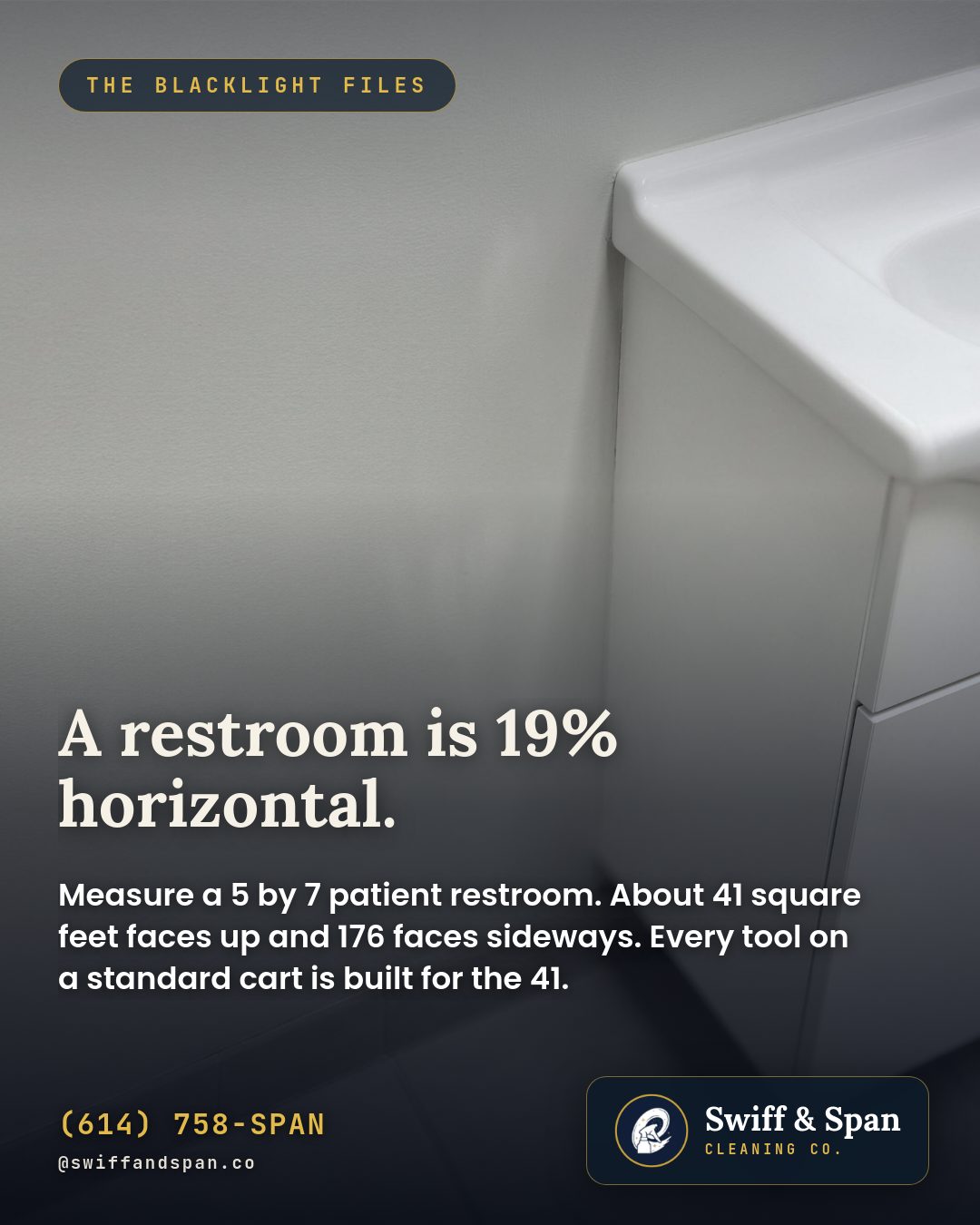
Surfaces that face up. The floor is 35 square feet. The vanity top is about 4. The top of the tank and the seat together are about 2. Call it 41 square feet.
Surfaces that face sideways. Four walls to eight feet on a 24-foot perimeter comes to about 192 square feet. Take out the door opening, add back both faces of the door, and call that even. The vanity front and sides add about 8. The vertical faces of the fixture itself add about 6. Call it 176 square feet.
41 divided by 217 is 19 percent.
Nineteen percent of that room faces up. Eighty-one percent faces sideways. Hold onto that ratio, because everything that follows is about what happens to it.
Frequently Asked Questions
How often should a medical office restroom be cleaned?
Daily at minimum for any restroom used by patients, with the fixture, floor and every high-touch point covered every visit. Frequency is the easy half. The harder half is coverage: a nightly clean that only reaches horizontal surfaces leaves roughly 81 percent of the room's surface area on a "when someone notices" schedule, no matter how many times a week somebody shows up.
What is electrostatic disinfection, and does a restroom need one?
An electrostatic sprayer charges the disinfectant droplet so it is attracted to surfaces and wraps around them instead of running off. A restroom is close to the best possible case for it, because a restroom is mostly vertical surface and mostly out of reach of a cloth. It does not replace detergent cleaning of soiled surfaces. It covers the 81 percent that a cloth was never going to reach.
Why does a restroom still smell after it has been cleaned?
Usually because the odor source is not on a surface anyone cleaned. Residue on the wall beside the fixture, in the floor-to-wall joint, and on the underside and back of the bowl keeps producing odor long after the floor has been mopped and the bowl has been scrubbed. A room can smell exactly as clean as its least-cleaned surface.
Can you actually test whether a restroom is clean?
Yes. ATP surface testing gives a numeric reading in relative light units in about fifteen seconds per swab. Under 100 RLU is the general industry line for a clean surface. Swiff & Span holds to 25 RLU on tested surfaces. We run the test in front of you during a complimentary walkthrough and you keep the readings, hired or not.
Every Columbus dental, medical, wellness, and commercial facility gets the same offer: a complimentary 30-minute ATP walkthrough. We swab your highest-touch surfaces, on the spot, and hand you the readings. No obligation, no pitch required to see the number. Book your complimentary ATP walkthrough or text (614) 758-SPAN.
Erik Kuusisto, Owner
Swiff & Span Cleaning Company