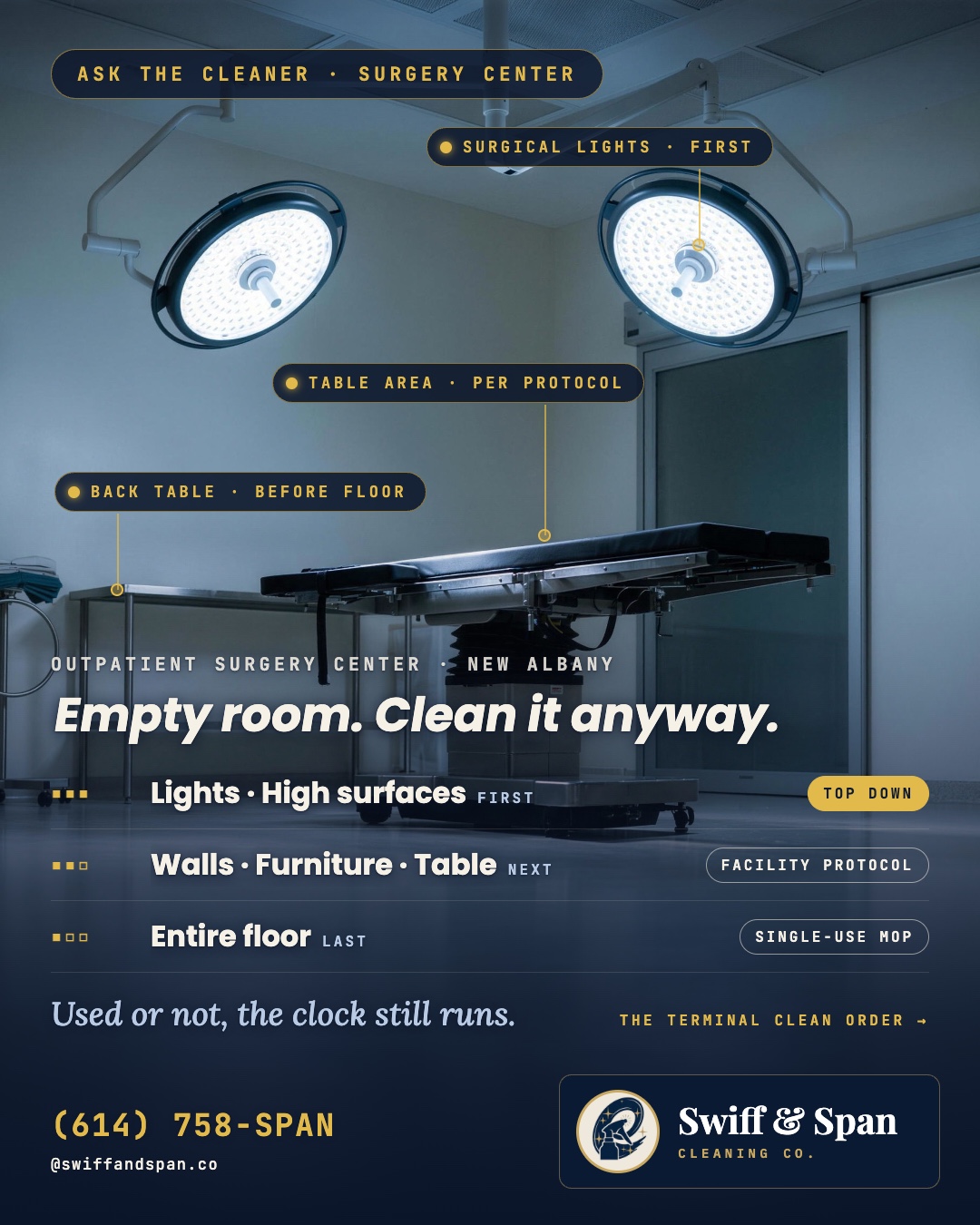
An operating room that sat empty all day still gets a full terminal clean tonight.
That surprises people who manage offices for a living, and it surprises plenty of cleaning companies too. Nobody operated in OR 3. Nobody bled, nobody opened a tray, nobody moved the table. Why would anyone mop it?
Because the clock in an ambulatory surgery center does not run on use. It runs on time. Here is what the surgical nursing guidance and the CDC actually say about cleaning operating rooms, what happens in the room after the last case, and how an outpatient surgery center in New Albany, Dublin or anywhere in Columbus should write it into a cleaning scope.
How often does a surgery center operating room need a terminal clean?
Once in every 24-hour period, whether or not the room was used. AORN’s recommended practices for environmental cleaning say operating rooms in which procedures may be performed should be terminally cleaned once during each 24-hour period during the regular work week, regardless of whether they were used.
AORN, the Association of periOperative Registered Nurses, writes the guidelines most surgical teams in the United States work from. Its environmental cleaning guidance has been revised several times since that line first appeared, and in 2026 AORN announced an update that renames it the Guideline for Environmental Hygiene. The daily terminal clean is one of the most recognizable pieces of it, and it is the first thing we ask about when a surgery center walks us through its rooms: which rooms are on the 24-hour clock, and who signs for each one.
“Terminal clean” means the full end-of-day clean of the room, top to bottom: high surfaces, lights and booms, walls where touched, furniture and fixtures, then the entire floor. It is different from the quick turnover clean between cases, which the perioperative team handles while the next patient is being prepared.
Why clean an operating room that nobody used?
Because a room that was available for surgery has to be ready for surgery, and “nobody used it” is hard to prove. Staff walk through, carts get parked and moved, supplies get pulled, dust settles on high surfaces, and the room’s last clean slowly becomes yesterday’s clean, then last week’s.
A fixed 24-hour clock removes the guesswork. The surgical team does not have to remember whether OR 3 was really idle on Tuesday. The room gets cleaned on schedule, the log shows it, and the first case on Wednesday starts in a room with a known, documented baseline.
There is a practical side for the owner too. A clock is easy to scope, easy to staff and easy to check. “Clean ORs as needed” is a sentence nobody can be held to. “Terminal clean every OR on the schedule each night, used or not” is a sentence a night supervisor can sign.
What does the CDC say about cleaning operating room floors?
Wet vacuum or mop operating room floors after the last surgical procedure of the day or night, with a single-use mop and an EPA-registered hospital disinfectant. That recommendation comes from CDC’s Guidelines for Environmental Infection Control in Health-Care Facilities, and it carries the CDC’s Category IB rating.
Two words in it matter more than they look. “Single-use” means the mop head that finishes one room does not walk into the next. And “EPA-registered hospital disinfectant” means a product with a label, a registration number and a stated contact time, used the way that label says.
The same CDC guideline has a line that surprises almost everyone: do not use mats with tacky surfaces at the entrance to operating rooms or infection-control suites. The sticky peel-off mats that look like they stop dirt at the door are not recommended at OR entrances. If your surgery center has one outside a procedure room, it is worth a conversation with your infection prevention lead.
What order should an operating room be cleaned in?
Top to bottom and least soiled to most soiled. AORN’s 2026 guidance on environmental hygiene says to start with the cleanest surfaces and move toward the dirtiest, and to begin with high surfaces so dust and used solution fall onto areas not yet cleaned.
Here is how that looks in a terminal clean:
- High surfaces first. Surgical light heads and their arms, booms, and the tops of mounted equipment, as the facility’s procedure allows.
- Walls and fixed fixtures. Touched and splashed areas, door push plates, light switches, cabinet fronts.
- Furniture and moveable surfaces. Back tables, ring stands, stools, kick buckets and carts, cleaned and moved so the floor beneath them is open.
- The surgical table area. Cleaned per the facility’s protocol and the manufacturer’s instructions, with the pads and the base handled as the infection prevention lead specifies.
- The floor, last. The whole floor, not a path around the furniture, with a fresh single-use mop head and the room’s own disinfectant solution.
Two habits keep the order honest. Every room gets fresh cleaning materials, so a cloth or mop head never carries one room into the next. Our article on the color-coded microfiber and two-bucket method explains how we keep that straight. And the disinfectant stays wet for its full label contact time, which in a busy building is the step most likely to get shortened. If dwell time is new territory, here is what contact time actually means.
What gets missed when a cleaning crew is rushed?
AORN’s 2026 environmental hygiene update lists the misses it sees most during turnover pressure. They apply just as much at 10 PM as they do between cases:
- One cloth on many surfaces, whether the cloth is reusable or disposable.
- Skipping items that were touched during care, because they do not look dirty.
- Setting supplies down before the disinfectant has finished its contact time.
- Quick wiping that does not leave the whole surface visibly wet.
- Cleaning dirty areas before clean ones, or going back and forth between them.
- Too little attention to high-touch items.
- Bringing clean or sterile supplies into the room before the clean is finished.
None of those are exotic. Every one of them is a habit, which means every one of them can be written down, trained and checked. That is the job of the scope.
What should a surgery center cleaning scope say?
It should name every room on the 24-hour clock, the order inside each room, the products and contact times, who owns which equipment, and how the work is recorded. A line that says “clean surgical suites nightly” leaves every one of those decisions to whoever is holding the mop.
Here is the operating room section we write with a surgery center:
- Rooms on the clock: every OR and procedure room listed by name or number, terminal cleaned each night it is on the schedule, used or not.
- Sequence: high surfaces, walls and fixtures, furniture, the table area per facility protocol, then the full floor.
- Products: each EPA-registered hospital disinfectant named, matched to the surface, with its label contact time written next to it. In practice that means products like Clorox Healthcare Bleach Germicidal or Diversey Oxivir Tb, chosen with the facility.
- Materials: fresh microfiber for each room and a single-use mop head for each OR floor.
- Hands off: sterile supplies, instrument trays, anesthesia equipment and anything the facility reserves for clinical staff, listed by name.
- Record: a room-by-room checklist with photo documentation, signed each night, with anything out of place left as found and reported to the charge nurse or administrator.
That last line is the one owners tell us they value most. A surgery center already lives on documentation. Its cleaning should be documented the same way, so that when a surveyor or an infection preventionist asks how OR 3 was cleaned on Tuesday, the answer is a page, not a memory. For the broader version of this idea across healthcare settings, see how hospital cleaning protocols translate to a private practice.
Who decides what a contractor cleans inside an OR?
The surgery center does. A contractor cleans environmental surfaces to the facility’s written protocol, and the facility’s infection prevention lead decides where that line sits for equipment. The surgical table, booms and lights all come with manufacturer instructions about which products and methods they tolerate, and those instructions win.
That is why we start every surgery center scope with a walk through the rooms alongside the person who owns infection prevention. We list each piece of equipment, mark who cleans it and with what, and put it in writing. The result is a scope the clinical team recognizes as their own, not a generic janitorial checklist with “OR” typed at the top.
Floors deserve their own mention. In a surgical suite the floor is the largest surface in the room and the last one cleaned, and it collects everything that falls from the surfaces above it. We wrote about why floors matter in clinical spaces if you want the longer read.
The short version for a surgery center administrator
Every operating room on your schedule gets a terminal clean once in each 24-hour period, used or not. The floor is wet mopped or wet vacuumed after the last case with a single-use mop and an EPA-registered hospital disinfectant, the room is cleaned top to bottom and clean to dirty, and the whole thing is written down.
If you run an outpatient surgery center in New Albany or anywhere around Columbus and want a second set of eyes on how your rooms are cleaned after the last case, Book your complimentary ATP walkthrough. We walk the rooms with you, read your current scope line by line and show you where the sequence, products or records leave gaps. It takes about 30 minutes, and you keep everything we find. Call (614) 758-SPAN or visit swiffandspan.com.
Frequently Asked Questions
How often should an operating room be terminally cleaned?
Once during each 24-hour period during the regular work week. AORN's recommended practices for environmental cleaning say operating rooms in which procedures may be performed should be terminally cleaned once in each 24-hour period, regardless of whether they were used that day.
What is the difference between a turnover clean and a terminal clean?
A turnover clean happens between cases and focuses on the surfaces and floor touched during the last procedure. A terminal clean happens at the end of the day and covers the whole room, top to bottom, including high surfaces, walls, furniture and the entire floor.
How should operating room floors be cleaned?
CDC guidelines say to wet vacuum or mop operating room floors after the last surgical procedure of the day or night, using a single-use mop and an EPA-registered hospital disinfectant. The disinfectant should stay wet for its full label contact time.
Are sticky mats recommended outside operating rooms?
No. CDC's Guidelines for Environmental Infection Control in Health-Care Facilities say not to use mats with tacky surfaces at the entrance to operating rooms or infection-control suites.
Can a commercial cleaning company clean a surgery center?
Yes, when it works to the facility's written protocol. The contractor cleans environmental surfaces in a set order with named products and contact times, while sterile supplies, instruments and clinical equipment stay with the surgical team as the facility's infection prevention lead specifies.
Every Columbus dental, medical, wellness, and commercial facility gets the same offer: a complimentary 30-minute ATP walkthrough. We swab your highest-touch surfaces, on the spot, and hand you the readings. No obligation, no pitch required to see the number. Book your complimentary ATP walkthrough or text (614) 758-SPAN.
Erik Kuusisto, Owner
Swiff & Span Cleaning Company